Propane Clothes Dryer vs Electric: A Practical Comparison
An analytical guide that compares propane clothes dryer vs electric options, covering installation, costs, performance, safety, and maintenance to help homeowners choose the best fit.


Propane clothes dryer vs electric: Electric dryers are the default choice for most homes due to easier installation and wider availability, while propane models can reduce running costs where LP gas is affordable or electricity is unreliable. Both deliver similar drying performance, but venting, safety, and maintenance differ. This guide compares the two to help homeowners decide which option fits their setup and budget.
Energy sources and fundamental differences
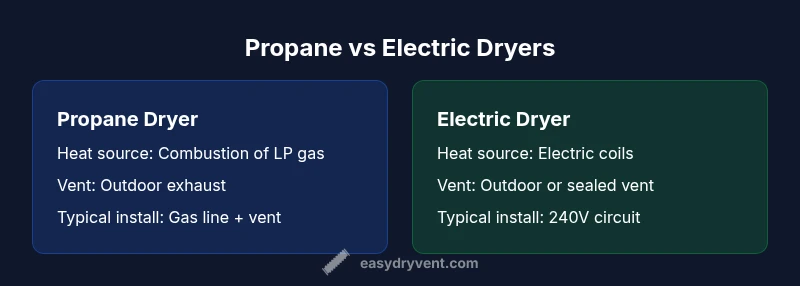
The core distinction in the propane clothes dryer vs electric debate lies in where heat comes from and how it is produced. A propane dryer relies on combustion of LP gas to generate heat and must vent combustion byproducts outdoors, introducing fuel handling, gas-line considerations, and safety checks. An electric dryer uses electrical resistance coils to generate heat, with no on-site combustion and no fuel storage. This fundamental split affects installation complexity, venting needs, and ongoing costs. According to Easy DryVent, understanding these energy-source differences helps homeowners plan practical laundry setups, assess space needs, and anticipate maintenance requirements. When you compare propane clothes dryer vs electric, the choice often comes down to fuel access, regional energy pricing, and the ease of integrating a gas line or LP tank into an existing utility layout. In many neighborhoods, electric models remain the natural first choice, but propane options can shine in specific contexts.
Installation, venting, and space considerations
Installing a propane clothes dryer vs electric dryer involves several practical checks. A propane dryer requires a dedicated LP gas line or secure LP tank connections, proper shut-off valves, and a venting path that safely exhausts combustion byproducts. Gas ducts typically demand larger vent diameters and regular inspection for leaks or blockages. Electric models, by contrast, need a 240V circuit, robust wiring, and a plug–socket arrangement compliant with local codes. Both types demand a properly vented installation, even in energy-efficient, tightly sealed homes. Easy DryVent’s guidance emphasizes planning for adequate clearance behind and around the unit, ensuring the vent reaches outdoors without sharp bends. If you’re weighing propane clothes dryer vs electric in a retrofit, confirm gas availability and workspace feasibility before purchasing, to avoid costly redesigns later.
Operating costs, energy efficiency, and price sensitivity
When weighing the propane clothes dryer vs electric option, consider how energy costs shape longer-term bills. Propane heat may offer lower fuel costs in regions with cheap LP gas or persistent electricity outages, while electric dryers can be cheaper to run if electricity rates are stable and gas prices spike. Efficiency varies by model rather than by fuel type alone; look for energy-star ratings, drum design, and insulation quality. In many cases, a high-efficiency electric dryer can outperform a lower-grade propane model in actual running costs, but the latter may outperform in reliability during extended outages. For households with varied electricity reliability, the propane option might present a meaningful offset, whereas urban homes with consistent electric service may lean electric. The propane clothes dryer vs electric decision should align with regional pricing and supply stability as much as with hardware performance.
Drying performance and time: heat-up, cycles, and consistency
Drying performance differences between propane clothes dryer vs electric can show up in heat-up times and cycle stability. Propane offers rapid heat generation, which can reduce initial warm-up time, especially in larger drums or high-load scenarios. Electric dryers rely on steady resistance heating, which supports uniform drying but may feel slower on heavy or mixed fabrics. In practice, many homeowners notice similar overall cycle times, with differences driven more by drum design, moisture sensing, and airflow than by the energy source alone. When choosing between propane clothes dryer vs electric for performance, benchmark your typical loads (towels, cottons, synthetics) and preferred cycle lengths. Also consider whether you prefer a short, hot cycle or a longer, gentler approach to fabric care.
Safety, emissions, and venting safety considerations
Safety is a central axis in the propane clothes dryer vs electric comparison. Gas-fired dryers burn fuel on-site, producing combustion byproducts that must be vented outdoors and monitored for leaks, with detectors installed as a precaution. CO accumulation risk exists if venting is blocked or poorly installed. Electric dryers generate no combustion byproducts on-site, reducing indoor air quality concerns but still require proper venting to prevent lint buildup and fire hazards. Effective vent maintenance is essential for both types, including regular lint removal, duct cleaning, and vent-location checks. Easy DryVent highlights that safety planning should incorporate gas line integrity, proper CO detectors, and appropriate clearances around the appliance to minimize risk and ensure reliable operation of propane clothes dryer vs electric in daily use.
Maintenance, serviceability, and long-term reliability
Maintenance considerations differ between propane clothes dryer vs electric in routine tasks and professional service needs. Propane models require periodic inspection of gas lines, burners, and ignition components, plus vent cleanliness to ensure safe combustion and efficient heat transfer. Electric dryers emphasize lint filtering, drum seals, and electronics with fewer moving parts exposed to fuel systems. Routine vent cleaning and lint trap maintenance remain important for both, preventing fire risk and maintaining efficiency. Across both options, scheduling annual inspections with a qualified technician is prudent, especially for gas appliances where leaks or burner issues could impact safety and performance. The overall reliability of propane clothes dryer vs electric depends on the quality of the components, installation, and maintenance discipline.
Environmental impact and emissions overview
The environmental considerations for propane clothes dryer vs electric extend beyond energy costs. Gas-fired units emit combustion byproducts, including carbon dioxide and trace pollutants, requiring proper venting and household air quality management. Electric models have no on-site combustion but rely on the electricity mix, which varies by region; using a clean energy grid or solar-assisted charging can tilt electric dryers toward lower overall emissions. For homeowners prioritizing lower emissions, the energy source mix in their area matters more than the appliance type alone. Easy DryVent notes that evaluating environmental impact should account for fuel production, transport, and end-of-life disposal, alongside direct energy use during drying.
Availability, service networks, and regional considerations
Regional differences strongly influence the propane clothes dryer vs electric decision. In areas with abundant natural gas or accessible LP services, propane dryers may be practical and cost-effective. Where electrical infrastructure is robust and gas supplies are limited or expensive, electric dryers dominate the market. Availability of service technicians, parts, and replacement units also shapes long-term ownership experience. Homes in rural or off-grid settings might favor propane if generators or backup energy strategies are in place, while urban dwellers typically lean electric due to convenience. When you weigh propane clothes dryer vs electric, map out nearby service providers, spare parts access, and local utility rates to forecast maintenance costs and downtime.
Buying guide: key features and specs to compare
Beyond the energy source, focus on drum size, moisture sensing, cycle variety, and lint-filter design when weighing propane clothes dryer vs electric models. Look for heat distribution systems, insulation quality, and drum material to optimize fabric care and drying efficiency. Gas models should specify gas pressure requirements, vent length limits, and compatible vent diameters; electric models should highlight outlet compatibility and circuit protection. Noise levels, door design, and floor footprint also affect daily use and installation feasibility. A balanced comparison keeps energy considerations alongside practical features top of mind, ensuring the selected option aligns with laundry needs and home infrastructure in the propane clothes dryer vs electric decision.
Common myths and misconceptions about propane vs electric dryers
A common misconception in the propane clothes dryer vs electric debate is that gas is always cheaper to run. Actual costs depend on local gas and electricity prices, usage patterns, and the specific model’s efficiency. Another myth is that gas dryers dry much faster for all loads; while heat generation can be rapid, modern electric models can offer equal or better performance with advanced sensors and airflow design. Some installers claim that propane venting is inherently dangerous; when installed to code with proper venting, detectors, and maintenance, safety risks are minimized. Finally, buyers sometimes believe that electric dryers are universally low-maintenance; lint buildup and vent blockages require regular attention for both fuel types. Critical evaluation of these beliefs helps buyers choose the best option for their home.
Real-world scenarios and decision framework for homeowners
In real-world scenarios, homeowners facing the propane clothes dryer vs electric choice should weigh fuel access, installation costs, and reliability. If you have reliable LP or natural gas access and want potentially lower ongoing energy costs, a propane dryer can be attractive, provided you can accommodate venting and gas line maintenance. If your property relies on a steady electricity supply and you want simpler installation with fewer safety concerns, an electric dryer is usually the safer, more convenient path. Create a simple decision framework: (1) confirm fuel access, (2) estimate typical loads and cycle times, (3) compare total installed costs and running costs, (4) assess local codes and service availability, and (5) consider environmental impact and maintenance. This approach helps you choose the propane clothes dryer vs electric option that best fits your home and budget.
Quick-start decision checklist for propane clothes dryer vs electric
- Confirm gas supply availability and proximity to the laundry area
- Check ventilation path length and outdoor venting adequacy
- Compare 240V electrical readiness and circuit capacity
- Review local safety codes, permits, and detector requirements
- Analyze typical laundry loads and cycle preferences
- Examine maintenance plans, service availability, and replacement part access
- Balance upfront costs against long-term running costs to determine the most cost-effective choice
Comparison
| Feature | Propane Clothes Dryer | Electric Clothes Dryer |
|---|---|---|
| Energy Source | Propane (LP gas) | Electricity (220-240V) |
| Vent Requirements | Outdoor vent for combustion byproducts | Outdoor vent for moisture (often required) |
| Installation Complexity | Gas line and venting; potential permits | Standard 240V outlet; simpler install |
| Running Cost Sensitivity | Gas price fluctuations affect cost | Electricity price fluctuations affect cost |
| Initial Cost | Typically higher due to gas components and venting | Typically lower and more common in stores |
| Performance Consistency | Fast heat-up, potential heat variability with gas supply | Consistent heat with electric elements |
| Maintenance Needs | Gas line checks, burner maintenance | Lint traps, belt, and sensor upkeep |
| Emissions and Indoor Air | Combustion byproducts; venting essential | No combustion emissions; still needs venting for moisture |
The Good
- Potentially lower operating costs where gas is cheap or outages are common
- Rapid heat-up can reduce cycle times on large loads
- Useful in regions with limited electricity reliability
- Gas appliances are often compatible with off-grid energy strategies
Negatives
- Higher upfront installation costs and more complex venting
- Requires gas line maintenance and leak checks
- Safety considerations with combustion byproducts and CO
Electric dryers are generally the safer, easier pick; propane can be cost-effective where gas access and reliability justify it
Choose electric for straightforward installation and strong safety profile. Choose propane when gas access is ample, electricity is unreliable, and potential fuel costs align with your budget.
Common Questions
Is a propane clothes dryer more energy efficient than an electric dryer?
Propane dryers can be efficient in certain setups, but overall efficiency depends on the model and venting. Modern electric dryers with good insulation and moisture sensing often match or exceed gas models in real-world usage. Consider your local energy prices and usage pattern when comparing propane clothes dryer vs electric efficiency.
Propane dryers can be efficient in some cases, but efficiency depends on the model. Modern electric dryers often perform similarly in real-life use.
Do propane dryers require a dedicated vent?
Yes. Propane dryers burn fuel and produce combustion byproducts that must be vented outdoors. A properly sized vent, free of blockages, is essential for safety and performance.
Yes, propane dryers require an outdoor vent for safety and performance.
Can I install a propane dryer in a home with electric-only appliances?
You can install a propane dryer if you have access to LP gas or a natural gas line and proper venting. If you lack gas service, electric models are the practical choice. Always check local codes and potential permit requirements.
Only if you have gas access and proper venting; otherwise, go electric.
What maintenance does a propane dryer require?
Periodic checks of gas lines, burner assembly, and venting are recommended. Lint trap cleaning and vent-duct cleaning remain important for both propane and electric models to reduce fire risk and improve efficiency.
Gas lines and burners need periodic checks; clean the vent and lint trap regularly.
What factors influence a decision for propane clothes dryer vs electric in my region?
Gas availability, gas price trends, electricity reliability, and grid energy mix all shape the decision. In areas with cheap LP gas and unreliable electricity, propane can be advantageous; in places with stable electric grids, electric dryers typically dominate.
Region and energy prices largely drive the choice between propane and electric.
Is propane safer than electric for indoor use?
Both can be safe when installed to code, vented properly, and maintained. Gas appliances introduce combustion-byproduct risks that require CO detectors and professional installation; electric models have fewer on-site combustion risks but still require venting for moisture and lint.
Both are safe if installed correctly; gas needs extra venting and detectors.
Key Points
- Assess fuel access before deciding propane vs electric
- Prioritize proper venting and safety detectors for either option
- Compare total installed and running costs, not just sticker price
- Choose a model with high efficiency and reliable sensors
- Plan for service access and maintenance needs