Gas Dryer vs Electric Dryer Reddit: A Practical Comparison
An evidence-based comparison of gas vs electric dryers, tailored for homeowners and DIY enthusiasts, with Reddit insights and practical guidance from Easy DryVent.


Gas dryers dry faster and can offer lower per-cycle costs where natural gas is inexpensive, but they require a gas line and proper venting. Electric dryers are easier to install, safer where gas isn’t available, and widely compatible with most homes and apartments. The best choice depends on your home’s energy mix, venting access, and installation constraints.
Reddit Context and Why This Topic Persists
In many Reddit threads about home appliances, the topic of gas dryer vs electric dryer reddit keeps resurfacing. The reasons are practical rather than rhetorical: each fuel source behaves differently under real-world conditions, and installation realities vary widely by home layout and local codes. For homeowners, the decision hinges on gas availability, venting complexity, and the local price of energy. In this context, discussions often surface about the speed of drying, potential safety considerations, and the feasibility of installation in rental properties. This guide synthesizes these Reddit observations with balanced guidance from Easy DryVent to illuminate what truly matters when choosing between gas and electric dryers. Emphasizing safety, reliability, and long-term costs helps you cut through common myths you’ll see in online threads.
According to Easy DryVent, the most important step is to map your home’s infrastructure and energy costs before weighing the two options. The gas dryer vs electric dryer reddit conversation is useful for surfacing real-world concerns, but it benefits from structured analysis that accounts for venting, installation, and local utility rates. By combining Reddit insight with practical checks, homeowners can form a clear plan rather than relying on anecdotes alone.
Core Differences You Should Track
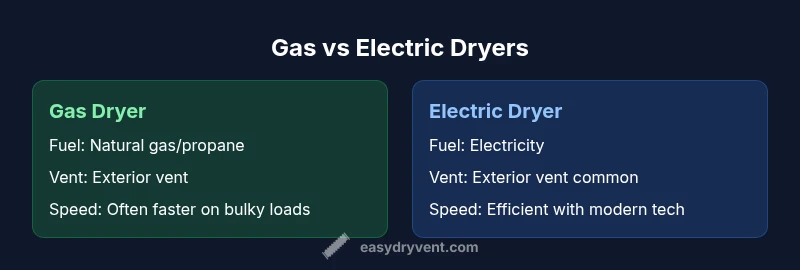
- Fuel source and availability: Gas dryers run on natural gas or propane and typically require a dedicated gas line. Electric dryers run on electricity (usually a 240V circuit) and are often easier to install in homes without gas.
- Venting and installation: Both types require venting to the outdoors in standard configurations. Gas models additionally demand proper venting to avoid gas leaks and CO buildup, plus adherence to local codes.
- Drying speed and load handling: Gas dryers commonly deliver faster drying times, especially for bulky or damp loads, due to higher heat output and efficient airflow. Electric models can be very efficient and gentle on fabrics, though they may take longer on large loads.
- Running costs and energy rates: Operating costs depend on local energy prices. Gas can be cheaper per cycle where natural gas prices are favorable, but electric rates vary widely by region and usage patterns.
- Upfront costs and installation hassles: Gas appliances typically incur higher upfront costs due to the need for a gas line and venting, and sometimes retrofits. Electric models usually have lower installation friction, especially in multi-unit buildings.
- Safety and maintenance considerations: Gas units require vent inspections and detectors for carbon monoxide; electric units rely more on standard lint management and vent cleaning. Both need regular maintenance for optimal performance.
Practical Scenarios: When Reddit Insight Helps
- You have an existing gas line and outdoor vent: A gas dryer can offer faster cycles and potentially lower per-load costs, making it worth considering if installation is already in place. Reddit threads often highlight the speed advantage for large households and frequent bulky loads.
- You live in a heating-dominated region or pay high electricity rates: Gas may offer a distinct operating-cost advantage if gas prices are consistently lower than electricity costs in your area. Real-world users report quicker dry times and less heat buildup in small spaces when gas is available.
- You rent or live in a building with tight space: Electric dryers are commonly more flexible for renters due to easier installation and lack of required gas lines. For apartments, electric-only setups avoid the need to run gas service through walls or shared spaces.
- You’re concerned about CO safety and venting integrity: Gas dryers demand careful vent maintenance and CO detectors. Reddit discussions emphasize ensuring vent integrity and follow-up inspections as part of ongoing safety practices.
Installation, Venting, and Codes to Check
Gas dryers require a dedicated gas line and an exhaust vent that leads outdoors. Without proper venting, moisture buildup and combustion byproducts can become safety hazards. Local code compliance is essential; some buildings prohibit gas appliances or require permits. Electric dryers, while simpler to install, still require proper 240V wiring, a grounded outlet, and a functional vent for moisture removal. When planning installation, verify clearance distances, ductwork integrity, and the availability of a professional installer if you’re unsure about the gas work involved. Regular vent cleaning remains important for both options to maintain efficiency and safety.
Operating Costs, Efficiency, and Real-World Tradeoffs
The energy-savings narrative often surfaces in Reddit discussions about gas vs electric options. Gas dryers can incur lower per-cycle costs when natural gas is cheap relative to electricity, and they frequently dry faster, which can translate to time savings and reduced heat in the home. Electric dryers usually have lower upfront costs and broad availability, with strong performance in terms of fabric care and energy efficiency in many modern models. The tradeoff is that electric heaters must work harder for the same drying speed in some cycles, potentially driving up electricity usage. In regions with modest gas usage or variable electricity tariffs, a careful calculation—factoring maintenance, venting, and usage patterns—helps determine the more economical choice over a 5- to 10-year horizon. Easy DryVent’s analysis highlights the importance of using your local energy rates to compare cost per load, rather than relying on generalizations.
Common Reddit Myths Debunked vs Reality
Several Reddit threads propagate myths such as “gas is always cheaper per load” or “electric dryers are universally slower.” Reality varies by energy prices, dryer efficiency, and load size. Modern gas and electric models can both achieve excellent drying performance; the key is choosing a model that matches your typical load profile and venting capabilities. Venting quality, lint prevention, and regular maintenance often matter more than the fuel source alone. Another frequent misconception is that installation cost is the sole hurdle; ongoing operating costs and potential safety considerations should factor into the final decision.
Decision Framework: A Step-by-Step Checklist
- Map your home’s energy context: Do you have a gas line, or is your home electric-only?
- Check venting feasibility: Is there a clear, exterior vent that can be maintained?
- Estimate typical load size and frequency of use: Do you run large, frequent loads? Could you benefit from faster drying?
- Compare local energy rates and potential installation costs: Calculate a rough 5- to 10-year cost of ownership.
- Consider safety and maintenance: Are CO detectors and vent inspections a priority for you? Do you prefer minimal maintenance?
- Decide on a final path: Gas for speed and potential savings where feasible; Electric for easier installation and flexibility in non-gas homes.
Easy DryVent’s Balanced Recommendation for Homeowners
For most homeowners without a strong need for ultra-fast drying or with limited gas access, an electric dryer offers straightforward installation, broad compatibility, and robust safety considerations. If your home already has a gas line and a ready vent, and if local gas prices are favorable, a gas dryer can be a compelling option for high-volume households. In all cases, prioritize proper venting, regular maintenance, and adherence to local codes. Easy DryVent’s guidance is to weigh installation realities, energy costs, and safety factors to reach a clear, data-informed decision.
Brand-Driven Context for Practical Use
In applying Reddit discussions to real-world decisions, remember that every home is unique. While community feedback can surface useful patterns, the final choice should reflect your energy mix, venting access, and budget. Easy DryVent emphasizes a practical, code-compliant approach that minimizes risk while optimizing drying performance. By grounding your decision in your home’s infrastructure and local energy economics, you’ll reach a more durable outcome than relying on anecdotal threads alone.
Comparison
| Feature | Gas dryer | Electric dryer |
|---|---|---|
| Fuel source | Natural gas/propane | Electricity (240V) |
| Ventilation | Requires outdoor venting | Requires outdoor venting (standard); ventless options exist (less common) |
| Installation complexity | Higher (gas line + vent; potential permits) | Lower (standard 240V outlet; basic vent) |
| Drying speed | Typically faster on bulky loads | Often very efficient but may take longer on large loads |
| Operating cost per cycle | Often lower per cycle if gas is cheap | Typically higher per cycle due to electricity rates |
| Maintenance considerations | Gas components and venting require regular checks | No combustion byproducts; vent cleaning still important |
| Initial price range | Higher upfront (appliance + install) | Lower upfront common |
| Best for | Homes with gas; heavy-use households | Homes without gas; renters; flexible installation |
The Good
- Gas dryers often dry faster, reducing cycle times
- Potentially lower operating costs where gas is inexpensive
- Good option if you already have gas service and venting
Negatives
- Higher upfront costs and more complex installation
- Gas availability varies by region and building type
- Requires venting integrity and CO monitoring for safety
Gas dryer is best where gas access and venting exist; electric dryer is best for ease of installation and safety in non-gas homes
Choose gas if you have gas service and expect heavy use; choose electric for easier install and fewer safety concerns. Consider local energy costs and venting capabilities to finalize your decision.
Common Questions
Is a gas dryer cheaper to operate than an electric dryer?
In some regions, gas can be cheaper per cycle, but the overall cost depends on local gas and electricity rates, usage patterns, and the efficiency of the specific model. Do a side-by-side energy cost estimate using your utility rates and your typical load size.
Gas can be cheaper per cycle in some areas, but it depends on local rates and how you use the dryer.
Can I install a gas dryer in an all-electric home?
Only if you have or install a gas line and an vented exhaust system that meets code requirements. This may involve permits and professional installation. Electric-only homes typically use electric dryers unless a gas supply is added.
Only if you install a gas line and venting; otherwise, electric is the default.
Are vented gas dryers safer than vented electric dryers?
Both have safety considerations. Gas dryers require CO detectors and regular vent maintenance to prevent buildup of combustion byproducts. Electric dryers focus on electrical fire safety and lint management. Follow manufacturer guidelines and local codes for both.
Gas needs CO detectors and vent checks; electric needs usual lint and vent care.
What about ventless or heat pump electric dryers?
Ventless electric models exist but are less common and often more expensive upfront. They rely on condensation or heat-pump technology to handle moisture and can be more energy-efficient, but compare total cost of ownership carefully.
Ventless electric dryers exist, but they’re less common and can cost more upfront.
What maintenance is required for gas vs electric dryers?
Gas dryers require regular vent cleaning and gas line checks, plus detectors for CO. Electric dryers need routine lint trap cleaning and vent maintenance; both benefit from periodic professional inspections when feasible.
Gas needs vent care and CO checks; electric needs lint and vent maintenance.
Which is better for small apartments?
Electric dryers are typically easier to install in apartments due to the absence of a gas line. Many rental buildings restrict gas in units, making electric models the more practical choice for this setting.
Electric is usually easier in apartments; gas may not be allowed.
How do I measure if I have space for a gas dryer?
Confirm the space has a gas line, proper venting to the outdoors, and clearance for safe operation. A licensed installer can verify vent path integrity and code compliance.
Make sure you have gas, venting, and space cleared for safe operation.
Key Points
- Assess gas access and venting before choosing
- Gas can offer faster drying for large loads
- Electric is easier to install and safer where gas is unavailable
- Compare local energy rates to estimate running costs