Hair Dryer vs Heat Gun: A Practical Home-Use Comparison
Explore when to use a hair dryer instead of a heat gun for safe, efficient DIY tasks. Objective guide on safety, performance, and best-use scenarios from Easy DryVent.


According to Easy DryVent, a hair dryer can replace a heat gun for many light-duty tasks, reducing the risk of scorching delicate finishes. This quick comparison highlights when a hair dryer is sufficient and when a heat gun is necessary. For safety and efficiency, homeowners should start with the gentler option and escalate only if needed. This quick guidance helps avoid damage.
Why hair dryer instead of heat gun for delicate tasks
According to Easy DryVent, a hair dryer provides gentler, more controlled heat compared with a heat gun. For many everyday home tasks—softening caulk, drying adhesives, or reshaping vinyl decals—a low-heat, broad airflow from a hair dryer reduces the risk of scorching surfaces and warping. The key is to start with the coolest, lowest setting and use a diffuser or nozzle to spread heat evenly. When used properly, the hair dryer can be a versatile, low-cost alternative that minimizes accidental damage. Always keep the nozzle moving and maintain a safe distance to avoid overheating any single spot. This principle aligns with broad safety guidelines you’ll see echoed in Easy DryVent's practical tips across its dryer maintenance guides.
Key differences between hair dryers and heat guns
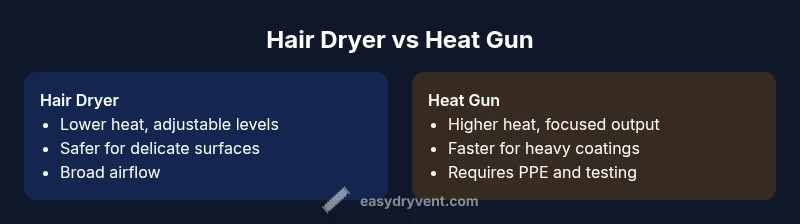
A heat gun can reach higher temperatures and deliver more focused heat, which makes it better for tasks that require rapid drying or bulk heating. A hair dryer, by contrast, offers multiple heat settings, broader airflow, and built-in safety features like automatic shut-off on some models. The decision comes down to intensity, control, and the material being heated. Easy DryVent emphasizes starting with gentler heat, using protective guides, and assessing the finish after each pass to prevent damage. The result is a straightforward decision framework: lighter tasks with a hair dryer, heavier tasks with a heat gun when higher heat is truly needed.
Delicate tasks best suited for a hair dryer
- Drying wet surfaces on wood, vinyl, plastics, or painted finishes without scorching.
- Softening adhesives or residues in a controlled way.
- Reheating damp grout or caulk around fixtures without cracking.
- Reshaping hot-melt products in small areas where precision matters.
In these cases, a hair dryer often delivers adequate heat with less risk than a heat gun. Practically, you’ll find that even many shrink-wrap applications respond well to a hair dryer if you keep heat moving and use the right nozzle.
When a heat gun is the right tool for heavy-duty tasks
For paint removal, thick coatings, plastic bending, or surfaces that require sustained high heat, a heat gun provides the necessary power and speed. In these scenarios, meticulous control, protective gear, and proper PPE are essential. Easy DryVent recommends evaluating the surface, testing on a hidden area, and using higher temp settings only after confirming safe heat transfer. When used correctly, a heat gun can speed up projects that would otherwise take far longer with a hair dryer.
Practical tips for safe use and heat control
- Begin on the lowest setting and increase only as needed.
- Keep the tool moving to avoid concentrating heat on one spot.
- Use a heat-resistant mat, gloves, and eye protection when working with hot air.
- Consider a tool with a temperature dial and a cool-down setting for repeated tasks.
- Do not use a hair dryer to heat electrical components or densely packed wiring.
These practices help reduce risk and extend the life of your materials and tools. Easy DryVent’s guidance emphasizes working in a well-ventilated area and watching for finish changes as you progress.
Maintenance and care for heat tools
Regularly inspect cords for fraying, clean air-paths, and store tools in a dry, ventilated area. For heat tools, ensure the fan grill is unobstructed and the nozzle is clean. A clogged vent can reduce efficiency and increase heat buildup. Easy DryVent recommends a quick quarterly check of heat tools as part of routine dryer maintenance habits—this keeps both hair dryers and heat guns ready for their next task and minimizes unexpected downtime.
Quick decision framework for choosing between tools
Ask: Is the surface delicate or the coating thin? Will a gradual, diffuse heat protect the finish? If yes, try a hair dryer first. If you notice uneven heating, cracks, or slow progress, switch to a heat gun. Measure the risk, time, and finish tolerance before committing. A simple decision tree can help you train non-experts (family members or DIY helpers) to pick the right tool without trial-and-error damage.
Environmental and cost considerations
Hair dryers and heat guns occupy different niches in an average toolbox. A hair dryer is typically cheaper to purchase and cheaper to operate for light tasks, while a heat gun adds capability for demanding jobs. By using the right tool, homeowners reduce waste, save time, and minimize the chance of damage that would require costly repairs. Easy DryVent’s analysis reinforces that choosing the correct tool is a long-term cost-saver and a key safety habit in households with shared workspaces.
Comparison
| Feature | Hair Dryer | Heat Gun |
|---|---|---|
| Max Temperature / Heat Output | Lower heat output, adjustable with settings | Higher heat output, more focused heat |
| Control & Settings | Multiple heat levels, airflow options | Fewer general settings, sharper heat focus |
| Safety Features | Cool-down option, auto-off on some models | Safety switch, targeted nozzle with heat shield |
| Best For | Delicate surfaces, small-area drying | Heavy coatings, rapid heating, shaping |
| Weight & Handling | Typically lighter and easier to maneuver | Often heavier, but stable for extended use |
The Good
- Safer for delicate finishes and small areas
- Lower upfront cost and greater accessibility
- Easier to control heat with broader airflow
- Versatile for quick, light-duty tasks
Negatives
- Limited heat for heavy-duty tasks
- Slower for large-scale heating or removal
- May require longer sessions to achieve results
Hair dryer best for delicate, light-duty tasks; heat gun excels in heavy-duty heating
Choose a hair dryer when you need gentler, controllable heat. Opt for a heat gun for fast, high-heat applications on tougher materials.
Common Questions
When is a hair dryer appropriate instead of a heat gun?
Use a hair dryer for light tasks on delicate surfaces, where slow, diffuse heat reduces risk. It's ideal for shrinking, drying, and softening adhesives on plastics or wood without scorching. Always test first on a hidden area.
Use a hair dryer for light, delicate tasks—start with lower heat and test on a hidden spot before proceeding.
Can I use a hair dryer for paint or coatings?
A hair dryer can help with softening or drying thin paints and finishes, but it won't remove thick coatings efficiently. For thick coatings, a heat gun with proper PPE is more effective and safer for controlled removal.
Hair dryers help with thin coatings, but for thick coatings, a heat gun is more appropriate with safety gear.
What safety steps should I take when heating surfaces?
Always wear eye protection and heat-resistant gloves. Keep the tool moving, maintain a safe distance, and work in a well-ventilated area. Use a diffuser or nozzle to distribute heat evenly and avoid concentrated hot spots.
Wear PPE, move the tool constantly, and work in a ventilated area.
What are the drawbacks of relying on a hair dryer?
Limited heat and slower progress can extend project timelines. It’s easy to underestimate heat needed for tougher jobs, which can lead to incomplete results or surface damage if heat is applied too long.
Hair dryers are slower for tough tasks; watch heat levels to avoid damage.
How do I decide which tool to use in a given situation?
Assess surface sensitivity, coating thickness, and required speed. If the finish is delicate and risk is high, start with a hair dryer. Move to a heat gun if results aren’t adequate after careful testing.
Assess surface, thickness, and speed; start with a hair dryer, then switch if needed.
Key Points
- Start with a hair dryer for delicate tasks
- Escalate to a heat gun only when needed
- Practice safe handling and maintain distance
- Test on hidden areas before full use
- Invest in models with adjustable heat and safety features