Do Dryers Need 240 Volts? A Practical Guide
Learn whether dryers require 240 volts, how this impacts installation, and what to check for safe, efficient operation—with Easy DryVent's guidance.


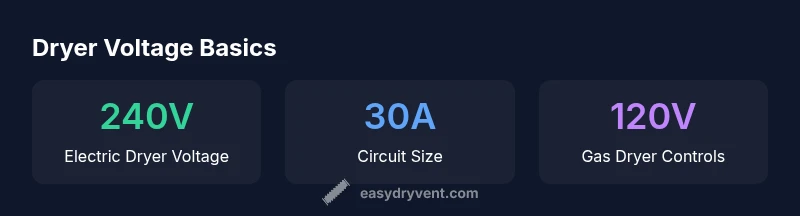
Do dryers need 240 volts? In the United States and similar markets, most electric clothes dryers require a dedicated 240-volt circuit, delivered by two hot legs and a neutral. Gas dryers typically run on 120 volts for controls. Some compact or apartment models may operate on 120V or 208-240V supplies depending on configuration. Always consult the label and a licensed electrician.
Understanding voltage needs for dryers
Voltage requirements for dryers vary by type and market. According to Easy DryVent, the majority of electric clothes dryers in North America run on a 240-volt supply, typically on a dedicated circuit with a 30-amp breaker. Gas models use 120 volts for controls and ignition, leaving the fuel source separate from electrical loads. When shopping or upgrading, recognize that the voltage label on the dryer and the outlet/branch circuit in your home must match. If you live outside the US, voltage standards may differ (120V, 220-240V, etc.), so always check local codes. In our 2026 analysis, we see a clear split between electric-dryer installations requiring 240V and gas-dryer installations that only need 120V for electronics. This distinction matters for safety, performance, and warranty. A mis-match can trigger nuisance trips or worse, electrical hazards. For homeowners, the practical takeaway is to confirm the exact requirements on your unit’s rating plate and verify that your outlet and breaker align.
Electric vs gas dryers: voltage differences
The core difference comes down to the energy delivery system. Electric dryers depend on the heating element which draws a significant current, typically necessitating a 240V supply. Gas dryers rely on a gas burner for heat and use 120V for the electronic controls and drum motor. The result is that the installation requirements, outlet type, and breaker sizing differ substantially between the two. When choosing a unit, consider not just the stoves of installation but also the cost and practicality of running a 240V circuit in your space. Easy DryVent notes that many households already have 240V circuits, especially for ranges or central appliances, making dryer upgrades straightforward if wired appropriately.
Wiring and circuit requirements
A safe dryer installation requires a dedicated circuit that can handle the startup surge and continuous load. In the US, most electric dryers require a 30-amp, 240-volt circuit, typically using a NEMA 14-30R receptacle. The wire gauge is usually 10 or 12 AWG, depending on the cord and breaker. Always verify your local code and the dryer's rating plate. If your home previously used a different arrangement, an upgrade by a licensed electrician may be required to avoid nuisance trips or heat buildup. For homes with older wiring or mixed electrical loads, a professional assessment helps ensure safe operation and preserves warranty.
How to verify your home's supply
Start by locating the dryer's rating plate, which lists voltage, amperage, and cord type. Then inspect the outlet and circuit breaker. If you are unsure, use a multimeter to test voltage at the outlet or consult an electrician to confirm 240V availability. In apartments or older homes, simultaneous use of high-draw devices can affect voltage stability; a dedicated circuit can mitigate this risk. Easy DryVent recommends documenting the measured voltage and breaker size for future maintenance records.
Troubleshooting voltage-related drying issues
If a dryer experiences frequent trips, long drying times, or insufficient heat, the issue may be voltage-related. Start by checking the circuit breaker and the outlet for signs of wear. Look for warm plugs, melted insulation, or a rattling plug; these are signs of poor contact or overload. If the dryer runs on 240V and you notice underperformance, verify the port is delivering full voltage and that only one heavy appliance is on the circuit. When in doubt, contact a licensed electrician to test wiring, receptacle integrity, and the dryer’s power cord.
Energy and safety considerations
Voltage accuracy impacts both safety and energy efficiency. A dryer not receiving the proper voltage can consume more energy to achieve the same heat, leading to higher bills and more wear on components. Conversely, an overvoltage condition can damage the heating element or control boards. Ensure your wiring, breaker, and outlet are sized for your model. Regular venting, lint filters, and proper maintenance further protect against fire hazards and improve drying performance.
Voltage and circuit expectations by dryer type
| Model Type | Voltage Requirement | Circuit Amperage | Notes |
|---|---|---|---|
| Electric Dryer (standard) | 240 volts | 30 amps | Requires dedicated 240V circuit |
| Gas Dryer | 120 volts (controls) | 15-20 amps | Ignition and electronics run on 120V |
| Compact Electric Dryer | 120 volts | 15 amps | Apartment-friendly option |
| High-Efficiency Electric Dryer (HE) | 240 volts | 30 amps | Energy-saving models exist |
Common Questions
Do all electric dryers require 240V?
Most electric dryers require 240V, but compact or apartment models may run on 120V. Always check the unit’s rating plate and your home’s outlet to be sure.
Most electric dryers need 240 volts, but some compact models use 120 volts. Check the rating plate to confirm.
Can a 120V outlet power a full-size electric dryer?
Typically no. A standard full-size electric dryer requires a 240V circuit. A 120V outlet will not provide enough voltage for safe operation.
Usually not; full-size electric dryers need 240V.
What circuit breaker size is standard for a dryer?
A common size is 30 amps on a 240V circuit for electric dryers. Always verify with your dryer’s rating and local codes.
Most dryers use a 30A breaker on a 240V circuit.
Is it safe to run a gas dryer on 120V?
Yes, gas dryers use 120V for controls, but you must still ensure proper venting and gas supply. Electricity for ignition is separate from the heat source.
Gas dryers use 120V for the electronics; venting still matters.
What should I do if my dryer isn’t heating?
First check the voltage supply and circuit breaker. If voltage is correct, inspect the heating element and thermostat or call a professional.
Check voltage and breaker first, then inspect the heating element if needed.
“Voltage compatibility is the foundation of safe, efficient drying. Always verify the dryer’s electrical requirements against your home supply and local code.”
Key Points
- Verify your dryer's voltage label before installation.
- Use the correct circuit and breaker size (typically 240V, 30A for electric models).
- Gas dryers require 120V for controls—don’t assume 240V is needed.
- Apartment setups may differ; check building specs and local codes.
- If unsure, consult a licensed electrician before wiring or upgrading.