Dryer 120 or 240: Which Voltage Setup Is Right for Your Home
A detailed comparison of 120V vs 240V dryer setups, covering wiring needs, installation, performance, safety, and cost for homeowners.


When deciding between dryer 120 or 240, the baseline rule is that 240V service powers standard electric dryers with better heating and faster cycles, while 120V models exist mainly for compact loads or retrofit experiments. If your home can support a 240V circuit, it’s typically the safer, more efficient choice for regular laundry. However, installation costs and compatibility should be weighed against your current electrical setup.
Understanding Voltage Foundations for Dryers
Choosing between dryer 120 or 240 starts with the basics of home electrical service. In most modern homes, a dedicated 240-volt circuit has long been the standard for full-size electric dryers, delivering higher heating power and shorter drying times for typical loads. A 120-volt dryer exists mainly for compact units or limited-scenario installations where space, cost, or retrofit feasibility limits wiring. According to Easy DryVent, the voltage choice drives not only heating capacity but also the practical realities of wiring, panel load, and outlet availability. Before any purchase, homeowners should map current circuits, assess the capacity of the main panel, and identify whether a dedicated 240-volt circuit can be accommodated in the laundry area without compromising other appliances. The decision should balance the desire for speed and performance against the realities of existing wiring and remodel potential, especially in older homes that may require upgrades to meet modern safety standards. This upfront assessment helps prevent post-purchase surprises and keeps installation risk to a minimum.
Understanding Voltage Foundations for Dryers\n\nChoosing between dryer 120 or 240 starts with the basics of home electrical service. In most modern homes, a dedicated 240-volt circuit has long been the standard for full-size electric dryers, delivering higher heating power and shorter drying times for typical loads. A 120-volt dryer exists mainly for compact units or limited-scenario installations where space, cost, or retrofit feasibility limits wiring. According to Easy DryVent, the voltage choice drives not only heating capacity but also the practical realities of wiring, panel load, and outlet availability. Before any purchase, homeowners should map current circuits, assess the capacity of the main panel, and identify whether a dedicated 240-volt circuit can be accommodated in the laundry area without compromising other appliances. The decision should balance the desire for speed and performance against the realities of existing wiring and remodel potential, especially in older homes that may require upgrades to meet modern safety standards. This upfront assessment helps prevent post-purchase surprises and keeps installation risk to a minimum.
Comparison
| Feature | 120V Dryer Setup | 240V Dryer Setup |
|---|---|---|
| Voltage Source | Standard 120V outlet/circuit; may require adapter on some models | Dedicated 240V circuit (often NEMA 14-30 or similar) |
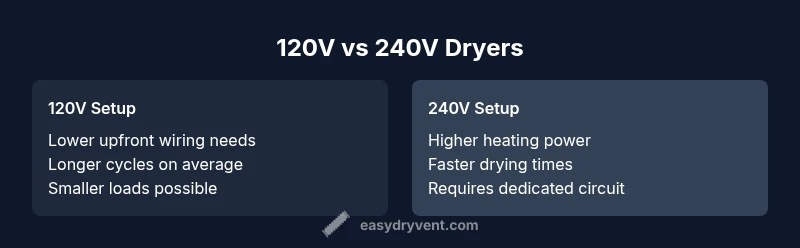
| Heating Power | Lower heating power in typical 120V models | Higher heating power in typical 240V models |
| Drying Time | Longer cycles on 120V due to limited heat | Shorter cycles on 240V due to greater heat delivery |
| Installation Complexity | Easier if existing 120V is available; retrofit may be needed for 240V | Typically requires electrical upgrades and a dedicated circuit |
| Best For | Small loads, compact spaces, or retrofit tests | Regular family loads and larger households |
| Cost to Install | Lower if you stay on 120V; minimal wiring changes | Higher due to panel upgrades, wiring runs, and permits |
| Energy Efficiency | Performance depends on model; 120V units can be efficient for light use | Typically more efficient overall for full-size loads with modern 240V designs |
The Good
- Faster drying and better heat control with 240V
- Better future-proofing for larger households
- Potentially broader model availability on 240V
Negatives
- Higher upfront wiring and installation costs
- Not feasible in all homes without electrical upgrades
- Longer lead times for permits and inspections
In most cases, a 240V dryer setup is the better long-term choice when wiring allows.
Choose 240V for faster, more reliable drying and better performance on regular loads. Opt for 120V only if wiring upgrades are impractical and loads are light.
Common Questions
What is the main difference between a 120V and 240V dryer?
The primary difference is heating power. A 240V dryer typically delivers higher heat and shorter cycles, suitable for regular-sized loads, while a 120V dryer is designed for smaller or lighter use. Wiring and circuit requirements also differ, affecting installation time and cost.
The main difference is heating power and circuit needs: 240V is for standard loads; 120V is for smaller uses. Expect longer dry times on 120V.
Can I upgrade my existing dryer outlet to 240V?
Upgrading to a 240V outlet typically requires a dedicated circuit, appropriate wiring gauge, a compatible breaker, and possibly a permit. It’s best handled by a licensed electrician to meet local codes and safety standards.
Upgrading usually needs a dedicated circuit and a licensed electrician to ensure safety and code compliance.
Are gas dryers affected by this voltage discussion?
Gas dryers primarily need 120V for control systems, igniters, and fans, while the heating uses gas. The voltage decision mostly concerns the dryer's electrical components and efficiency, not the gas heating itself.
Gas dryers still rely on 120V for controls; voltage choice mainly affects electric components and overall efficiency.
What signs indicate I should upgrade to 240V?
Frequent long drying times, repeated trips on a breaker, and plans for larger household loads are common indicators that a 240V circuit would be beneficial. If you’re remodeling or replacing aging wiring, consider upgrading.
If drying takes forever and breakers trip, or you expect bigger loads, a 240V upgrade is worth considering.
Are there compact or apartment-friendly solutions for this voltage decision?
Yes. Compact or apartment-friendly dryers often run on 120V, but they may have smaller capacities and longer cycle times. If space or power is scarce, a 120V compact model can be a practical stopgap until a full upgrade is possible.
Compact 120V options exist for tight spaces, but expect smaller loads and longer cycles.
What should I ask a contractor before upgrading voltage?
Ask about required wire gauge, panel capacity, permit requirements, estimated timeline, and whether the upgrade affects other circuits. Also confirm compatibility with existing dryer models you’re considering.
Ask about wire size, panel capacity, permits, timeline, and model compatibility before starting.
Key Points
- Assess existing electrical capacity before choosing voltage.
- Prioritize a dedicated 240V circuit if possible.
- Expect faster drying with 240V models on large or frequent loads.
- Factor installation costs into your decision, including permits.
- Ensure safe venting and proper outlet placement for optimal performance.