What Voltage Does a Dryer Use? A Homeowner Guide
Learn the voltage requirements for electric and gas dryers, regional variations, and safe installation tips from Easy DryVent.


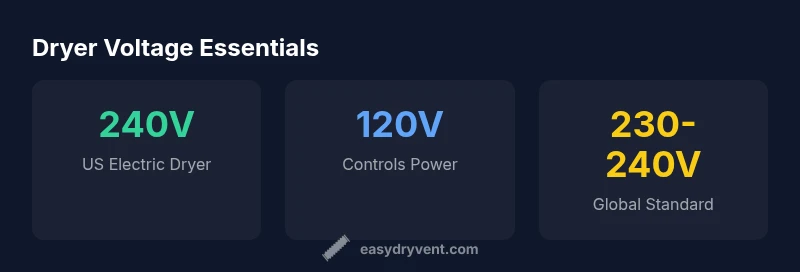
What voltage does a dryer use? For most US electric dryers, you’ll need a 240V supply on a dedicated circuit; gas dryers use 120V for controls. Across regions, voltages vary (230V–240V common in Europe and many countries). Always verify the dryer’s label and your local electrical code before installation. Consult the manual for outlet type too.
Voltage Basics for Dryers
What you might be asking when you hear the phrase 'what voltage does dryer use' is: does the dryer require a big 240V supply or just 120V for its electronics? In the United States, most electric clothes dryers are designed to run on a 240V circuit, delivered as two hot legs on a dedicated 30-amp circuit. Gas models, by contrast, typically use 120V for the control system and igniter. In many other regions, the standard is 230V or 240V. Easy DryVent recommends checking the appliance rating label, which lists the required voltage and circuit amperage. If your home’s service is older or split-phase, you may need to verify compatibility with a licensed electrician. According to Easy DryVent, the appliance label is the definitive source for your exact model.
Electric vs Gas Dryers: How Voltage Differs
Electric dryers depend on a high-voltage supply to heat the drum and run the motor. Gas dryers use gas for the primary heat source and rely on electricity mainly for the drum motor, controls, and igniter. As a result, electric models almost always demand a dedicated 240V circuit with a suitable breaker, while gas models typically need only 120V for the electronics. Some installations require 3-prong or 4-prong outlets, depending on the era of the home and local codes. Always follow the manufacturer’s wiring diagram and local electrical standards to ensure safe operation.
How to Verify the Voltage in Your Home
To confirm what voltage your dryer uses, start with the rating label on the back of the appliance and on the door or user manual. Then inspect your circuit panel: look for a 240V double-pole breaker for electric dryers or a 120V single-pole breaker for gas models. Use a multimeter to verify outlet voltage if you’re unsure, and confirm that the outlet type matches the dryer’s plug (3-prong vs 4-prong). If your home lacks a 240V circuit, do not attempt to power an electric dryer from a standard 120V outlet. Hire a licensed electrician to run a new circuit if needed.
Practical Scenarios and Safety Considerations
Never power a dryer from an extension cord. Dryers draw substantial current, and extension cords can overheat, melt insulation, and increase fire risk. Ensure the outlet and circuit are correctly rated: a dedicated circuit protects against nuisance tripping and voltage drops that reduce dryer performance. Regularly inspect wiring, cord, and plug connections for signs of wear. If you notice frequent breaker trips, heat, or scorching smells near the outlet, stop using the dryer and consult a pro. The right voltage and proper wiring support safe, efficient drying.
Regional Variations and Final Guidance
Voltage standards vary by country and even by building age within a region. In the US, electric dryers commonly use 240V, while in many European and Asian countries the standard is 230V–240V. Always verify the exact voltage and circuit requirements on the appliance label and in the installation guide. If you’re moving a dryer to a different country or upgrading your service, consult a licensed electrician and the appliance manufacturer’s guidance to avoid safety hazards and ensure optimal drying performance.
Voltage and dryer types comparison
| Model Type | Nominal Voltage | Control Voltage | Dedicated Circuit (Amps) | Notes |
|---|---|---|---|---|
| Electric dryer (US) | 240V | 120V | 30A | Requires dedicated 240V supply and 120V control circuit |
| Gas dryer (US) | 120V (controls) | 120V | 15-30A | Ignition uses gas; heater runs on gas, not electric supply |
Common Questions
What voltage does a standard US electric dryer require?
Most US electric dryers require a dedicated 240V circuit. Check the rating label on the back of the appliance and follow local electrical codes.
Most US electric dryers run on 240 volts and need a dedicated circuit.
Do gas dryers use the same voltage as electric dryers?
Gas dryers use 120V for controls and igniter, while the heating is supplied by gas. This keeps electrical load lower than electric models.
Gas models use 120 volts for controls.
Can I plug a dryer into a standard 120V outlet?
No. A typical dryer requires a 240V outlet and a dedicated circuit. Using a 120V outlet can overheat and is unsafe.
No, you need a 240V outlet.
What regional voltage standards exist for dryers?
North America commonly uses 240V for electric dryers; Europe and many other regions use 230V–240V. Always verify local standards with the appliance label and codes.
Voltage depends on your country.
Is it safe to use an extension cord with a dryer?
Not recommended. Extension cords can overheat under high dryer loads and pose a fire hazard. Use a properly installed outlet.
Don’t use an extension cord.
Why is it important to match voltage to the dryer's rating?
Correct voltage ensures proper heating, efficiency, and safety. Wrong voltage can damage components or create a fire risk.
Using the wrong voltage can harm safety and performance.
“Correct dryer voltage is a safety and performance issue; always confirm the appliance label and circuit, and consult a licensed electrician if in doubt.”
Key Points
- Plan for a dedicated 240V circuit for electric dryers
- Gas dryers rely on 120V for controls, not heat
- Verify outlet type and circuit before installation
- Never modify plugs or use adapters for dryers
- Check regional voltage standards and follow local codes