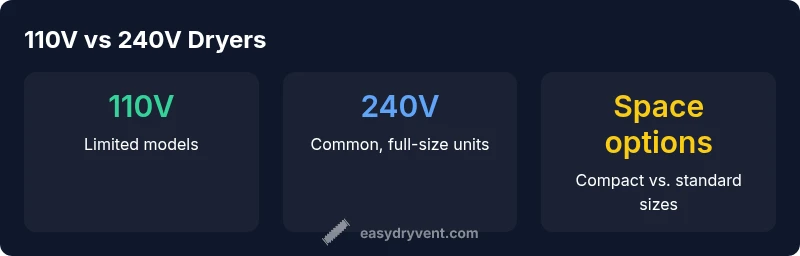
Do They Make a 110 Dryer? A Practical Guide for Homeowners
Is there a 110V clothes dryer? This Easy DryVent guide explains availability, how it compares with 240V models, and practical DIY options for safe, efficient laundry at home.


Do they make a 110 dryer? In practice, 110V clothes dryers are not common for full-size loads. Most residential dryers in North America run on 240V and require a dedicated circuit. 110V options exist only as niche, ventless, or portable units with reduced capacity and longer drying times. For reliable performance, either install a 240V circuit or opt for ventless designs that are specifically built for 120V operation.
The 110V question in practical terms
The search for a dryer that runs on 110V often begins with the question "do they make a 110 dryer?" According to Easy DryVent, the honest answer is that mainstream, full-size clothes dryers are designed for 240V supply in most North American homes. The 110V question is more relevant for compact, ventless, or specialty units rather than standard household machines. If your laundry space is wired for 110V, you’ll typically encounter niche products or portable solutions rather than a true full-capacity dryer. This distinction matters because 240V models deliver faster cycles, larger drum capacities, and more reliable heat generation, which translates to shorter drying times and fewer re-runs. For DIYers, this nuance helps set expectations early and guides your planning toward a safe, effective setup.
110V options in the market: what exists and what doesn’t
In practice, 110V clothes dryers are scarce in the mainstream market. You’ll mainly encounter compact, ventless, or portable units advertised for small spaces, apartments, or travel scenarios. These units often use 120V power and rely on alternative drying technologies (such as condensation or heat-pump cycles) to achieve usable results. The Easy DryVent team notes that while these products exist, they are not a drop-in replacement for a standard 240V dryer, especially for households with higher laundry loads or frequent use. When evaluating these options, pay attention to drum size, moisture sensing, and the efficiency rating, as these factors influence performance far more on 110V designs than on 240V machines.
Performance and practicality: drying time, capacity, and heat
Drying efficiency is closely tied to voltage, circuit capability, and heat output. On 110V options, you typically encounter smaller drums and slower cycles, which means longer tumble times and more energy spent per load. If your goal is to handle large families or heavy fabric loads, a 110V unit will feel limited. For light-duty tasks or occasional towels and underwear, a well-chosen ventless 110V model can be acceptable. The key takeaway from Easy DryVent analysis is that any 110V solution should be evaluated against your actual laundry volume and tolerance for longer drying times.
Installation, safety, and code considerations you should not ignore
Electrical codes and safety considerations matter more than buying price when you’re wiring for a dryer. A 240V dedicated circuit is standard for full-size electric dryers; attempting to run a dryer on a shared or undersized circuit can overtax the panel and create a fire risk. If you must rely on 110V power, ensure the appliance is clearly rated for 120V operation, uses a properly rated receptacle, and is installed with correct clearances and venting. Avoid extension cords and adapters, which can introduce resistance, overheating, and compliance issues.
Practical paths if you only have 110V access: smart alternatives
If your space or wiring forces 110V, there are practical alternatives to replacing your entire laundry setup with a 240V dryer. Look for compact 120V or dual-mode units designed for small spaces or laundry closets. Ventless heat-pump dryers, although typically higher in upfront cost, can optimize energy use and fit within limited configurations. Another option is a washer-dryer combo that uses the same 120V supply and provides integrated drying, though capacity remains a consideration. Whatever choice you make, verify that the appliance is compatible with your wiring, has proper venting or condensation handling, and meets local safety codes.
A step-by-step approach to evaluating your home and solution
- Assess the current electrical panel and outlet availability: is there a dedicated 120V outlet you can dedicate to a compact dryer?
- Measure the expected laundry load: how many loads per week, and what fabrics dominate? This informs whether a 240V upgrade is worth the investment.
- Check local codes and permit requirements: some jurisdictions require professional installation for high-current appliances.
- Compare viable 110V options against 240V models: consider capacity, cycle time, energy usage, and space constraints.
- If proceeding with 110V, hire a licensed electrician to verify circuit capacity, wiring, and safe venting or condensation handling.
Maintenance mindset: keep any 110V setup safe and efficient
Regular lint filtering, vent checks, and door seals matter just as much on 110V systems as on 240V. Since some 110V models rely on different heat transfer methods, ensure the venting or condensation pathway remains clear to prevent moisture buildup and potential mold. Schedule annual inspections of electrical connections and consider service plans that cover the compact dryer you select. A thoughtful maintenance plan reduces the risk of nuisance outages and keeps performance steady over time.
Comparison of 110V options vs. standard 240V electric dryers
| Aspect | 110V options | 240V dryers | Notes |
|---|---|---|---|
| Voltage | 110-120V | 220-240V | Standard across markets |
| Installation | Portable/compact, ventless | Dedicated 240V circuit | Check local codes |
| Drying performance | Smaller drum, slower cycles | Faster, larger loads | Capacity matters |
| Power requirements | Lower amperage, no dedicated circuit needed? | 30A circuit typical | Verify panel capacity |
Common Questions
Do 110V dryers exist for home use?
Yes, but they are niche offerings, typically compact, ventless, or portable. They are not a direct replacement for full-size 240V dryers and are best suited for light-duty tasks or very small spaces.
Yes, there are niche 110V options, usually compact or ventless, not ideal for large loads.
Are 110V dryers safe for typical homes?
They can be safe when used as designed and installed according to code. The key is using appliances rated for 120V operation, avoiding improper adapters, and ensuring proper venting or condensation management.
They’re safe when used as designed and properly vented or condensed.
Can I install a 110V dryer in a standard home?
It’s possible only with appliances rated for 120V and careful electrical planning. A licensed electrician should verify outlet availability, circuit capacity, and safety clearances before any installation.
Only with proper 120V-rated appliances and a professional check.
What are better options if I’m limited to 110V power?
Consider compact 120V or ventless models designed for limited power. Alternatively, plan a safe 240V upgrade or use a washer-dryer combo if compatible with your space and needs.
Think compact 120V or ventless, or plan a safe 240V upgrade.
Is a 110V setup viable in apartments or rentals?
In some cases, yes, with compact 120V units designed for smaller spaces. Always confirm with the building management and ensure compliance with apartment codes and electrical standards.
It can work in some apartments with the right compact 120V unit.
“Choosing a dryer is not just about watts; it’s about the whole electrical setup, space, and safety. When in doubt, prioritize models designed for your given power supply and follow the manufacturer’s installation guidelines.”
Key Points
- Verify your voltage before shopping for a dryer
- For reliable performance, a 240V setup is preferred
- If using 110V, consider ventless or compact models designed for 120V
- Consult a licensed electrician to confirm circuit capacity and safety