What Dryer Is Better: Electric vs Gas Dryer Comparison
A practical, analytical comparison of electric and gas dryers to help homeowners decide which is better for their space, budget, and drying needs. Includes energy costs, performance, venting, and maintenance guidance from Easy DryVent.


When deciding what dryer is better, your answer hinges on trade-offs between upfront cost, operating costs, and installation feasibility. Electric models are typically cheaper to buy and install and work well in most homes, while gas models can offer faster drying and potentially lower per-load costs where gas is affordable and venting is available. Easy DryVent’s framework emphasizes matching the dryer to your utility rates, venting setup, and family laundry patterns.
Understanding the question: what dryer is better in practical terms
When homeowners ask what dryer is better, the answer hinges on priorities and your home’s venting and utility setup. A better dryer for one household might be different for another. This guide uses a practical framework to compare electric and gas models, focusing on energy use, drying speed, installation requirements, safety, and long-term costs. Throughout, Easy DryVent provides actionable guidance based on typical family loads, common laundry rooms, and local utility considerations. The goal is to help you pick the dryer that best fits your space and budget, not just the cheapest sticker price.
Electric vs gas dryers: core differences that matter
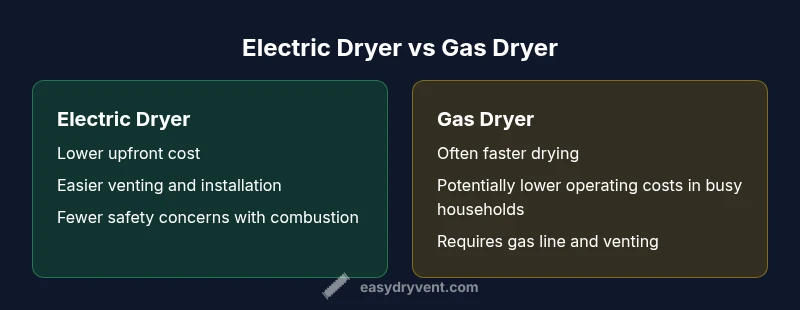
Electric and gas dryers operate with different heat sources and control logic. Electric models heat with an electric element and are generally simpler to install and vent. Gas models use a gas burner and typically deliver faster drying times when loads are large, depending on venting and exhaust. The initial cost often differs—electric dryers usually cost less upfront, while gas models may offer lower operating costs in high-volume households if utility rates and venting are favorable. Installation quality and venting length influence performance and safety. Consider existing gas lines, electrical capacity, and the layout of your laundry area when deciding what dryer is better for your home.
Energy costs, efficiency, and long-term ownership
Energy efficiency is a major factor in the long-term cost of ownership. Look for Energy Star certified models and compare energy consumption across similar capacities. Gas models can be more economical per load in some markets, but only if gas is cheaper than electricity and if you run many cycles per week. Electric models tend to have lower maintenance costs and simpler service options. Factor in vent cleaning, filter maintenance, and potential repairs. Easy DryVent’s framework emphasizes evaluating local utility rates, maintenance needs, and expected load patterns to determine which dryer is better for you.
Drying performance, fabric care, and sensor technology
Drying performance depends on features like moisture sensors, drum design, and drum size. Modern dryers can automatically stop when clothes are dry to avoid over-drying and fabric damage. Gas dryers often excel at faster drying for heavy loads, while electric models with efficient sensors can protect fabrics and reduce wrinkles. The best dryer is the one that balances drying speed with fabric care, energy use, and user-friendly controls. Consider cycle options like heavy-duty, delicate, and sensor-dry to match your laundry needs.
Venting, installation, and safety considerations
Proper venting is critical for both electric and gas models. A gas dryer requires a dedicated vent line to the outdoors and a gas supply line installed by a licensed professional. Electric dryers require a proper electrical outlet and circuit, with venting sized for the model. Regular lint screening and vent cleaning are essential to prevent fires and maintain efficiency. Check local codes and warranty requirements, and plan for up-front installation costs when evaluating what dryer is better for your home.
Real-world scenarios: choosing based on your home
Small apartment with limited space and a basic vent may favor a compact electric model with efficient heat recycling. A busy family with frequent loads in a home with natural gas might benefit from a gas dryer due to faster cycles and potential energy savings. Homes with electric-only utility infrastructure should lean electric, while homes with accessible gas lines and strong venting may favor gas. Always consider duct length, vent location, and ease of service when making a decision about what dryer is better.
How to decide: a practical decision framework
Use this step-by-step framework to compare options and pick the right dryer. Step 1: determine installation feasibility (gas line or 240V outlet). Step 2: estimate annual energy costs using local rates and household load. Step 3: evaluate drying performance needs and fabric care priorities. Step 4: assess maintenance effort and service availability in your area. Step 5: factor resale value and warranty terms. With Easy DryVent's approach, you can systematically identify the best dryer for your home and avoid overpaying for features you won't use.
Comparison
| Feature | Electric Dryer | Gas Dryer |
|---|---|---|
| Upfront cost | Lower upfront cost | Higher upfront cost due to gas line and venting needs |
| Operating cost | Typically higher electricity cost per load | Potentially lower per-load cost depending on local gas prices |
| Drying speed | Standard to slower on average | Often faster for large or heavy loads |
| Installation requirements | Requires 240V circuit and proper venting | Requires gas line, dedicated vent, and proper venting |
| Maintenance | Fewer moving parts, simpler maintenance | Gas systems require vent cleaning and gas line checks |
| Safety considerations | Electrical safety, fire risk from lint | Gas leaks and combustion byproducts; CO risk |
The Good
- Clear energy and cost trade-offs between electric and gas models
- Different installation requirements are clearly defined
- Electric dryers are easier to install in most homes
- Gas models can offer faster drying times for high-use households
Negatives
- Gas installation adds upfront costs and regulatory considerations
- Actual energy savings depend on local utility rates and usage patterns
- Finding a model that balances performance and efficiency can be challenging
Electric is typically the better default for most homes, while gas is advantageous for high-use households with proper venting and favorable gas costs.
Electric dryers generally win on upfront cost and installation simplicity. Gas dryers can win on drying speed and potential operating costs when used heavily and gas is affordable, provided there is safe venting and a gas supply.
Common Questions
Which is more energy-efficient, electric or gas dryers?
Energy efficiency varies by model. Both electric and gas dryers can be efficient if they include moisture sensors, efficient heating elements, and appropriate load sensing. Compare Energy Star ratings and model energy consumption to estimate long-term costs.
Efficiency depends on the individual model. Look for moisture sensors and Energy Star ratings when choosing between electric and gas.
Do gas dryers dry clothes faster than electric dryers?
Gas dryers often dry faster, especially on large loads, due to higher heat output. However, modern electric models with smart sensors can close the gap. Your results depend on the exact model and venting conditions.
Gas can dry faster for big loads, but high-end electric models with good sensors can keep up.
What installation costs should I expect?
Electric installation typically requires a 240V outlet and adequate circuit capacity. Gas installation needs a gas line, proper venting, and professional service. Both may incur permit or inspection fees depending on your area.
Installation varies; electric is usually simpler, gas needs a licensed installer for gas lines and venting.
Can I reuse an existing vent for a gas dryer?
Gas dryers require a dedicated outdoor vent; you should not reuse a vent designed for another appliance. Ensure vent diameter and routing meet code requirements to protect safety and efficiency.
Gas vents must be properly sized and installed; don’t share vents with other appliances.
What maintenance is needed for both electric and gas dryers?
Regularly clean the lint trap, check the vent for blockages, and schedule annual service if needed. Gas dryers require gas line checks and vent inspections to prevent leaks and ensure safe combustion.
Keep the lint trap clean and have vents checked at least yearly; gas dryers add gas line checks.
How long do dryers typically last?
Most modern dryers last many years with proper maintenance, though wear on components varies by model and usage. If you run frequent cycles or heavy loads, anticipate potentially earlier replacement.
With proper care, dryers last many years; heavy use may shorten lifespan.
Key Points
- Evaluate your venting capabilities before choosing.
- Compare local energy costs to estimate annual operating expenses.
- Consider your load size and how quickly you need clothes dried.
- Gas may be better for high-volume households with access to gas.
- Electric is usually simpler to install and maintain.