Gas Dryers vs Electric: Is Gas Worth It for Home Use?
A balanced, data-driven comparison of gas and electric dryers, focusing on heat, efficiency, costs, installation, and safety to help homeowners choose wisely.


Gas dryers generally offer faster drying cycles and can lower operating costs for busy households with reliable gas supply, but they require venting and professional installation. This quick comparison outlines when gas may be preferable and where electric models still shine.
why are gas dryers better than electric in practice
According to Easy DryVent, why are gas dryers better than electric in practice is a nuanced question. The answer hinges on usage patterns, venting availability, local energy prices, and the home’s layout. Gas dryers typically heat faster and can dry large loads more quickly, which benefits busy households. But installation requirements—gas line access, proper venting, and potential code considerations—can offset speed and efficiency gains in retrofit situations. In this guide, Easy DryVent breaks down heat sources, energy use, costs, safety, and maintenance with practical advice, so homeowners can decide based on real-world conditions rather than marketing claims. The key is to balance performance expectations with installation realities in your space, and to plan for safe venting and annual inspections to prevent buildup and fire hazards.
Moving beyond the headline claim, consider your laundry patterns, available space for venting, and local utilities pricing to determine if gas is truly the better fit for your family.
How Gas and Electric Dryers Heat and Dry
Gas dryers burn natural gas to generate heat via a burner and heat exchanger, while electric models rely on electric coils that heat rapidly but may take longer to reach optimal temperatures. Gas models often run hotter, which shortens cycle times for bulky or damp loads. Electric dryers tend to deliver more uniform heat across the drum but can be slower under heavy loads. Both types rely on a moisture sensor and tumbler to optimize dryness, but heat source differences influence fabric care, energy usage, and cycle options. In real-world homes, the choice often hinges on how quickly you need laundry done and whether your space accommodates venting for gas lines. For households with reliable gas service and the ability to vent, gas can be advantageous; for apartments or spaces without venting, electric remains practical.
Installation, Venting, and Plumbing Considerations
Installing a gas dryer entails ensuring a safe gas line connection, an appropriate vent path to the outdoors, and compliance with local codes. Venting must be properly sized and free of obstructions to prevent backdrafts and lint buildup, which can pose fire hazards. Electric dryers require a suitable 240V circuit and a dedicated outlet, along with standard venting. Retrofit projects often demand professional assessment, including potential wall modifications, vent hood placement, and gas-safe termination checks. Consideration factors include building age, chimney or vent duct integrity, and the proximity of the appliance to the exterior vent opening. Proper shut-off valves, gas detectors, and annual vent cleaning are prudent practices to minimize risk while preserving performance.
Energy Efficiency, Operating Costs, and Emissions
Gas dryers can offer energy advantages in regions where natural gas prices are favorable relative to electricity, especially for households with heavy, frequent drying cycles. However, efficiency is not guaranteed and varies by model, usage, and climate. Electric dryers generally have simpler installation and fewer venting constraints, which can reduce ongoing maintenance and risk. When evaluating operating costs, owners should weigh expected dryer loads per week, climate, and local utility rates. Easy DryVent analyses suggest that the long-term value of gas versus electric is highly region-specific and depends on local energy markets, venting availability, and retrofit feasibility. Emissions considerations may also factor into decisions for eco-conscious homes—gas models produce combustion byproducts that require proper venting and vent maintenance.
Drying Performance, Load Size, and Fabric Care
Load size and fabric type influence performance more than the heat source alone. Gas dryers often excel with large or dense loads, delivering faster cycles and thorough drying for towels and bedding. Electric models may deliver gentler, more uniform heat suited to delicate fabrics and smaller loads. The moisture-sensing technology helps optimize cycle duration in both cases, reducing overdrying which can wear fabrics. Homeowners should consider typical laundry volume, the types of fabrics most frequently dried, and whether the space supports efficient venting for gas. In practice, ensuring proper drum capacity, a well-sealed lint filter, and appropriate cycle settings can yield comparable fabric care across both heat sources when used with sensible load management.
Safety, Maintenance, and Code Compliance
Gas dryers introduce venting and gas line considerations that electric models generally avoid. Regular vent cleaning, lint trap maintenance, and annual professional checks for gas lines help mitigate fire and carbon monoxide risks. Electric dryers, while lacking combustion byproducts, require attention to electrical circuits and heat management to prevent overheating. Both types benefit from clean lint filters and periodic drum belt inspections. Compliance with local building codes and appliance safety standards remains essential, particularly in multi-unit buildings or homes with older ventilation infrastructure. Easy DryVent emphasizes routine safety reviews and professional servicing to sustain performance and minimize hazards.
Real-World Scenarios: When Gas Is Ideal vs When Electric Is Safer and Simpler
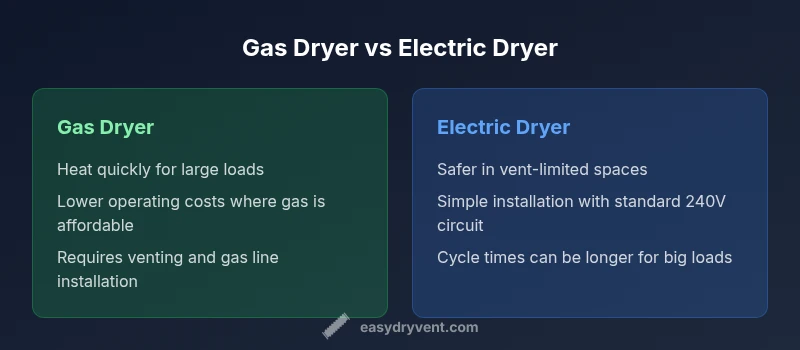
In households with steady access to natural gas and adequate venting, gas dryers can deliver quick turnaround and cost advantages for large families or frequent laundry cycles. For renters, condos, or homes without venting capacity, electric dryers offer straightforward installation and fewer constraints, making them a safer and simpler choice. Climate and electricity rates also influence decisions: in regions with high electricity prices or energy-efficient municipal programs, gas may present long-term savings. Conversely, in apartments or retrofits where vent installation is impractical, electric dryers frequently become the most feasible option. The key is to evaluate your space, energy pricing, and laundry habits before committing.
Choosing the Right Model: Practical Buyer's Guide
Start with your space constraints and energy setup. If you opt for gas, verify vent path integrity, ensure a proper gas line size, and plan for annual vent maintenance. For electric, confirm 240V circuit availability and workspace clearance. Compare drum sizes, cycle options, moisture sensors, and warranty terms across models rather than focusing solely on heat source. Consider interactive tools, user reviews, and energy guides provided by manufacturers to estimate long-term costs. A practical approach balances upfront costs with expected usage patterns, space feasibility, and the reliability of utility services in your neighborhood.
Common Myths Debunked
Myth 1: Gas dryers always cost less to operate than electric dryers. Truth: Operating costs depend on local energy prices and usage; in some markets electric may be cheaper. Myth 2: Gas dryers are unsafe due to combustion risks. Truth: When installed correctly with proper venting and regular maintenance, gas dryers can be safe; safety hinges on ventilation and professional service. Myth 3: Electric dryers are universally easier to install. Truth: Electric models can require significant venting or ducting in some homes; the simplest option varies by home configuration. Myth 4: You cannot use a gas dryer in a tight space. Truth: Proper venting and clearance can enable gas dryers in many spaces, though some layouts may limit feasibility.
Comparison
| Feature | Gas Dryer | Electric Dryer |
|---|---|---|
| Heat source | Gas burner and heat exchanger | Electric heating coils |
| Heat-up time | Typically faster for large loads | Typically slower for large loads |
| Installation & venting | Requires gas line and exterior vent | Requires 240V circuit and exterior vent |
| Operating costs (region-dependent) | Often lower with affordable gas pricing | Often higher or comparable depending on electricity rate |
| Maintenance | Vent cleaning and gas line inspections | Vent cleaning and regular parts checks |
| Best for | High-volume households with venting and gas access | Vent-constrained spaces or apartments; simpler installation |
The Good
- Faster drying times for large loads
- Potential energy cost savings where gas is inexpensive
- Strong performance in high-humidity spaces with proper venting
- Greater suitability for households with heavy laundry needs
Negatives
- Higher upfront cost for gas models
- Requires venting and a gas supply
- More complex maintenance and safety considerations
- Retrofit challenges in tight or retrofit spaces
Gas dryers are recommended for high-volume homes with reliable venting; electric dryers are preferred in vent-restricted spaces.
Choose gas if you have ready access to a gas line and a safe vent path for frequent, large loads. Choose electric if venting is limited, space is tight, or installation complexity is a concern.
Common Questions
What is the main advantage of a gas dryer over an electric dryer?
Gas dryers typically heat up faster and can shorten cycle times, especially for large or bulky loads. This can translate into shorter total drying time over the week. However, the advantage depends on local gas prices and proper venting.
Gas dryers heat faster and can save time on big loads, but you should consider venting and gas costs.
Do gas dryers require venting, and why is it important?
Yes. Gas dryers require venting to safely expel combustion byproducts and humidity. Poor venting can lead to buildup, mold, and fire risk. Proper vent sizing and regular cleaning are essential.
Gas dryers need venting to safely exhaust fumes and moisture; keep vents clean and up to code.
Are gas dryers more expensive to install than electric ones?
Gas dryer installation is typically more complex and may involve gas line work and venting modifications, which can add upfront costs. Electric installations usually require a dedicated circuit but are often simpler to install in many homes.
Gas installs are usually pricier upfront due to venting and gas line work.
Can I use a gas dryer in a rental or apartment?
Gas dryers can be installed in some apartments if the building allows gas lines and venting. Always check with management and ensure proper venting and gas safety compliance before purchase.
Gas dryers can work in some apartments if venting and gas access are allowed.
What maintenance is essential for gas dryers?
Regular vent cleaning, lint filter maintenance, and periodic gas line inspections are important. Have a professional inspect gas connections and vent paths annually to ensure safe operation.
Keep vents clean and have gas lines checked yearly.
Key Points
- Assess venting feasibility before choosing gas.
- Weigh local gas vs electricity costs for your usage pattern.
- Account for upfront installation costs in the total value.
- Gas excels with large or frequent loads.
- Electric wins in vent-constrained spaces and easier installation.