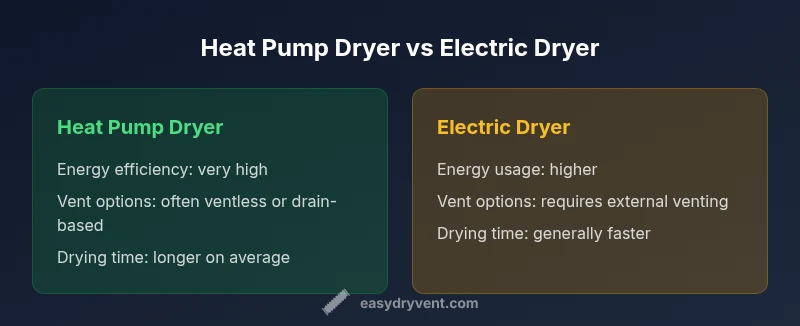
Heat Pump Dryer vs Electric Dryer: A Practical Comparison for Homeowners
Compare heat pump dryers vs electric dryers: energy efficiency, drying performance, costs, installation, and maintenance to help homeowners choose the best option in 2026.


In the heat pump dryer vs electric dryer comparison, heat pump models deliver superior energy efficiency and gentler drying, though cycles can be longer. This guide compares energy use, performance, installation, and total cost to help homeowners decide which option fits loads and budgets.
What matters in this comparison
According to Easy DryVent, when evaluating heat pump dryer vs electric dryer options, homeowners should weigh energy efficiency, drying performance, upfront cost, and long-term maintenance. This section explains the framework we use to compare models and how each factor shifts value depending on household needs. We begin with a plain English definition of how these two technologies work, then describe how the energy path affects your monthly bills and environmental footprint. The central trade-off most households face is energy intensity versus drying speed; heat pump designs trade some speed for efficiency, while traditional electric models prioritize rapid cycles at the cost of higher energy use. We also discuss installation considerations, such as venting requirements and space needs, which can influence long-term satisfaction and safety. Throughout, we’ll use neutral language and practical examples to help you map your loads, climate, and budget to a sensible choice. If you are sizing for a small apartment, a family with back-to-back laundry days, or a homes-with-dryer-vent limitations scenario, you’ll find guidance tailored to each case. The goal is not to sell one option over another, but to illuminate the practical differences so you can decide with confidence.
How electric dryers work
Electric dryers heat using electric elements that warm the drum air, then rely on a tumbling action and a vent system to remove moisture. This straightforward heating method delivers quick cycles, strong heat, and predictable performance, especially in climates with shorter outdoor humidity swings. In contrast to heat pump models, electric dryers generally create warm, dry air that circulates until clothes feel dry, then shut off. The simplicity of the design often translates into lower upfront costs and easy replacements. However, energy use is higher because heat must be produced anew in each cycle, and the air-warming process can waste energy through vented exhaust. We discuss variations across models, including sensor-based dry cycles that can reduce over-drying, and why some households still prefer traditional electric dryers for heavy loads or frequent daily laundry. Practical considerations include the layout of your laundry space, the efficiency ratings in your region, and the impact of dryer size on energy performance. Understanding how electric dryers operate lays the groundwork to compare them against heat pump options on more than price alone.
Energy efficiency and operating costs
Heat pump dryers operate using a closed-loop refrigerant cycle and a condenser to remove moisture from clothes, which dramatically reduces energy consumption over time compared with traditional electric dryers. The energy path is gentler on the energy bill, and the heat is reused rather than discarded as exhaust heat. Easy DryVent analysis shows that typical households can see meaningful energy efficiency gains when choosing a heat pump model, especially for households running multiple loads per week. However, the actual savings depend on factors such as cycle length, load size, and climate. Electric dryers, by contrast, deliver fast cycles but at higher energy rates per load. For households with limited dryer usage or infrequent loads, the energy savings may be more modest. When evaluating operating costs, consider your local electricity rates, climate, and how you schedule laundry to estimate total monthly costs and environmental impact over the appliance’s lifetime.
Drying performance and fabric care
Drying performance is not just about speed; it’s also about fabric care and moisture removal quality. Heat pump dryers typically operate at lower temperatures, which is gentler on fabrics and reduces wear over time. They often use sensors to optimize cycle length, balancing dryness with energy use. Some loads—like heavy towels or bulky blankets—may take longer to dry in a heat pump model, but the improvement in fabric longevity can offset the extra time for households prioritizing care and delicates. Electric dryers excel at quick cycles and are resilient for dense materials, but higher heat can cause more wear on fabrics and can lead to more slight over-drying without careful sensor use. When choosing between the two, map your typical laundry profile to these performance traits to predict real-world results.
Venting, condensation, and drainage considerations
A key practical distinction is venting and moisture management. Many heat pump dryers are condenser or heat-recovery units that do not require external venting, instead condensing moisture and draining or collecting water. This can simplify installation in spaces without a vent duct and offers more flexible placement. Electric dryers generally rely on exhaust venting to the outdoors, which can require proper ductwork and regular vent cleaning to prevent lint buildup and fire risk. If you live in a small apartment or an older home with limited venting options, a ventless heat pump model can be especially advantageous. Always verify the specific model’s venting requirements and drainage options before purchasing, because installation complexity and maintenance needs can vary by design and manufacturer.
Installation, space, and maintenance considerations
Space requirements, noise, and accessibility influence long-term satisfaction. Heat pump dryers often occupy similar floor space to electric models but may require a condensate drain or water reservoir. Stacking or side-by-side installations are common, with some units offering reversible doors for tight laundry rooms. Maintenance for heat pump dryers focuses on keeping the condenser and lint filters clean, and periodic drainage checks may be needed if the unit uses a drain connection. Electric dryers require vent inspections and occasional duct-cleaning, which can add to maintenance tasks but is straightforward with a routine schedule. In both cases, confirm that the electrical supply matches the model’s requirements and that the installation location provides the necessary clearance for airflow and access for servicing.
Real-world usage scenarios and load management
Consider how your household patterns affect the decision. A busy family with back-to-back laundry cycles may benefit from the faster cycles of electric dryers, especially if time is a premium. A household prioritizing energy efficiency, especially where electricity rates are high or where venting is impractical, might find heat pump dryers to be more cost-effective over the appliance lifetime. In single-person or couple households with lighter weekly loads, the energy savings of a heat pump dryer may still be substantial, but the marginal benefit could be smaller if loads are infrequent. Use a simple load calculator to compare expected energy use and costs for your typical weekly schedule across both technologies.
Cost considerations and buying guidance
Upfront costs for heat pump dryers are typically higher than for standard electric models, reflecting the more complex refrigeration-based technology. Over the appliance lifetime, the reduced energy consumption can offset the higher purchase price, particularly in homes with high electricity rates or frequent laundry. When evaluating options, consider total cost of ownership: purchase price, energy cost, maintenance, potential venting upgrades, and expected replacement cycles. Look for energy efficiency ratings, warranty length, and service network availability in your region. If you’re unsure, prioritize models with good condenser cleanliness access, robust lint-filter design, and reliable sensor technology to maximize efficiency and performance. Balance upfront expense against long-term savings to determine the best fit for your household.
Common myths and clarifications
Myth 1: Heat pump dryers dry clothes faster than electric dryers. Reality: They typically run longer cycles to achieve the same dryness level, but with lower energy use and gentler fabric handling. Myth 2: Heat pump dryers always require venting. Reality: Many models are condenser types that don’t need external vents, though some configurations may still use venting. Myth 3: Electric dryers are always cheaper upfront. Reality: While initial cost can be lower, total ownership costs may be higher due to energy consumption and maintenance.
Summary: how to choose in 2026
If your priority is long-term energy savings, flexible installation, and fabric care, a heat pump dryer is a solid choice, especially in homes with limited venting options. If upfront cost and fastest cycle times are crucial for your schedule or budget, an electric dryer remains a strong option. Use your load profile, budget, and space constraints to guide the final decision, and consider a model with strong sensors and easy maintenance features to maximize value.
Comparison
| Feature | Heat pump dryer | Electric dryer |
|---|---|---|
| Energy efficiency | Very high efficiency due to refrigerant cycle and condenser | Moderate efficiency; relies on electric coils |
| Drying time | Typically longer cycles for similar loads | Typically shorter cycles |
| Ventilation/venting | Often ventless or requiring drainage; flexible installation | Requires external venting to the outside |
| Maintenance | Condenser cleaning and filter care; periodic drainage | Lint filter cleaning and vent checks; occasional duct cleaning |
| Upfront cost | Higher upfront cost | Lower upfront cost |
| Best for | Households prioritizing energy savings and flexible installation | Budget-conscious buyers needing fast cycles |
The Good
- Energy efficiency can reduce operating costs over time
- Gentler drying preserves fabrics longer
- Flexible installation options (ventless or venting)
Negatives
- Higher upfront purchase price
- Longer cycle times for some loads
- Potential maintenance needs (condenser cleaning)
Heat pump dryer is generally the better long-term value for energy-conscious homes; electric dryers win on upfront cost and fastest cycles
Choose heat pump if you want energy savings and flexible installation. Choose electric dryer if upfront cost and drying speed matter more.
Common Questions
What is a heat pump dryer and how does it differ from a traditional electric dryer?
A heat pump dryer uses a refrigerant cycle and condenser to recycle heat, making it more energy-efficient than a conventional electric dryer. It cools and reuses air to dry clothes, often with no external vent needed. Expect longer cycle times but lower energy costs over time.
Heat pump dryers save energy and heat clothes gently, but you may wait longer for loads to finish.
Do heat pump dryers require outside venting?
Most heat pump models are condenser dryers that do not require external venting. They condense moisture internally and drain it, which can simplify installation in spaces without a vent. Some configurations may still vent in certain models, so check the spec sheet.
Most heat pump dryers don’t need an exterior vent, but always verify the model’s venting options.
Are heat pump dryers slower than traditional electric models?
Yes, heat pump dryers often run longer cycles to achieve the same dryness level, but they use substantially less energy and are gentler on fabrics. For users who prioritize speed over energy savings, electric dryers may feel more convenient.
They save energy but can take longer to dry the same load.
Is the upfront cost worth it for heat pump dryers?
The decision depends on usage and energy prices. If you run many loads weekly and electricity is expensive in your area, heat pump models can pay back the higher purchase price over time. For light usage, electric dryers may be more economical initially.
If you run lots of loads and electricity is costly, heat pumps can pay off over time.
What maintenance do heat pump dryers require?
Maintenance centers on keeping the condenser clean, checking the drainage or water-reservoir, and cleaning lint filters regularly. Occasional checks for clogs help maintain efficiency. Routine maintenance is generally straightforward.
Keep the condenser clean and lint filters clear for best efficiency.
Which saves more energy overall, heat pump or electric?
Heat pump dryers typically save more energy over the appliance’s life due to their efficient heat reuse. Actual savings depend on load size, cycle choices, and local energy costs.
Heat pumps usually save more energy, but results depend on usage and climate.
Key Points
- Prioritize energy savings with heat pump models
- Expect longer cycles with heat pumps but lower energy use
- Ventless options offer flexible installations
- Upfront cost is higher for heat pump dryers
- Maintenance focuses on condensers and filters