Condenser vs Heat Pump Dryers: Are They the Same?
A thorough, objective comparison of condenser and heat pump dryers—how they work, energy use, upfront costs, maintenance, and long-term value to help homeowners choose wisely.


Condenser and heat pump dryers are not the same. A condenser dryer uses a simple heat source to evaporate moisture and vents the resulting water away, while a heat pump dryer recycles heat in a closed loop to dry clothes more efficiently. For most homes, the choice hinges on energy use, upfront cost, space, and long-term maintenance.
Is a condenser dryer the same as a heat pump? How they work
Is a condenser dryer the same as a heat pump? Not exactly. Condenser dryers use a heating element to warm air that passes through wet clothes. The air cools, releasing moisture into a tank or drain, and the dried air recirculates for another cycle. Heat pump models, by contrast, run a sealed refrigerant loop that transfers heat from the incoming air to the outgoing air, effectively reusing most of the warmth. This fundamental efficiency difference is what drives their practical performance, maintenance needs, and long-term costs. According to Easy DryVent, the underlying physics are straightforward: heat pumps maximize heat recovery, reducing energy drawn from your supply, while condenser dryers lean on a straightforward heat source and venting process. In real homes, this translates to noticeably different energy profiles, longer-term savings, and potential installation considerations depending on your space and climate.
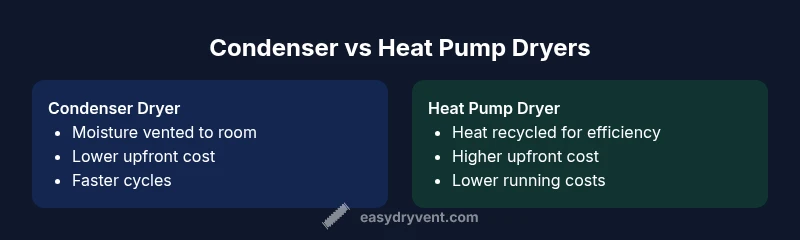
- The condenser approach is typically simpler and cheaper upfront, but it exhausts heat and moisture, making it less energy-efficient over time.
- The heat pump approach is more complex but reuses heat, offering superior efficiency and lower running costs in many scenarios.
- Your decision should weigh climate, load size, and how much you value short-term price versus long-term energy bills.
This section lays the groundwork for a practical comparison. The Easy DryVent team emphasizes that while both dryer types remove moisture from laundry, the way they handle heat and moisture is the core differentiator—one that shapes performance, noise, footprint, and service needs.
idk_like_field_should_keep_to_schema_only_if_needed
Would you like a comparison chart?
Comparison
| Feature | Condenser dryer | Heat pump dryer |
|---|---|---|
| Energy efficiency | Lower efficiency (higher running costs) | Higher efficiency (lower running costs) |
| Drying time | Typically faster cycles | Often longer cycles due to heat recycling |
| Initial cost | Lower upfront cost | Higher upfront cost |
| Running cost | Higher energy use per cycle | Lower energy use per cycle |
| Vent/installation | Vents moisture to room (no special venting needed for indoor spaces) | Sealed system with no heat exhaust to room (requires proper air circuit) |
The Good
- Condenser: cheaper upfront; simpler installation
- Heat pump: lower running costs over time; better for energy-conscious homes
- Heat pump: gentler on clothes due to lower drying temperatures
Negatives
- Condenser: higher ongoing energy costs; more heat released into the room
- Heat pump: higher upfront cost and potential maintenance sensitivity
- Heat pump: may require more space and ventilation considerations in tight setups
Heat pump dryers are generally more energy-efficient over the long term, but condenser models can be more budget-friendly upfront.
Choose heat pump if you want lower running costs and better long-term value. Choose condenser if upfront cost and installation simplicity matter more, and you have appropriate space for venting.
Common Questions
Are condenser dryers cheaper to buy than heat pump models?
Yes, condenser dryers typically cost less to purchase than heat pump models. However, the cheaper upfront price often comes with higher running costs over the dryer’s lifetime. When evaluating value, balance your initial budget with anticipated energy use and maintenance.
Condenser dryers usually cost less upfront, but you’ll likely pay more in energy over time.
Do condenser dryers require special venting?
Condenser dryers do not require external venting because they collect moisture in a reservoir or drain. This can simplify installation in spaces without an outside wall. Heat pump models, on the other hand, do not vent warm air to the outside either, but their higher efficiency depends on a well-sealed system.
Condenser dryers don’t need external venting, which can simplify placement.
Which dries faster, condenser or heat pump?
Condenser dryers often complete cycles faster due to higher heat input. Heat pump models may take longer per cycle, but they use gentler heat and recycle energy, which lowers running costs. For someone who prioritizes speed, condenser models can be preferable.
Condenser dryers usually finish quicker, while heat pumps save energy over time.
Can a condenser dryer be converted to a heat pump model?
Conversion is not practical; condenser and heat pump dryers rely on fundamentally different heat exchange systems. If you’re upgrading, plan for a new unit rather than a retrofit. This is usually a consideration when replacing an aging unit.
Conversion isn’t practical; you’d replace the unit rather than retrofit.
What maintenance do these dryers require?
Both types require regular lint filter cleaning and occasional vent checks. Heat pump models may need periodic checks of refrigerant lines and seals. Following manufacturer guidelines helps maintain efficiency and safety.
Regular lint removal and periodic system checks keep both types running well.
Key Points
- Evaluate energy use over time, not just upfront cost
- Assess your space for venting needs or tight spaces
- Consider climate and typical laundry loads when choosing
- Expect longer running cycles with heat pumps in some cases
- Factor maintenance needs into total cost of ownership