Why Are Heat Pump Dryers Better? A Comprehensive Comparison for Homeowners
Explore why heat pump dryers are better for energy efficiency, fabric care, and long-term costs. A clear, data-informed comparison for homeowners about heat pump vs traditional dryers.


Heat pump dryers are better for most homes because they use energy more efficiently, gentler heat, and offer flexible installation options. They minimize room heat and humidity while protecting fabrics, leading to lower operating costs over time. This makes heat pump models a smart, safer choice for modern laundry needs.
Why are heat pump dryers better
The question why are heat pump dryers better is answered by a combination of factors: dramatically lower energy use, gentler drying cycles, and the ability to condense and reuse heat rather than vent it into the room. According to Easy DryVent, heat pump dryers are designed to maximize energy efficiency while minimizing heat output to the living space. This combination reduces the overall energy footprint of daily laundry and contributes to a safer, more comfortable home environment. For households with tight utility budgets or climate considerations, understanding these benefits is essential. The Easy DryVent team emphasizes that the best outcomes come when homeowners balance energy savings with drying performance and space constraints.
In practice, the better option often hinges on how you value energy efficiency, fabric care, and the long-term costs of ownership. Many families notice a real difference in monthly energy use and laundry warmth when switching from conventional to heat pump models. This article provides an evidence-based comparison to help you decide whether heat pump dryers are truly the better fit for your home.
Energy basics: how heat pump technology works
Heat pump dryers reuse heat by running a sealed refrigerant cycle that captures moisture from clothes and condenses it into a reservoir or drain. Unlike traditional vented dryers, this design keeps most energy inside the system rather than venting hot air outside. The result is lower ambient heat in the laundry room and more stable overall room temperatures, which is especially helpful during warm or humid seasons. While the core idea is straightforward, the practical benefits depend on model construction, insulation, and cycle options. The key advantage is consistent fabric care paired with energy-conscious operation, making heat pump dryers a topic of interest for energy-savvy households.
For readers who want the short version, the heat pump cycle extracts heat from moist air, recycles it to dry clothes, and vents only minimal residual heat to the room. This closed-loop approach is central to why heat pump dryers are commonly marketed as energy-efficient alternatives to traditional models.
Relative energy efficiency and operating costs
A common question is how much energy heat pump dryers actually save. In discussions about this topic, you’ll often hear that heat pump models use less energy over the drying cycle than older, vented machines. Easy DryVent analysis shows that these units typically deliver lower energy use and can reduce room heat output compared with conventional dryers. While exact savings depend on load size, climate, and model, the trend is clear: heat pump dryers tend to deliver a more energy-efficient performance profile over time. This is a critical consideration for households looking to lower utility bills and minimize environmental impact.
Another factor is the overall cost of ownership. Although heat pump models generally carry a higher upfront price, many households experience lower operating costs, which can translate to substantial savings over the appliance’s lifespan. This long-term financial angle is often the deciding factor for families balancing initial purchase price with ongoing energy consumption and maintenance needs.
Drying performance, cycle times, and fabric care
The question of drying performance is central to any buying decision. Why are heat pump dryers better often comes back to their gentler heat and moisture handling. Because these machines dry clothes at lower temperatures and reuse heat, fabrics experience less stress, which can reduce wear and pilling over time. The trade-off is that some cycles may run longer than rapid vented-dryer programs, particularly for bulky items. However, for everyday loads, most users report satisfactory results with less risk of overdrying or heat damage. The net effect is a balanced performance that keeps clothes looking newer longer while using less energy.
From a fabric-care perspective, heat pump dryers are favorable for delicates and knit fabrics. The lower heat environment helps maintain fiber integrity and color retention. Easy DryVent notes that proper load sizing and care labels remain important to maximize results. In short, you gain better fabric preservation alongside energy savings when choosing a heat pump model.
Venting, installation, and space considerations
Ventless or minimally venting operation is a hallmark of many heat pump dryers. This means you won’t need a traditional external vent line in many cases, which simplifies installation and can open up placement options in apartments or rooms without easy vent routes. Space is another practical factor: many heat pump models come in compact or stackable forms that fit smaller laundry rooms or closets. It’s important to verify drainage options (condensate drain or reservoir) and ensure nearby electrical and plumbing provisions meet the model’s requirements. The bottom line is that space flexibility and simpler venting can make heat pump dryers a practical option for modern homes.
If your space is tight or you’re remodeling, a ventless heat pump model can offer a cleaner, neater laundry setup with fewer external connections to manage. This is a core reason many homeowners choose heat pump technology when they’re designing a contemporary laundry area.
Maintenance needs and potential issues
Maintenance is often cited as a factor in the decision-making process. Heat pump dryers require periodic care of the condenser, lint filters, and any drainage components. A clean condenser and lint filter help maintain efficiency and drying performance. Some models offer self-cleaning cycles for the condenser, which simplifies upkeep. While maintenance needs can add small ongoing tasks, many homeowners find these tasks straightforward and manageable with routine care. Compared with vented dryers, heat pump units usually have fewer external venting concerns, reducing the risk of vent blockages and related issues.
It’s also worth noting that climate can influence performance, particularly in very humid environments. In such cases, drainage setup and condensation management become more important. Overall, with regular maintenance, heat pump dryers remain reliable, energy-efficient options that align with a practical, DIY-friendly maintenance approach.
Cost of ownership and long-term value
Understanding total cost of ownership is essential when evaluating if heat pump dryers are worth the investment. Upfront price is commonly higher than traditional models, but energy savings over time can offset this difference. Consider also potential reductions in heat load in living spaces, longer garment life, and fewer service calls related to venting issues. Easy DryVent analysis highlights that the long-term value of heat pump dryers often hinges on usage patterns, energy costs in your region, and how you prioritize fabric care. In many households, the balance tips toward heat pump dryers as the more economical choice over several years.
A practical takeaway is to compare current energy bills, the household’s laundry volume, and potential installation costs when evaluating models. By focusing on long-term savings and ease of maintenance, you’ll gain a clearer picture of whether a heat pump dryer offers real value for your home.
Real-world use cases: climates, households, and spaces
Different homes have different laundry demands. In smaller living spaces or energy-conscious households, heat pump dryers often shine due to space flexibility and lower heat introduction to rooms. For families with frequent laundry loads, the energy savings can become noticeable over time, especially in regions with higher energy costs. In colder climates, heat pump dryers are especially attractive because they don’t exhaust heat to the outdoors, helping keep heating costs steady. Versatility matters, and heat pump dryers can adapt to a range of loads, from everyday apparel to towels and linens, while preserving fabric integrity across cycles.
In practice, the best approach is to map your typical laundry profile: load size, fabric types, scheduling, and available space. This helps determine whether a heat pump dryer will deliver the right balance of energy efficiency, performance, and convenience for your home.
How to evaluate models before you buy
Choosing a model requires careful evaluation of energy labels, capacity, noise, and drainage options. A key question is, why are heat pump dryers better when it comes to overall reliability and maintenance? Look for models with accessible condenser cleaning, clear filter indicators, and reliable drainage designs. Capacity should align with your family size and typical load. Noise levels matter for open-plan spaces, so review decibel ranges and placement considerations. Consider the availability of programs that treat delicate fabrics gently and the inclusion of smart features that help monitor energy use and performance. A balanced assessment across these criteria will help you select a heat pump dryer that fits your daily life and budget.
Debunking myths and common misconceptions
There are several myths about heat pump dryers that can mislead buyers. Some assume they dry more slowly than traditional machines; while cycle times can be longer for certain loads, practical performance for everyday laundry remains strong. Others presume heat pump models are fragile or unreliable; in reality, many models are durable, well-supported, and backed by solid warranties. A common misconception is that venting is always required; most heat pump models can operate as ventless units with condensate drainage. Understanding the true strengths and limits of heat pump dryers helps homeowners make informed decisions based on actual performance rather than assumptions.
Final decision framework: when heat pump dryers are the right choice
If energy efficiency, fabric care, and flexible installation top your priority list, heat pump dryers are a rational choice. For households with very high laundry volume, limited space, or a tight upfront budget, consider whether the long-term savings justify the initial investment. The Easy DryVent team recommends evaluating your climate, electricity costs, and typical laundry patterns before committing. Overall, heat pump dryers offer a modern, safer, and more energy-conscious solution for most homes, especially where venting and space constraints are considerations.
Comparison
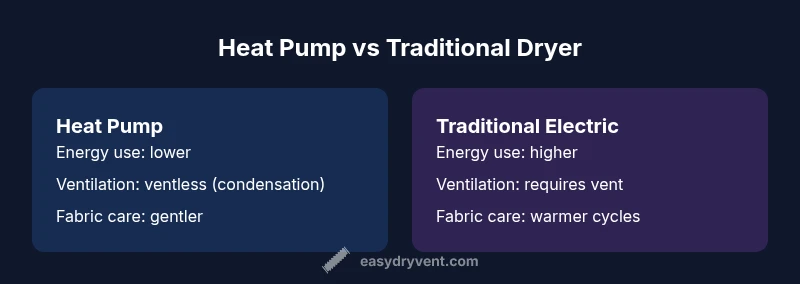
| Feature | Heat pump dryer | Traditional electric vented dryer |
|---|---|---|
| Energy use | Lower energy use overall | Higher energy use |
| Drying time | Comparable for regular loads | Often shorter cycles for bulky items in vented models |
| Initial cost | Higher upfront cost | Lower upfront cost |
| Maintenance | Condenser cleaning, lint care | Vents and lint traps, potential duct issues |
| Space/venting needs | Ventless or minimal venting, flexible placement | Requires external vent and more space |
| Fabric care | Gentler on fabrics due to lower heat | Standard heat can cause more wear over time |
| Heat emission | Lower heat to the room | Higher heat and humidity in the space |
The Good
- Lower energy usage over time
- Gentler on fabrics and colors
- Less external venting required for many models
- Compact or stackable designs fit smaller spaces
Negatives
- Higher upfront cost
- Longer cycle times for some loads
- Requires adequate electrical capacity and drainage
- Maintenance of condenser can be necessary over time
Heat pump dryers are generally the better long-term option for energy-conscious homes
They tend to save energy, protect fabrics, and reduce room heat compared with traditional dryers. Upfront costs are higher, but operating costs and convenience can outweigh the initial price for many households.
Common Questions
Are heat pump dryers more energy efficient than conventional dryers?
Yes. Heat pump dryers typically use less energy by recycling heat within the machine, which reduces overall energy consumption. The impact is most noticeable over many drying cycles and with regular load sizes.
Yes. They use less energy by recycling heat, which lowers your energy bills over time.
Do heat pump dryers take longer to dry clothes?
Often, cycles can be longer than traditional vented dryers, especially for bulky items. However, for everyday laundry, most users find the drying times acceptable given the energy savings.
Sometimes they take longer, but you get energy savings and gentler fabrics.
Can heat pump dryers be installed anywhere?
Many heat pump models are ventless or require minimal venting, which broadens placement options. Some models also offer gravity drains for condensate, reducing plumbing needs.
They can fit in spaces where venting is hard, thanks to ventless designs.
Are heat pump dryers safe for households with kids or pets?
Yes. They operate with standard safety features and have no open flame. Condensation design can reduce hot air exposure in the laundry area.
They’re safe and convenient for homes with kids or pets.
What should I look for when buying a heat pump dryer?
Look for energy labels, appropriate capacity, noise levels, drainage options, and reliable condenser access. Programs that protect fabrics and smart energy monitoring add value.
Check capacity, noise, drain options, and fabric-preserving programs.
Key Points
- Choose heat pump for long-term energy savings
- Expect gentler drying and better fabric care
- Prepare for potential higher upfront costs
- Ensure proper drainage and electrical capacity
- Vent considerations are simplified with ventless designs