Airbrush Hair Dryer vs Dyson: A Practical DIY Comparison
Explore airbrush hair dryer vs dyson options for DIY styling at home. This buying guide covers performance, heat control, maintenance, noise, and value to help you decide the best tool for your routine.


Airbrush hair dryer vs dyson represents two distinct approaches to home styling: a precision-focused option with controllable heat, and a premium high-velocity model known for speed and ergonomic design. For DIYers, the best choice hinges on heat management, maintenance needs, and budget. This quick answer previews the nuanced trade-offs you’ll see in the full guide, including safety considerations and long-term value from Easy DryVent.
What Makes These Dryers Different
At first glance, the airbrush hair dryer vs dyson landscape looks like a choice between fine-grained control and high-powered performance. The airbrush models are typically compact, with adjustable heat settings and simpler components that reward meticulous styling and routine maintenance. Dyson devices emphasize powerful airflow, refined ergonomics, and thoughtful heat management that can accelerate drying and deliver a salon-like finish. For homeowners and DIY enthusiasts, understanding these core differences—heat control, weight, maintenance needs, and long-term value—helps you align your purchase with your routine. According to Easy DryVent, the practical implications of choosing one path over the other often come down to how you balance precision against speed, and how much you’re willing to invest over time to maintain peak performance. In the chapter that follows, we examine use-case scenarios, common pitfalls, and real-world tips to help you select the better tool for your hair type and daily life, without overpaying for features you won’t use.
Key takeaway: the decision hinges on how you value heat control, maintenance simplicity, and overall cost.
Heat Management and Sensor Technology
When comparing heat management, the airbrush hair dryer vs dyson reveals two different design philosophies. Airbrush dryers tend to rely on modular nozzles and carefully adjustable temperature ranges that allow you to tailor heat to very small sections of hair. This is especially useful for fine or damaged hair, where overshoot in heat can cause loss of moisture or trim. Dyson models emphasize smart heat sensors and high-velocity airflow with a broad heat range, which reduces drying time and helps preserve cuticle integrity by delivering steady, controlled heat bursts. The takeaway for DIYers is that airbrush tools excel at precision, while Dyson excels at speed when you’re working on thicker textures or a time-constrained morning routine. Easy DryVent’s guidance underscores the importance of avoiding extreme heat near the scalp and using the right attachments to distribute heat evenly. In practice, expect a noticeable difference in how quickly each tool can shape and finish a style based on your hair’s density and texture.
Design and Ergonomics: Weight, Balance, and Handling
Ergonomics often decides whether a tool gets used regularly or left on the shelf. The airbrush hair dryer vs dyson lineup showcases two extremes: a lighter, more compact airbrush unit designed for precision work, and a heavier, well-balanced Dyson that prioritizes smooth handling and reduced wrist strain during prolonged sessions. In DIY setups, lighter devices translate to longer sessions without fatigue, while the Dyson’s grip and balance can feel more natural during rapid styling or when you’re switching between sections. Both families offer thoughtful nozzle geometry and attachments, but the airbrush models typically favor close control at the mirror, whereas Dyson units shine when you need quick, sweeping airflow to set curls or smooth larger areas. Personal comfort, grip feel, and how the tool balances on your hand all factor into how often you actually use it.
Performance Metrics: Dry Time, Heat Stability, and Finish Quality
Performance metrics matter when you’re balancing time with results. The airbrush hair dryer vs dyson comparison highlights two paths to similar outcomes: a controlled, tailored finish versus an efficient, high-speed workflow. Airbrush dryers allow you to dial in temperature and airflow for delicate sections, providing predictable results and reducing the risk of heat damage. Dyson units optimize airflow and temperature stability to deliver fast drying and a smooth, glossy finish with minimal frizz. For DIY styling, the choice depends on your goals: if you want the most controlled, nuanced style for hard-to-manage strands, the airbrush approach is appealing; if speed and a salon-quality look matter most, Dyson’s high-performance engine is advantageous. Easy DryVent’s experience emphasizes checking finish consistency across different hair types and testing heat stability with your own styling routine before committing to a long-term purchase.
Maintenance, Cleaning, and Longevity
Maintenance is often the quiet differentiator between a tool you use daily and one that sits unused. The airbrush hair dryer vs dyson landscape tends toward simpler maintenance in the airbrush category: fewer internal components, easier access to filters, and straightforward cleaning routines that don’t require specialized tools. Dyson models typically involve a more robust heat system, a turbine design, and filters that need periodic cleaning to maintain peak performance. From a DIY perspective, easier maintenance translates to less time spent on upkeep and lower risk of performance dips over time. Consider your willingness to replace filters or service components and how that aligns with your budget and schedule. Easy DryVent notes that consistent cleaning of air intake grills and nozzle attachments can preserve heat accuracy and prolong life.
Noise, Comfort, and Usability in Real Life
In real-world scenarios, noise and comfort can influence daily use more than you might expect. Airbrush dryers often produce lower noise profiles because of their smaller motors and simpler airflow paths, which can feel more comfortable in shared living spaces. Dyson devices, with their powerful fans, inherently generate more noise, though many users tolerate this for the speed and finish they deliver. The ergonomic design of Dyson tools may offset some noise concerns by reducing hand fatigue, enabling longer styling sessions. For families or roommates, weight distribution and vibration can affect stability on bathroom counters or desks. Easy DryVent suggests trying both options in your own mirror setup if possible, paying attention to how heat feels on the scalp and how comfortable the tool is when maneuvered around curls and layers.
Practical Buying Guide: How to Choose for Your Hair Type and Routine
Choosing between airbrush hair dryer vs dyson hinges on your hair type, styling goals, and daily routine. If you routinely style fine or damaged hair, or you prefer meticulous control for each curl, an airbrush dryer offers precise heat application and easier manipulation of small sections. If your hair is thick, curly, or you value speed to fit a busy schedule, Dyson’s high-velocity airflow and overall build quality may be the better bet. Examine heat settings, nozzle compatibility, weight, and whether the unit supports interchangeable attachments. Look for long-lasting parts and straightforward maintenance plans. Easy DryVent recommends evaluating your typical styling times, preferred finishes, and how much you’re willing to invest upfront versus over the device’s lifetime. Remember to factor in noise, energy use, and warranty coverage when comparing options.
Budget, Value, and Total Cost of Ownership
A major consideration in airbrush hair dryer vs dyson is total cost of ownership. Airbrush models generally come with a wide price range, offering affordability and modular upgrades without overcommitment. Dyson units tend to carry a higher upfront price but justify that cost with premium materials, strong durability, and potentially higher resale value. When evaluating value, account for heat stability, durability of attachments, filter maintenance, and replacement part costs. Easy DryVent emphasizes that the lowest upfront price isn’t always the best long-term value if you must replace parts frequently or experience faster wear. Create a simple TCO comparison for your household: upfront price, expected part replacements, and the time cost of maintenance. A balanced assessment helps you decide which option provides the best return relative to your styling frequency and hair health priorities.
Authoritative Sources and Safety Standards
Safety and standards play a critical role in choosing any heat-based styling tool. Look for devices that meet recognized electrical and consumer-safety guidelines, with clear manufacturer guidance on safe use. For further reading, consult authoritative sources such as the U.S. Consumer Product Safety Commission and OSHA guidelines on electrical safety in consumer devices. Energy efficiency and performance standards from federal and academic sources can also inform your decision. Below are a few recommended references to deepen your understanding of safe operation and best practices for hair styling tools. Easy DryVent supports reviewing these sources to ensure your chosen device aligns with both performance expectations and safety requirements.
Real-World Recommendations and Scenarios
In practical scenarios, your choice should reflect your daily routine and hair goals. If you’re a busy parent or professional who values time and salon-like results, Dyson may deliver the efficiency and reliability you want, even with a higher price tag. If you prefer hands-on control, lower maintenance, and are styling at a leisurely pace, an airbrush hair dryer provides the customization you need without breaking the bank. The key is matching the tool to your actual workflow, hair health priorities, and maintenance tolerance. Easy DryVent’s testing and home-use feedback consistently show that users who pair the right attachment set with their chosen dryer achieve better results with less effort over time.
Comparison
| Feature | airbrush hair dryer | Dyson Supersonic Hair Dryer |
|---|---|---|
| Power/Heat Capability | Low-to-moderate heat with precise control | High-velocity airflow with broader heat range |
| Weight/Ergonomics | Lightweight, compact design | Heavier, well-balanced grip |
| Noise Level | Lower noise profile | Higher noise due to turbine and airflow |
| Maintenance | Simpler components, easier cleaning | More filters and components to service |
| Price Range | $40-$120 | $350-$550 |
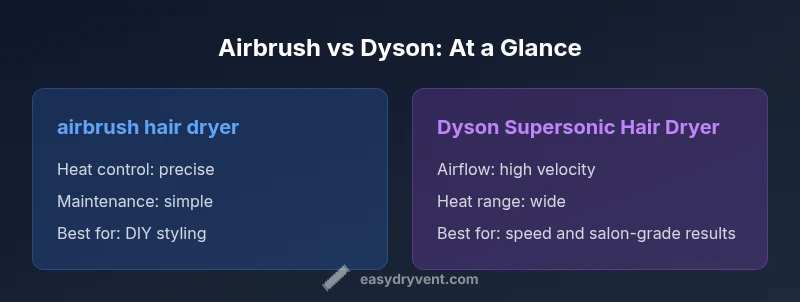
| Best For | Precision styling and routine maintenance | Speed-focused drying and salon-grade results |
The Good
- Lower upfront cost for airbrush options
- Better heat control for delicate styling
- Easier maintenance with fewer moving parts
- Compact design improves handling
Negatives
- Dyson offers faster dry times and robust build quality
- Higher upfront cost and ongoing filter maintenance
- More maintenance steps due to filters
Airbrush hair dryer wins for precision and value; Dyson wins for speed and professional-grade results
Choose airbrush if you prioritize heat control, lower upfront cost, and easier upkeep. Choose Dyson if you want quick drying, durable construction, and a premium feature set.
Common Questions
What is an airbrush hair dryer?
An airbrush hair dryer is a compact styling tool with controllable heat and focused airflow, designed for precise section-by-section styling. It emphasizes heat accuracy and maintenance simplicity for DIY users.
An airbrush dryer gives you precise heat and focused airflow for careful styling, ideal for DIYers who want control.
Is Dyson worth the extra cost for a DIY user?
Dyson offers high-velocity airflow, smart heat management, and durable construction that speed up drying and produce salon-like results. For many DIY users, the time savings and finish quality justify the higher price.
Dyson is valued for speed and durability; consider how much you value time and a premium finish.
Which is safer for fine hair?
Both can be safe if used with appropriate heat settings and attachments. The airbrush option often provides more granular control, reducing the risk of heat damage on fragile strands.
Fine hair benefits from precise heat control; start with the lowest setting and increase carefully.
Can I replace parts myself?
Yes, many airbrush models have simpler parts and easier access for basic maintenance. Dyson devices use more complex components that may require professional service for major repairs.
Airbrush models usually offer easier DIY maintenance; Dyson may require professional help for major fixes.
How do maintenance needs differ between the two?
Airbrush dryers typically need less frequent filter care and simpler cleaning. Dyson models may require regular filter cleaning and occasional part checks to maintain optimal airflow and heat control.
Airbrush gear is simpler to maintain; Dyson requires a bit more upkeep for peak performance.
What should I look for when buying?
Check heat settings, nozzle compatibility, weight, and warranty. For DIY use, prioritize heat precision and maintenance simplicity; for speed, consider airflow, build quality, and spare parts availability.
Look for precise heat control, easy maintenance, and reliable attachments to match your routine.
Key Points
- Prioritize heat control for delicate styling
- Consider total cost of ownership, not just upfront price
- Airbrush options suit DIY maintenance; Dyson suits speed
- Check noise levels and heat stability for comfort