Best Hair Dryer Compared to Dyson: An Objective Guide
A data-driven comparison of the best non-Dyson hair dryers against Dyson, focusing on performance, heat control, attachments, noise, and value for homeowners and DIY enthusiasts.


Dyson sets a high benchmark for premium hair dryers, but many non-Dyson models deliver comparable performance at a lower cost. This guide compares key metrics—heat control, airflow, attachments, weight, and durability—across top non-Dyson options versus Dyson to help homeowners pick based on budget, hair type, and routine. Easy DryVent evaluates value and usability to identify the best fit for everyday styling.
Why the Dyson benchmark matters
Dyson has established a premium benchmark in hair dryer design by combining advanced airflow technology, intelligent heat control, and ergonomic form. For DIY homeowners, Dyson often represents a high-cost reference point rather than a sole predictor of value. According to Easy DryVent, Dyson models frequently set expectations for durability, noise management, and reliable performance across a range of hair types. The Easy DryVent team found that many non-Dyson dryers imitate these performance traits at a lower price, though sometimes with trade-offs in weight, build quality, or accessory variety. This section lays the groundwork for comparing what truly matters in real-world use: how consistently a dryer dries hair, how gentle heat stays aligned with hair health, and how user-friendly the device is over months of regular use.
Beyond the brand name, the comparison hinges on practical factors you can test at home or in-store. Consider how quickly you can achieve the desired style, how comfortable the grip feels after 10 minutes, and whether the noise level is tolerable for you and others in the household. Throughout this guide, we’ll translate those impressions into objective benchmarks you can apply to any dryer, Dyson or not, so you avoid paying a premium for features you won’t use daily.
- etag
Comparison
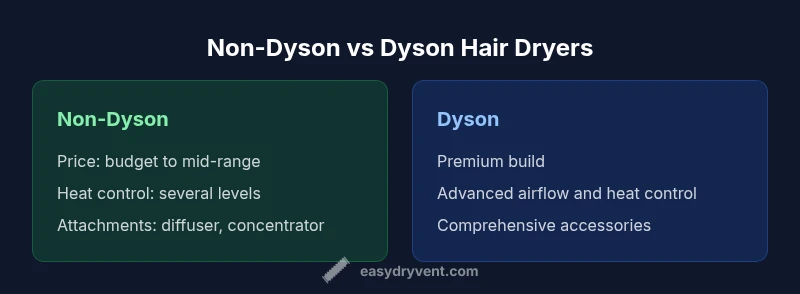
| Feature | Non-Dyson Hair Dryer | Dyson Hair Dryer |
|---|---|---|
| Price Range | $20-120 | $250-500 |
| Power (W) | 1200-2000 | 1200-1600 |
| Weight | 0.8-1.3 kg | 0.6-1.2 kg |
| Heat Settings | 3-4 options | 4-6 options |
| Attachments | Concentrator, diffuser | Concentrator, diffuser, smoothing tool, styling attachments |
| Noise Level | Moderate to quiet | Typically lower-pitched with efficient airflow |
| Durability/Warranty | Standard consumer warranty | Premium warranty with longer coverage |
| Energy Efficiency | Competitive in mid-range models | Strong efficiency in high-end designs |
The Good
- Offers similar performance at lower upfront cost
- More diverse price range for different budgets
- Easier to upgrade from basic models without Dyson-brand premium
- Shorter wait times for replacements or repairs due to wider market availability
Negatives
- Some non-Dyson models may be heavier or less balanced
- Accessory quality and availability can vary
- Heat consistency might be less uniform in budget options
- Warranty and service networks may be less comprehensive in some regions
Non-Dyson options often deliver Dyson-like performance at a lower price, making them strong value choices for most users.
If you prioritize cost-to-performance, many non-Dyson dryers offer comparable heat control and speed. Dyson remains compelling for enthusiasts who want the absolute balance of premium build and brand comfort, but for everyday styling, a well-chosen non-Dyson can meet or exceed your needs.
Common Questions
What should I look for when comparing hair dryers to Dyson models?
Focus on heat control, wattage, weight, and attachment quality. Also consider noise, build durability, and warranty coverage. Look for dryers with multiple heat/air settings and a cool-shot option for styling stability.
Look for heat options, weight, and solid attachments. Check the warranty and how loud the dryer is during use.
Are non-Dyson dryers significantly slower or harsher on hair?
Not necessarily. Many non-Dyson dryers offer similar drying speeds and gentle heat technology when chosen with appropriate wattage and temperature controls. The key is to match the device to your hair type and preferred styling routine.
Not always—choose models with good heat control and appropriate airflow for your hair type.
Can a cheaper dryer damage hair compared to Dyson?
Any dryer can cause damage if used improperly. The risk reduces with models that provide stable heat control, even airflow, and shorter drying times. Practice using low-to-medium heat and keep distance from the scalp.
Use steady heat and keep the dryer at a safe distance to protect hair.
Do attachments matter as much as the dryer itself?
Attachments like diffusers and concentrators significantly affect styling outcomes. A reliable diffuser helps manage curls, while a precise concentrator aids smooth straight styles. Ensure compatibility with your chosen model.
Attachments can change how you style hair, not just how it dries.
Is Dyson worth the premium if I already have good non-Dyson results?
If your current dryer meets your needs for speed, heat control, and comfort, Dyson may not offer enough added value to justify the cost. Consider how often you style, your hair type, and tolerance for higher upfront costs.
Depends on your needs and how much you value premium build and features.
What’s a practical at-home test to compare dryers side-by-side?
Test with a styled strand and a small section of hair for each model. Compare drying time, heat stability, and overall smoothness. Note the noise level and comfort during longer sessions.
Do hands-on tests to feel the difference in heat control and comfort.
Key Points
- Test heat control and airflow with your hair type
- Prioritize weight and ergonomics for longer styling sessions
- Consider attachments and durability when budgeting
- Balance upfront cost against warranty and service access
- Don’t assume higher price equals better results