Pattern Blow Dryer vs Dyson: A Buying Guide
A thorough comparison of pattern blow dryer vs dyson, detailing performance, cost, features, maintenance tips, and safety considerations to help homeowners choose the right tool.


Pattern blow dryer vs dyson present two distinct design philosophies that affect heat control, speed, and durability. Pattern models are typically affordable and straightforward, while Dyson units emphasize engineered airflow and protective heat management—often at a higher price. Easy DryVent’s analysis shows that the best choice hinges on drying speed, attachments, warranty, and total cost of ownership for your home.
Understanding the comparison landscape
When homeowners compare pattern blow dryer vs dyson, you're weighing two distinct design philosophies that influence heat, speed, and durability. The pattern category often focuses on affordability and straightforward performance, while Dyson emphasizes engineering precision, airflow management, and smarter heat protection. According to Easy DryVent, the choice often comes down to how you balance upfront cost against long-term results. If your goal is a reliable, no-fuss tool that covers occasional styling tasks, patterns can be appealing. If you frequently style high-volume hair or want the fastest drying with built-in protection against heat damage, Dyson may justify the premium. In this article, we explore core criteria: drying speed, heat control, attachments, maintenance needs, warranty, and total cost of ownership. We’ll reference the latest guidance for homeowners and DIY enthusiasts who want practical, clear guidance rather than marketing hype. By the end, you’ll have a framework to evaluate the two sides of the pattern blow dryer vs dyson debate in your own bathroom.
Core design philosophies that shape results
Two core design philosophies dominate the pattern blow dryer vs dyson comparison. Pattern-oriented models tend to emphasize simplicity, cost, and reliable basic performance. Dyson units prioritize advanced motor technology, redirected airflow, and intelligent heat management. These differences influence how quickly your hair dries, how evenly heat is distributed, and how much you need to adjust settings for different hair types. Easy DryVent notes that most homeowners benefit from identifying their typical styling routines before choosing one path. If you mostly touch up roots, blow-dry a straight style, or share a device among family members, a straightforward pattern dryer often meets needs at a lower total cost. If your styling is frequent or experimental, the Dyson approach can save time and reduce heat damage over repeated sessions.
Performance benchmarks: drying speed and heat control
Performance is a focal point in the pattern blow dryer vs dyson discussion. In practice, Dyson’s models tend to deliver faster drying due to high-velocity airflow and sophisticated heat regulation. Pattern dryers vary widely by brand and model, offering solid results for standard blowouts but often with slower overall drying when used on thick or coarse hair. When evaluating options, look at motor type (brushless vs traditional), maximum heat settings, and the presence of temperature sensors that modulate heat in real-time. Real-world tests from Easy DryVent show that the gap in drying speed can be noticeable for very humid bathrooms or dense hair textures, yet many users achieve salon-like results with well-chosen pattern models. Remember that consistency of heat is as important as peak heat for hair health.
Ergonomics, weight, and handling for long sessions
Ergonomics play a crucial role in user satisfaction with any dryer. The pattern blow dryer vs dyson debate often centers on weight distribution, grip comfort, and cord length. Pattern dryers tend to be lighter and simpler, which can reduce fatigue on quick styling sessions. Dyson’s design emphasizes balance and quiet operation, but some users find the airstream nozzle and weight concentrated toward the handle can influence fatigue over longer sessions. If you have arthritis, tender wrists, or routinely style for extended periods, test grip feel and nozzle reach in-store. In our guidance, prioritize a comfortable feel, a balanced weight distribution, and a cord length that accommodates your vanity setup.
Attachments and versatility: nozzles, diffusers, and compatibility
Attachments unlock a lot of the potential in a dryer. The pattern blow dryer vs dyson comparison hinges on available nozzles and diffusers. Pattern models often come with a basic concentrator and a few affordable add-ons. Dyson typically provides a curated set of attachments with high compatibility and magnetic mounting, reducing replacement hassles. If you style curly or wavy hair, diffuser options can dramatically influence outcomes. Consider whether the attachment ecosystem for the dryer you’re eyeing supports your typical styling needs, and check if third-party accessories are readily available for pattern models. The right nozzle choice can improve shine, reduce frizz, and speed up your routine.
Maintenance, durability, and long-term reliability
Maintenance demands vary between the pattern blow dryer vs dyson families. Pattern dryers commonly feature replaceable filters and easier access for cleaning, which lowers maintenance friction for DIY homeowners. Dyson units often incorporate sealed components and longer-lasting motors, but repairs can be more specialized and sometimes costly. Easy DryVent recommends following annual cleaning routines, inspecting cords for wear, and replacing filters when recommended by the manufacturer. Durability expectations should factor in your household’s climate, frequency of use, and storage conditions. A well-maintained unit will outlast a neglected one—regardless of brand—and this is where cost of ownership becomes a decisive factor.
Cost of ownership: upfront price, energy, and longevity
Cost of ownership paints the clearest picture in the pattern blow dryer vs dyson comparison. Pattern models typically land in a lower upfront price range, with affordable replacements and common parts. Dyson units sit at a premium price tier, but can offer higher energy efficiency and faster drying, which might translate into energy savings over time for some users. When calculating the long-term cost, consider energy usage per hour, expected lifespan, and repair or replacement expenses. Easy DryVent’s analysis indicates that the break-even point—where Dyson’s higher price is offset by faster drying and potential heat protection benefits—varies by hair type, daily routine, and bathroom layout. For households with straightforward styling needs, pattern dryers can deliver excellent value; for high-frequency styling, Dyson’s speed and heat management may justify the premium.
Real-world scenarios: who benefits from which in practice
In practical scenarios, the choice between pattern blow dryer vs dyson often boils down to use case. A busy parent with a short morning routine may prefer a pattern dryer for its cost-effectiveness and straightforward operation. A professional stylist or a home user with thick, coarse hair who values speed and reduced heat exposure may lean toward Dyson. People living in small bathrooms with restricted ventilation may prioritize units that preserve heat without overheating the space. Collectively, these scenarios highlight that there is no one-size-fits-all answer; your decision should align with how you style, how much you’re willing to invest upfront, and how important heat management is to your routine, health, and styling goals.
Buying checklist and decision framework: steps to choose wisely
To translate the pattern blow dryer vs dyson debate into a practical purchase, follow this step-by-step framework. Step 1: define your hair type and typical styling tasks. Step 2: set a budget for upfront cost and potential ongoing energy use. Step 3: compare motor type, heat control features, and available attachments. Step 4: evaluate warranty terms and service options. Step 5: test the balance, weight, and nozzle reach in-store or via reputable reviews. Step 6: read user feedback about reliability and customer service. Step 7: decide based on your personal priorities—speed, heat protection, or budget—and pick the model that minimizes regret over time.
Practical takeaways and final guidance
The pattern blow dryer vs dyson decision should be guided by your hair type, styling frequency, and willingness to invest upfront. If you value straightforward operation and lower cost, pattern models are compelling. If you want the fastest drying and smarter heat management, Dyson can be worth the premium. Regardless of choice, maintain your device, use the right attachments, and stay mindful of heat exposure to protect hair health.
Comparison
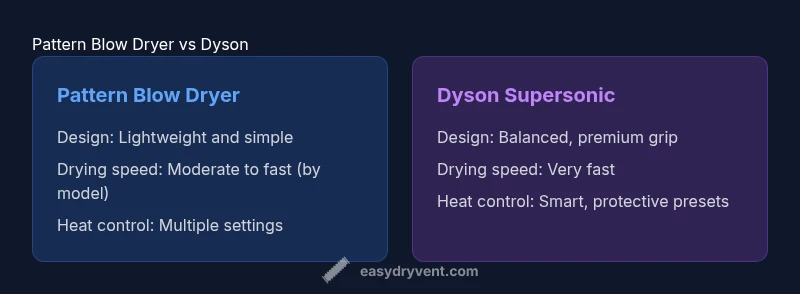
| Feature | Pattern blow dryer | Dyson Supersonic |
|---|---|---|
| Design & Ergonomics | Lighter, traditional grip | Ergonomically balanced with magnetic attachments |
| Drying Speed | Moderate to fast depending on model | Typically very fast with high-velocity airflow |
| Heat Control | Multiple heat settings; variable output | Smart heat management with guided presets |
| Noise Level | Varies by model; often louder | Quieter operation in premium ranges |
| Price Range | $60-$120 | $350-$500+ |
| Best For | Budget-conscious styling; casual use | Users prioritizing speed and heat protection |
The Good
- Lower upfront cost with pattern models
- Straightforward maintenance and parts availability
- Wide attachment ecosystems in many brands
Negatives
- Dyson offers superior heat management and speed
- Pattern models may vary in durability
- Repair costs can be higher for premium brands when needed
Dyson wins on speed and heat management; pattern models win on cost and simplicity
Choose Dyson if you value faster drying and advanced heat protection. Choose pattern dryers for budget-friendly, reliable styling and easier maintenance.
Common Questions
What is the main difference between pattern blow dryer and Dyson in terms of heat control?
The main difference is that Dyson units tend to include smart heat management with preset profiles to protect hair, while pattern models offer a range of heat settings but rely on simpler mechanisms. Your experience will depend on how sensitively you adjust heat for your hair type.
Dyson uses smarter heat management with presets, while pattern dryers offer more basic heat settings.
Are pattern blow dryers a good budget alternative to Dyson for family use?
Yes, pattern blow dryers can be excellent budget-friendly options for families, providing reliable performance for routine styling. They typically cost less upfront and are easier to replace if a device is moved between bedrooms or bathrooms.
Pattern dryers are a solid budget option for family use.
Do attachments differ a lot between pattern dryers and Dyson?
Attachment ecosystems vary. Dyson often provides a cohesive set of magnetic attachments with precise fit, while pattern models may rely on third-party or manufacturer-specific nozzles. Verify compatibility before buying if you rely on specialized brushes or diffusers.
Check attachment compatibility before purchasing.
Which lasts longer, pattern dryers or Dyson?
Durability depends on model and usage. Premium Dyson units may offer longer motor life and robust service networks, while many pattern dryers have practical warranties and simpler repair options. Regular maintenance extends both.
Durability depends on model and upkeep.
Is the Dyson price justified for casual home use?
For casual home use, Dyson’s premium price may not be justified if you only need occasional styling. If speed, heat protection, and a quiet experience are important, it could be worth the investment.
It depends on how you value speed and heat protection.
What maintenance steps help extend the life of either dryer?
Regularly clean filters, wipe down the body, check the cord for wear, and store in a cool, dry place. Follow the manufacturer’s guidance for filter replacement and routine inspections.
Clean filters, inspect cords, and follow the manual.
Key Points
- Assess hair type and styling frequency before buying
- Weigh upfront cost against long-term energy use
- Check attachment availability and compatibility
- Prioritize heat control if you routinely style thick hair
- Inspect warranty and service options for peace of mind