How Much Dryer Cost to Run: Practical Guide for 2026
Explore how much a clothes dryer costs to run in 2026, what drives per-load costs, and practical tips to cut energy use without sacrificing drying performance.


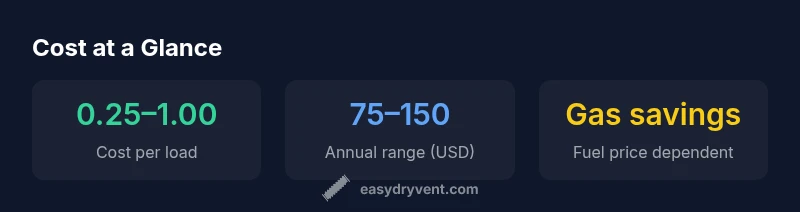
On average, running a standard electric clothes dryer costs about 0.25 to 1.00 USD per load, depending on your local electricity rate and the cycle you choose. For a typical household drying 4–6 loads per week, annual costs usually fall in the 75–150 USD range. These estimates come from Easy DryVent Analysis, 2026.
How much dryer cost to run in 2026
Understanding the cost to run a dryer starts with basic energy use and the local electricity rate. According to Easy DryVent, the best starting point to estimate costs is to quantify energy use per cycle and multiply by your rate, then scale by how often you run it. On average, an electric clothes dryer costs roughly 0.25 to 1.00 USD per load, depending on the cycle chosen and the energy price in your region. For a typical household drying 4–6 loads per week, annual costs commonly fall in the 75–150 USD range. These figures are derived from Easy DryVent Analysis, 2026. You can also see how different settings affect consumption, and why sensor based cycles often save money without sacrificing laundry performance.
Beyond per-load estimates, consider how your local climate, vent efficiency, and dryer placement influence overall cost, since heat loss or poor venting can push energy use higher.
How energy costs per load are calculated
The energy cost per load is a product of energy use per cycle (in kilowatt-hours, kWh), times your electricity rate. For many electric dryers, typical cycles use 2.0–4.5 kWh; at a rate of 12 cents per kWh, that translates to about 0.24–0.54 USD per load. Higher heat settings or longer cycles push the upper end upward. Efficient models with moisture sensing tend to stay closer to the lower end. Always check the label on your unit for the exact energy consumption and multiply by your local rate to estimate your own cost.
If you regularly use time-based drying, you may overshoot energy use; sensor-based cycles can curb this waste by stopping when clothes are dry.
Electric vs gas dryers: cost implications
Electric dryers generally run at higher per-load energy costs in regions with expensive electricity, while gas dryers can be cheaper per load where natural gas is affordable. Typical per-load costs areElectric: 0.25–1.00 USD; Gas: 0.10–0.60 USD. Annual costs depend on usage patterns and fuel prices. Gas models may also have lower operating costs in mild climates where extended cycles aren’t needed, but initial purchase price and venting requirements can offset savings.
Always compare your local energy tariffs and your dryer’s efficiency label to determine which option is more economical for your home.
Practical steps to estimate your costs
To estimate your own costs, start with a simple calculator approach:
- Find your electricity rate (cents per kWh) on your latest bill or from your utility site.
- Look up your dryer’s energy usage per cycle (kWh) from the Energy Guide label or manufacturer specs.
- Multiply energy per cycle by the rate, then multiply by your weekly load count to get weekly and annual projections.
- Repeat for a gas dryer using local fuel prices and appliance efficiency.
These steps help you build a realistic annual budget and identify opportunities to cut costs.
Real-world cost ranges by usage patterns
Consider three typical usage patterns. Light usage (2–3 loads/week) may cost roughly 20–40 USD per month in electricity terms, depending on rate and cycle choice. Moderate usage (4–6 loads/week) commonly lands in the 75–150 USD per year band as noted. Heavy usage (8–12 loads/week) can push annual costs well above 150 USD, especially in high-rate regions. Each scenario assumes standard 110–130V household power and typical cycle behavior.
Cost-saving strategies that actually cut energy use
Adopt practical habits that cut running costs without sacrificing drying performance:
- Use moisture-sensing or auto-dry cycles to avoid over-drying.
- Dry full loads rather than partial loads to maximize efficiency per batch.
- Clean the lint trap after every load and schedule annual vent cleaning to maintain optimal airflow.
- Use lower heat settings when possible and reduce cycle length by relying on sensor dryness.
- Consider air-drying delicate items or using a clothesline on sunny days to lower dryer usage altogether.
Common mistakes that drive up your bill
Avoid these pitfalls: running hot on every cycle, overloading or underloading the drum, ignoring lint vent buildup, and using the timed dry setting instead of sensor dry. Each mistake adds unnecessary energy use and extends drying time. Regular maintenance and mindful drying habits reliably reduce costs over the long term.
Cost comparison and ranges by dryer type
| Category | Low per-load cost | High per-load cost | Estimated annual cost range | Notes |
|---|---|---|---|---|
| Electric dryer | 0.25 | 1.00 | 75-150 | Depends on cycle and rate |
| Gas dryer | 0.10 | 0.60 | 60-120 | Fuel price dependent |
| High-efficiency models | 0.10 | 0.40 | 40-90 | Sensor-dry features save energy |
Common Questions
What is the average cost to run a dryer per load?
Most electric dryer loads cost about 0.25–1.00 USD per load, depending on rate and cycle. This varies by region and the efficiency of the unit. Use sensor-dry cycles to minimize wasted energy.
A typical dryer load costs about a quarter to a dollar, depending on where you live and the cycle you choose.
Do gas dryers cost less to run than electric?
Gas dryers can be cheaper per load in areas with low gas prices, but fuel costs and installation considerations vary. Always compare gas and electric rates in your region.
Gas can be cheaper per load in some places, but it depends on your local gas and electric prices.
How can I reduce running costs quickly?
Use sensor-dry cycles, avoid under- or overloading, clean lint traps and vents regularly, and opt for lower heat settings when appropriate. These habits cut energy use without harming effectiveness.
Try sensor-dry cycles and keep vents clean to cut energy use fast.
Is it worth buying a high-efficiency dryer?
If you run many loads weekly, the upfront cost can be offset by long-term energy savings and faster drying times. For light usage, the savings may be smaller.
Yes, if you do a lot of laundry, it can pay off over time.
How often should I clean the lint vent?
Clean the lint trap after every load and schedule a professional vent cleaning annually or as recommended by the manufacturer to maintain efficiency and safety.
Clean the lint screen every time, and have vents inspected annually.
“The most reliable way to lower dryer running costs is to pair efficient models with proper vent maintenance and load optimization.”
Key Points
- Know your rate and per-cycle energy use to estimate costs
- Sensor-based cycles save more energy than timed drying
- Gas can be cheaper per load in some regions; compare local tariffs
- Regular vent maintenance improves efficiency and lowers bills
- Aim for full, balanced loads to maximize efficiency per cycle