New Dryer Price in 2026: What to Expect and How to Budget
Explore how new dryer prices vary in 2026, what drives cost, and how to estimate total cost of ownership. Easy DryVent analyzes market ranges and practical tips for homeowners.


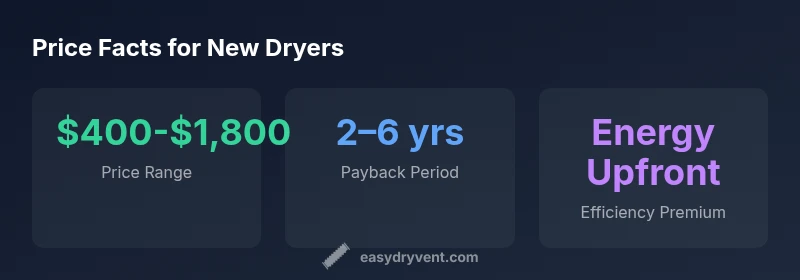
New dryer price in 2026 varies widely by type, size, and features. Basic electric top-load models tend to be the cheapest, while front-load, high-efficiency, and smart-enabled dryers push the price higher. Easy DryVent analysis, 2026, shows typical new-dryer price bands from about $400 to $1,800, with installation and ventilation costs potentially adding to the total.
How new dryer prices are set in 2026
Price formation for new dryers hinges on four broad levers: model type (electric vs gas), capacity (compact vs full-size), build quality and feature set (basic, high-efficiency, smart-connected), and installation costs (venting, duct length, and professional service). While the sticker price grabs attention, homeowners should also consider energy efficiency ratings, warranty terms, and expected maintenance costs. Easy DryVent analysis, 2026, shows that price bands widen as you climb from basic electric top-load to premium smart front-load machines. This is partly due to improvements in heat pump technology, moisture sensors, and connectivity that enable better energy management. By understanding these drivers, you can set a budget that accounts for both upfront costs and long-term operating expenses.
Price bands by type and feature
Here’s how price bands generally stack up across common dryer configurations, based on Easy DryVent Analysis, 2026: Basic electric top-load models are the cheapest entry point; Front-load electric or gas models command higher upfront prices but offer better efficiency and capacity; Premium smart front-load dryers carry the highest price but deliver strong energy savings and convenience. Installation and venting improvements can add to the total initial investment. Seasonal promotions and financing can shift these costs. When planning, consider how your household size, laundry frequency, and local electricity or gas costs will influence the final number.
How energy efficiency affects price
Higher efficiency ratings typically carry a price premium, but they can reduce operating costs over time. Energy Star certified models often cost more upfront but save energy in day-to-day use. The payback period depends on usage, electricity costs, and local incentives. Easy DryVent Analysis, 2026 notes that the premium for efficiency ranges from a modest bump for mid-range models to a substantial increase for premium heat-pump dryers. Consumers should weigh potential energy savings against the upfront delta and warranty coverage.
Electric vs gas: price and installation differences
Gas dryers usually require venting and gas-line considerations, which add to both the upfront price and installation effort. Electric models tend to be simpler to install but can vary in energy efficiency. Price gaps between electric and gas depend on market conditions, retailer policies, and home infrastructure. If a home already has proper gas access, gas models may offer long-term energy cost advantages, though fuel prices and usage play a crucial role in total cost of ownership.
Hidden costs that affect total price
Beyond the sticker price, homeowners should budget for venting components, vent hoses, lint-duct cleaning, pedestals or stacking kits, installation labor, and potential duct repairs. Some homes require vent retrofits or additional wall/ceiling clearances, which can add to the initial investment. Warranty extensions, delivery charges, and promotional financing may also impact the total price. Understanding these add-ons helps create a more accurate forecast of total cost of ownership.
Calculating total cost of ownership (TCO)
To estimate TCO, start with the sticker price, then add installation and venting costs, warranty extensions, and any required accessories. Next, estimate annual operating costs based on local electricity rates and expected usage. For example, if a dryer uses 600 kWh/year and electricity costs are $0.15 per kWh, annual energy cost is about $90. If an energy-efficient model reduces usage by 15–25%, annual savings range from roughly $13.50 to $22.50. Over several years, these savings can offset the upfront premium. Easy DryVent Analysis, 2026 emphasizes tailoring the TCO to household behavior and regional energy prices.
Strategies to snag a better deal on a new dryer
- Time your purchase around major sales events (holiday weekends, end-of-month promotions).
- Combine promotions with manufacturer rebates and retailer financing offers.
- Consider slightly older year models when a clearance sale occurs, while ensuring warranty coverage.
- Check installation packages and bundled venting kits to avoid surprise add-ons.
- Compare energy ratings and compute payback based on your usage pattern; higher efficiency isn’t always the best value if you don’t run the dryer often.
How to compare models with a price checklist
Use a structured checklist to compare models:
- Upfront price and available promotions
- Energy efficiency rating and estimated annual energy use
- Capacity and load size compatibility
- Venting needs and installation complexity
- Warranty length and coverage
- Installation and venting costs
- Expected maintenance and service intervals
- Financing options and total cost of ownership over 5–10 years
Typical new-dryer price ranges by model type
| Model Type | Estimated Price Range | Notes |
|---|---|---|
| Basic Electric Top-Load | $400-$700 | Cheapest entry point; adequate for small households |
| Front-Load Electric or Gas | $800-$1,400 | Popular for capacity and efficiency; gas adds venting complexity |
| Premium Smart Front-Load | $1,400-$1,800 | Energy-saving features; higher upfront cost |
Common Questions
What is the typical price range for a new dryer in 2026?
Prices for new dryers in 2026 vary by model and features, but commonly fall in the range of a few hundred to around two thousand dollars depending on capacity and energy rating. Easy DryVent analysis, 2026 accounts for installation and venting costs in total price.
New dryers in 2026 typically range from a few hundred up to around two thousand dollars, depending on capacity and energy features.
Do installation costs affect the total price?
Yes. Venting kits, ductwork, professional installation, and any required vent retrofits add to the upfront price. These costs can significantly affect total cost of ownership, especially in older homes.
Installation costs can add a noticeable amount to the upfront price, so factor them into your budget.
Is a gas dryer more expensive than an electric one?
Gas models often have higher upfront installation costs due to gas line connections and venting. The price gap varies by market, but installation complexity typically makes gas dryers pricier upfront.
Gas dryers usually cost more to install, but may offer long-term energy savings depending on local fuel prices.
How should I evaluate energy efficiency when comparing prices?
Compare energy ratings (Energy Star or similar) and predicted annual energy use. Higher efficiency models may have a higher upfront price but lower operating costs, which can narrow the gap over time.
Look at energy ratings and annual energy use to weigh upfront cost against long-term savings.
Are rebates or promotions available for new dryers?
Yes. Manufacturers often offer promotions, and local utilities sometimes provide rebates for energy-efficient appliances. Check current offers and combine promotions with financing to maximize value.
Check for promotions and rebates from manufacturers and utilities before buying.
How long is the payback period for higher-efficiency models?
Payback depends on usage and energy costs. Typical payback can range from 2 to 7 years, influenced by your local electricity price and household laundry load.
Energy-efficient models often pay back in a few years, depending on usage and rates.
“Prices are a moving target, but the true value comes from energy efficiency and installation costs, not just the sticker price.”
Key Points
- Budget for total cost of ownership, not just sticker price
- Higher efficiency can pay for itself over time with energy savings
- Gas dryers may cost more upfront due to venting, but can offer long-term savings
- Look for promotions and financing to reduce upfront burden
- Check installation requirements early to avoid hidden add-ons