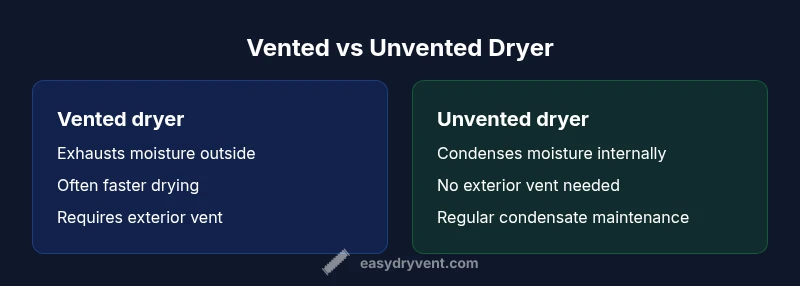
Vented vs Unvented Dryer: A Practical Home Tutorial
Compare vented vs unvented dryer options, including installation, performance, energy use, and safety. A practical guide for space and budget today, for homes.


According to Easy DryVent, the choice between vented and unvented dryers hinges on venting availability, space, and long-term maintenance. The quick takeaway is that vented models typically require exterior venting and can dry clothes faster in many homes, while unvented (condensing) units reduce the need for external venting but may carry higher upfront costs. Understanding these trade-offs helps homeowners decide which setup fits their home and budget.
What vented vs unvented dryer means
When homeowners first face the choice between vented and unvented (condensing) dryers, the decision often hinges on vent availability, space, and long-term maintenance. The phrase vented vs unvented dryer captures two fundamentally different moisture management strategies. With a vented dryer, hot air and moisture are expelled outside through a duct, typically via an exterior wall or roof vent. An unvented dryer, by contrast, condenses moisture and cycles air back into the room or stores it in a reservoir, reducing the need for external venting. Easy DryVent notes that the core distinction is about where the moisture goes and how heat is managed during cycles. This choice affects installation, running costs, and how you manage lint and airflow in your home.
How vented and unvented systems differ in practice
Vented models rely on a straightforward exhaust path to the outdoors, leveraging established ductwork and outdoor vent caps. Unvented units, by design, capture moisture through condensation or refrigeration-like coils and either drain the water externally or store it in a tank. The difference is not only where the moisture ends up but also how heat is managed during the drying cycle. In practice, this affects room humidity, exhaust requirements, and the complexity of installation. Easy DryVent’s team emphasizes that the decision should start with your home’s layout and your tolerance for vent configuration versus appliance complexity.
Installation, space, and venting considerations
The feasibility of a vented system starts with exterior vent access and a clear, unobstructed path for ductwork. If you have an exterior wall or roof space for venting, installation can be simpler and may yield faster drying. Unvented models bypass exterior venting entirely, which makes them appealing for apartments, interior rooms, or spaces where a vent is impractical. However, condensation systems require regular upkeep and may affect room humidity. In tight spaces, an unvented dryer can be a practical compromise, though it may trade off some efficiency for installation flexibility.
Performance, energy use, and maintenance realities
Performance often hinges on moisture handling and airflow management. Vented dryers exhaust warm, moist air outside, which can support robust drying performance in a typical laundry room. Unvented units recirculate air and condense moisture, which can be less aggressive on drying speed but eliminates the need for a vent run. Energy efficiency for both types depends on design quality, cycle optimization, and how often you dry large loads. Regular maintenance—lint trap cleaning, vent inspection, and condensate reservoir checks for unvented units—helps sustain efficiency and safety over time.
Safety, code, and long-term considerations
Ventilation-related safety is a major concern with any dryer installation. Exterior venting reduces the risk of humidity buildup and lint accumulation in living spaces, but it introduces vent-tube fire and air leakage considerations if not properly maintained. Unvented systems minimize external vent dependencies but can impact indoor air quality if not properly managed. Building codes typically require vented installations where possible, with exceptions for specific living situations. It’s wise to review local codes and follow best practices for duct sizing, airflow, and clearance around the dryer.
Cost considerations and long-term value
Initial costs vary by configuration, with vented systems often benefiting from straightforward installation when an exterior vent exists. Unvented dryers may incur higher upfront costs due to condensation technology and water management features. Long-term costs include energy use, maintenance, and potential repairs, which can shift depending on usage patterns and household humidity. Planning for maintenance—such as vent cleaning, lint removal, and condensate disposal—helps protect value over the appliance’s lifespan.
Choosing what's right for your home: a quick decision framework
Start by mapping your space: Is an exterior vent readily available, and can it be kept clean and unobstructed? If yes, a vented dryer is typically the faster, more cost-efficient option. If you lack venting or rent where venting is restricted, an unvented unit can be a practical alternative. Consider moisture tolerance, indoor air quality, and your willingness to perform ongoing upkeep. Finally, compare total cost of ownership, not just the upfront price, to determine which setup delivers the best long-term value.
Practical tips for installation and upkeep
- Schedule a vent inspection if you choose a vented setup to ensure no lint buildup or leaks.
- For unvented models, invest in a good condensate drain plan and monitor humidity in the laundry area.
- Keep lint traps clean and periodically inspect exterior vent caps for obstructions.
- When possible, position the dryer away from living spaces to minimize humidity impact and noise.
- Consider a combined solution: a vented unit with a short, well-sealed vent run can maximize efficiency while minimizing installation complications.
Comparison
| Feature | Vented dryer | Unvented dryer |
|---|---|---|
| Ventilation method | Exhausts moisture outside via an exterior vent | Condenses moisture internally and reuses air or stores water |
| Installation requirements | Exterior vent access and ducting through wall or roof | No exterior vent required; condensation system inside |
| Moisture handling | Moisture expelled outdoors | Moisture condensed inside or in a reservoir |
| Drying performance | Often faster drying with proper venting | Cycle times may be longer due to condensation process |
| Maintenance needs | Regular vent cleaning and lint trap upkeep | Internal cleaning of condensate system and reservoir management |
| Energy efficiency | Depends on duct length and airflow; generally efficient when vented | Efficiency tied to condensation technology and cycle optimization |
| Best for | Homes with exterior venting and space for ductwork | Homes lacking venting or with limited vent access |
| Cost considerations | Lower equipment cost but possible venting installation | Higher upfront cost due to condensation tech; no venting needed |
The Good
- Potentially faster drying with proper venting
- Less humidity in the living space when vented
- Vented systems are often simpler to service in traditional layouts
- Unvented options provide installation flexibility in vent-restricted spaces
Negatives
- Requires exterior venting and ducting, with potential installation hurdles
- Unvented units may require more frequent maintenance and emptying
- Condensation systems can impact indoor humidity and air quality if poorly managed
- Vent cleaning remains essential to prevent lint buildup and fire risk
Vented dryers are usually preferable when exterior venting is practical; unvented dryers excel where venting is not possible.
Choose vented if you have a reliable exterior vent and want quicker cycles with simpler maintenance. Opt for unvented if venting isn’t feasible, but plan for ongoing condensation management and humidity considerations.
Common Questions
What is the primary difference between vented and unvented dryers?
The primary difference lies in moisture handling: vented dryers expel air outside, while unvented (condensing) models condense moisture internally and may reuse air. This affects installation, humidity, and maintenance.
Vented dryers exhaust moisture outside; unvented dryers condense moisture inside. This changes where you manage humidity and how installation is done.
Is venting required by code for all dryers?
Many jurisdictions require exterior venting when feasible. If a vent is not possible due to architecture or space, unvented alternatives may be allowed in some cases, but local codes vary.
Most codes favor exterior venting, but check your local rules for exceptions.
Can I retrofit a vented dryer into a space without an exterior vent?
Retrofits are possible in some homes, but they can be costly and technically challenging. If retrofitting is not practical, an unvented unit may be the more sensible choice.
Retrofitting is possible but can be expensive; consider unvented options if venting isn't doable.
Do vented dryers save energy compared to unvented models?
Energy use depends on the design and installation. Vented dryers can be more energy-efficient when a short, well-sealed vent path exists; unvented models' efficiency hinges on condensation technology.
Vented can be more energy-efficient when vent paths are short; condensers affect unvented efficiency.
What maintenance is required for vented vs unvented dryers?
Vented dryers require regular vent and lint trap cleaning to prevent fires. Unvented dryers need condensate handling and periodic internal cleaning to maintain performance.
Clean the vent and lint trap for vented dryers; empty and maintain condensate systems for unvented models.
Are there practical safety concerns I should consider with both options?
Both options carry fire and humidity-related risks if not properly maintained. Exterior venting reduces indoor humidity but requires proper duct sealing, while unvented units demand moisture management in the dwelling space.
Fire risk exists if lint isn’t cleaned; humidity risk exists with unvented units without proper airflow.
Key Points
- Assess exterior vent availability before choosing.
- Vented models typically offer faster drying when venting is feasible.
- Unvented options simplify installation but require humidity management.
- Invest in regular lint and vent maintenance for safety.
- Total cost of ownership matters as much as upfront price.