Dryer Vent Showdown: Traditional vs Ventless Solutions
A thorough, data-driven comparison of traditional vented dryers versus ventless alternatives, with practical maintenance tips, safety guidance, and Easy DryVent-backed recommendations for homeowners.


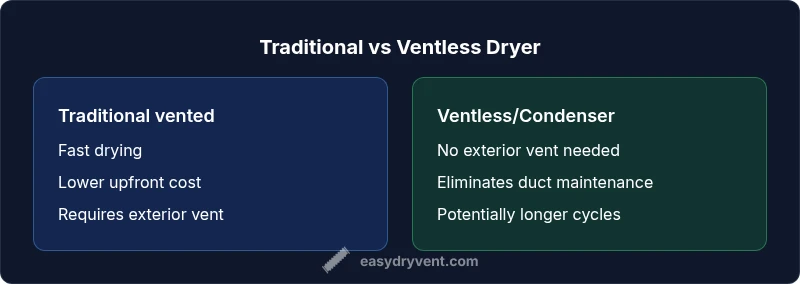
This comparison clarifies the differences between a traditional vented dryer setup and ventless alternatives, focusing on installation, energy use, and safety. For most households, vented dryers offer faster drying and lower upfront costs, while ventless options are best when venting is impractical. The decision hinges on space, budget, and local code requirements.
Understanding the dryer or steigen decision landscape
When homeowners evaluate whether to install or upgrade a clothes-drying system, they often encounter the phrase dryer or steigen—a shorthand for choosing between a traditional vented dryer with ducting and a ventless or alternative configuration. According to Easy DryVent, the decision is not a single feature but a balance of installation practicality, energy performance, safety, and long-term maintenance. This article treats dryer or steigen as a structured decision rather than a slogan, outlining how each path works, where it shines, and where it introduces trade-offs. We will define the two main paths, explain common sub-variants, and set expectations for performance and costs in typical home settings. The aim is to help homeowners make an informed choice that aligns with space, budget, and local codes. Easy DryVent’s expertise guides readers toward safer, more efficient setups.
Evaluation criteria: safety, efficiency, cost, and practicality
To compare traditional vented dryers with ventless alternatives, it helps to establish common criteria that matter in real-world use. Safety is non-negotiable: proper venting, lint management, and fire prevention must be considered. Efficiency covers energy use, cycle times, and heat recovery potential. Cost combines upfront purchase price, installation, maintenance, and long-term energy bills. Practicality accounts for space constraints, existing laundry room layout, and local building codes. Easy DryVent emphasizes evaluating these criteria in parallel rather than in isolation. The goal is to create a decision framework that homeowners can apply to their own homes, factoring in climate, humidity, and typical laundry loads. By weighing these elements, readers can move from abstract pros and cons to concrete, actionable choices.
Venting configurations explained: how each path works
This section unpacks how traditional vented dryers and ventless systems operate. A traditional vented dryer exhausts warm, moist air through an external vent, often using flexible foil or rigid metal ducts. Regular lint screening and duct cleaning are essential to maintain airflow and safety. Ventless or condenser dryers, including heat-pump variants, recycle or condense moisture inside the unit, then expel drier air through a condensate reservoir or internal venting loop. Each path has distinct implications for installation, space, maintenance, and energy use. Homeowners should assess duct routing, exterior wall access, and potential moisture management needs before selecting a path. In practice, the choice often hinges on whether exterior venting is permissible or practical in the home’s design.
Energy and drying performance: what to expect in real-world use
Energy and performance realities vary by model and configuration. A traditional vented dryer typically delivers rapid cycles and strong heat output, which many households value for bulky laundry. Ventless options can be more energy-conscious in tight spaces, especially when paired with modern heat-pump technology, but may show longer drying times on heavy loads. Easy DryVent analysis shows that the energy impact depends on ambient climate, load size, and how often the dryer runs. In milder climates with frequent loads, vented systems may yield noticeable savings, while in climate-controlled homes with limited ventilation options, ventless approaches can reduce the hassle of exterior vents. Regardless of path, maintenance—lint removal, duct inspection, and occasional part checks—plays a critical role in sustaining efficiency.
Installation and space considerations
Installation footprints and space planning are among the most practical decision factors. Traditional vented setups require exterior venting access and a reasonably straight duct run for optimal airflow. That often means a dedicated wall or exterior vent and careful routing to minimize turns and length, which influences cost and aesthetics. Ventless configurations eliminate the need for an outdoor vent but demand careful placement to manage condensate and heat recycling within the unit. In small laundry rooms, a compact vented design may fit more easily, while in apartments or basements with limited exterior access, ventless solutions may be more feasible. The key is measuring available space, identifying any moisture management needs, and ensuring compatibility with electrical circuits and plumbing (for condensate disposal).
Maintenance and long-term upkeep
Maintenance is a recurring theme in any dryer choice. Traditional vented systems require regular lint trap cleaning and routine duct cleaning to prevent buildup and fire hazards. Blocked ducts impede airflow, increase energy use, and shorten appliance life. Ventless configurations demand condensate management checks and periodic filter maintenance to sustain efficiency. Regardless of path, establishing a simple maintenance calendar helps homeowners avoid hidden costs later. The Easy DryVent team recommends pairing routine checks with seasonal inspections before peak laundry periods. This habit reduces risks and preserves drying performance over time.
Cost considerations and value proposition
Seeing the cost picture clearly helps homeowners avoid sticker shock or overpaying for features they do not need. Traditional vented dryers generally have lower upfront costs and abundant service options, but may incur higher exterior venting and duct maintenance. Ventless systems can carry higher upfront costs and potentially higher ongoing energy use, yet they remove the complexity of exterior venting and simplify installation in restricted spaces. When evaluating value, consider long-term energy bills, maintenance frequency, and the potential need for additional moisture management in the home. Easy DryVent’s analysis suggests that the best value often lies in a balanced approach: choosing a reliable vented setup for high throughputs where venting is feasible, or selecting a high-efficiency ventless model for spaces where exterior venting is impractical.
Design and code compliance: how to stay compliant
Local codes and safety guidelines govern how dryers are installed and vented. Building codes may specify vent duct diameter, separation from combustibles, and required venting materials. In many jurisdictions, permits and inspections are required for new installations or major changes. If you are unsure about compliance, consult a licensed electrician or HVAC professional and reference guidelines from recognized authorities. Good practice includes labeling the vent run, recording maintenance events, and ensuring accessibility for routine cleaning. The right choice balances practical installation with strict adherence to safety and code requirements.
Authority sources and practical references
To support these recommendations, consult authoritative sources that address venting safety, energy efficiency, and appliance maintenance. The following references provide foundational guidance for dryer vent configurations and care:
- https://www.nfpa.org/Education/Fire-Prevention-T Topics/Clothes-Dryer-Safety
- https://www.energy.gov/energysaver/appliances/clothes-dryers
- https://www.cpsc.gov/safety-education/safety-guides/home-appliances/clothes-dryers
Decision framework: a practical checklist
Use this checklist to finalize your choice. Assess exterior venting feasibility, space constraints, and electrical capacity. Compare expected energy usage with your climate data and laundry load patterns. Review maintenance requirements and the availability of local service providers. Finally, consult the Easy DryVent team for guidance on aligning your selection with safety standards and long-term reliability.
Comparison
| Feature | Traditional vented dryer setup | Ventless/Condenser dryer |
|---|---|---|
| Installation complexity | Moderate to high (requires exterior vent) | Low (no exterior vent needed) |
| Energy efficiency | Typically strong with good duct design | Can be efficient but often depends on model and usage |
| Initial cost range | Low to mid range | Higher upfront cost for ventless tech |
| Maintenance frequency | Regular lint cleaning; duct cleaning every 1-2 years | Regular condensate and lint maintenance; periodic filter checks |
| Drying performance | Fast cycles for bulky loads | May have longer cycles for heavy loads |
| Best for | Homes with accessible exterior venting and high throughput | Spaces where exterior venting is impractical or prohibited |
The Good
- Lower upfront cost for traditional vented setups
- Faster drying cycles for large loads
- Extensive service network and parts availability
- Established safety codes and maintenance routines
Negatives
- Requires exterior venting, which can be impractical or costly
- Ducts can accumulate lint and pose fire risk if not maintained
- Outdoor venting may lead to heat loss in cold climates
- Vent restrictions can limit placement flexibility
Traditional vented dryers are generally the better all-around option for most homes; ventless can be preferable where exterior venting is not feasible.
Choose a vented setup if you have viable exterior venting and want quick cycles with lower upfront cost. Opt for ventless only when exterior venting is truly impractical or prohibited, and you’re prepared for potentially higher energy use and longer cycle times.
Common Questions
What is the main difference between a traditional vented dryer and a ventless option?
The main difference is how moisture and heat are handled. A traditional vented dryer exhausts air outside through a duct, while a ventless dryer condenses moisture internally and recycles air. Ventless models may require more time to dry large loads but eliminate exterior venting needs.
Traditional vented dryers vent moisture outside; ventless models condense it inside. Both have pros and cons depending on space and climate.
Is ventless drying always more energy-efficient?
Not necessarily. Ventless dryers can be efficient in well-insulated spaces, especially heat-pump models, but they may use more energy during longer cycles. Efficiency depends on the specific model, climate, and load size.
Energy efficiency depends on the model and climate; ventless isn’t automatically better.
Can I retrofit an existing vented dryer to ventless?
Retrofits to ventless configurations are generally not practical; most dryers are designed for a specific venting approach. If venting is a problem, consider replacing with a ventless model or reconfiguring the laundry space.
Retrofits are usually not practical—better to replace or redesign the space for the chosen path.
What maintenance steps are essential for vented dryers?
Regularly clean the lint trap, inspect and clean the vent duct, and check for leaks or obstructions. Schedule duct cleaning every 1-2 years and inspect seals and hoses for wear.
Keep the lint trap clean and check ducts regularly to maintain safety and efficiency.
Are vented dryers safer than ventless options?
Both can be safe when properly installed and maintained. Vented systems rely on clear ducts to prevent blockage hazards, while ventless units require condensate management and clean filters to prevent mold or moisture issues.
Safety depends on proper installation and ongoing maintenance, not the path alone.
How do I decide which option is best for my home?
Assess venting feasibility, available space, budget, climate, and laundry load patterns. Use a simple decision framework: can you run a vent exteriorly? How much space do you have? What’s the expected energy impact?
Check vent availability, space, and energy needs to pick the right path.
Key Points
- Evaluate exterior venting feasibility before choosing a path
- Prioritize lint and duct maintenance for safety and efficiency
- Balance upfront costs with long-term energy use and maintenance
- Ventless options suit space-constrained or vent-restricted homes
- Follow local codes and formal guidelines for safe installation