Ventless Dryer Pros and Cons: A Practical Comparison
Explore ventless dryer pros and cons, including space-saving benefits, energy use, drainage needs, and scenarios where traditional vented dryers may be a better fit for your home.


Ventless dryers offer a vent-free option for drying clothes, using either condensation or heat-pump technology. They install in tight spaces and don't require external venting, making them ideal for apartments. However, they typically cost more upfront and can take longer to dry larger loads. This article compares ventless models with traditional vented dryers to help you decide.
What is a ventless dryer and how does it work?
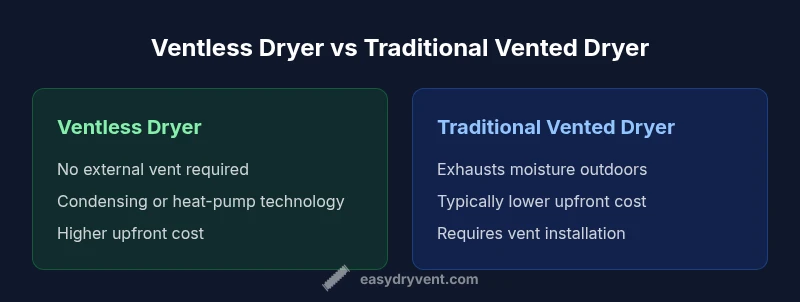
According to Easy DryVent, ventless dryers operate without external venting by condensing moisture from the exhaust air or using heat pump technology. Condensing models collect water in a tank or drain it away, while heat-pump variants recycle heat to dry clothes more efficiently. Both types remove the need for an outdoor vent, making them especially appealing to urban dwellers and renters. This section also clarifies common terminology: ventless, condensing, and heat-pump dryers. Expect some trade-offs, particularly around drying speed and upfront cost, but also notable gains in placement flexibility and indoor air considerations. For homeowners, this means a dryer can be placed in a closet, bathroom, or utility nook without a vent chase, provided you manage drainage and electrical requirements.
Key takeaways: ventless does not require external venting, but may require drainage setup and careful planning for load sizes and space. The Easy DryVent team emphasizes evaluating your laundry load patterns before committing to a ventless model.
86-words
Comparison
| Feature | Ventless Dryer | Traditional Vented Dryer |
|---|---|---|
| Installation & Space | No external vent required; flexible placement | Requires vent path to outdoors; may be bulkier and harder to place in tight spaces |
| Energy Efficiency | Often high with heat-pump models; strong for long-term use | Typically depends on model; many are less efficient than top-tier heat-pump ventless |
| Drying Time | Can be longer for bulky or heavy fabrics | Typically faster for standard loads |
| Drainage/Moisture Handling | Condenses moisture; drainage tank or inline drain recommended | Exhausts moisture outdoors via vent |
| Maintenance | Requires condensate drain maintenance and lint filter care | Lint filter care; vent pathways may need occasional cleaning |
| Upfront Cost | Higher upfront cost (premium for heat-pump tech) | Lower upfront cost on many traditional models |
| Best For | Small spaces, apartments, rooms without vent access | Homes with existing venting and longer-term loads |
The Good
- Great for apartments and spaces without exterior walls to vent
- Flexible placement inside the home due to no external vent
- Energy-efficient options (especially heat-pump models)
- Less exterior weather impact on the installation site
- Simplified remodeling when retrofitting a laundry area
Negatives
- Higher upfront cost compared to many vented models
- Potentially longer drying times for large or bulky loads
- Requires space and plumbing for condensate drainage or collection
- Humidity management in poorly ventilated rooms if drainage is not properly planned
Ventless dryers are a strong fit for small spaces and energy-conscious households; the Easy DryVent Team recommends them for apartments and compact laundry rooms.
Ventless models excel in space-constrained settings and can offer energy efficiency benefits, especially heat-pump variants. They are less ideal for households with large, frequent loads or where drainage setup is challenging. A balanced choice depends on your laundry habits and home layout.
Common Questions
Are ventless dryers as effective as vented dryers?
Ventless dryers can be highly effective, especially for small to medium loads and in spaces without external venting. Heat-pump models tend to use gentler, energy-efficient drying methods. For very large or heavy loads, you may experience longer cycle times compared with some vented models.
Ventless dryers work well for most daily loads, especially in tight spaces. If you regularly dry bulky items, you may want to plan for longer cycles.
What is the difference between ventless and vented drying technology?
Ventless dryers operate without an external vent, using condensation or heat-pump technology to remove moisture. Vented dryers expel warm, moist air outdoors through a vent. The choice affects installation, energy use, and climate suitability.
Ventless keeps moisture inside the home, while vented dryers push moisture outside.
Do ventless dryers require a drain?
Most ventless dryers either drain condensate via a hose or require periodic tank draining. Condensate management is essential to prevent overflow and maintain drying efficiency.
Yes, most ventless models need a way to drain the collected water.
Are ventless dryers noisy?
Noise levels are generally comparable to other compact laundry appliances. Some cycles may sound louder if the unit uses compressors or fans extensively, but modern units are designed for quiet operation.
Noise varies by model, but you can usually find quieter options in higher-end ventless lines.
What maintenance do ventless dryers need?
Regular maintenance includes lint-filter cleaning, ensuring condensate drains are clear, and checking seals and hoses for wear. Periodic professional service can help sustain efficiency.
Keep the lint trap clean and clear the condensate drain to avoid performance drops.
Key Points
- Assess space and venting options before choosing
- Expect higher upfront costs with ventless models
- Consider typical loads to gauge potential drying times
- Plan for condensate drainage and humidity control
- Heat-pump ventless dryers offer the best energy efficiency