Vented Electric Dryer vs Ventless: Key Differences
Compare vented electric dryers and ventless models to understand installation needs, energy use, drying performance, and maintenance for safer, more efficient home laundry.


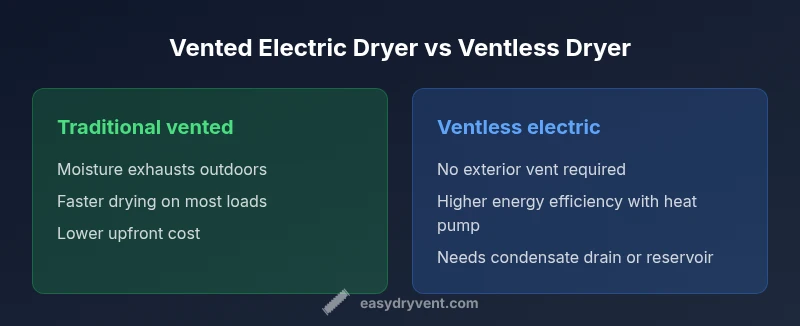
Vented electric dryers exhaust moisture outdoors via a duct, while ventless models recycle moisture internally through condensation or heat-pump cycles. The two differ in installation needs, energy efficiency, and drying speed. Understanding these distinctions helps homeowners pick the option that best fits space, budget, and laundry habits.
Defining electric vs ventless dryers
At a high level, an electric dryer refers to the power source that powers the heating element and drum rotation. Within that umbrella, there are vented and ventless configurations. A traditional electric dryer is vented to the outdoors via a duct, expelling hot air and moisture outside the home. A ventless model, by contrast, recycles moisture internally through condensation or a heat-pump process, removing water without an outside vent. Many homeowners ask, is electric dryer the same as ventless? The answer is no in most cases, because 'electric' describes power and 'ventless' describes moisture handling. According to Easy DryVent, the simplest way to distinguish these two categories is to examine how moisture is handled and where the heat ends up during operation. The Easy DryVent team found that two common misperceptions often confuse homeowners: that 'electric' always means 'ventless,' and that all ventless units work the same way. In reality, there are important differences in installation, energy use, and drying performance that affect both safety and efficiency. Understanding these differences helps homeowners pick the option that matches their space, budget, and laundry load. For many households, the decision hinges less on the power source and more on where you can place the unit and how you manage moisture. This guide clarifies the core distinctions, the practical implications, and the scenarios where each type shines.
Comparison
| Feature | Traditional vented electric dryer | Ventless electric dryer (condensing/heat pump) |
|---|---|---|
| Moisture handling | Exhausts to outdoors | Condenses moisture internally; drains or stores condensate |
| Vent requirement | Exterior vent required | No exterior vent required |
| Energy efficiency | Moderate/variable by model | Often higher efficiency; heat-pump variants excel |
| Typical drying time | Generally faster cycles for many loads | Often longer cycles for bulky items, models vary |
| Upfront cost | Lower upfront cost | Higher upfront cost due to condensate/heat-pump tech |
| Maintenance needs | Regular vent duct cleaning and lint checks | Condensate management and filter care |
| Ideal spaces | Homes with exterior vent path | Small spaces or no external venting options |
| Climate sensitivity | Less dependent on climate | More sensitive to humidity and drainage conditions |
The Good
- Typically lower upfront cost
- Fast drying cycles with proper venting
- Widely available parts and service
Negatives
- Requires exterior venting, which can be hard to implement
- Heat and humidity vented outside may waste energy
- Potential duct maintenance and mold risk if not cleaned
- Blocked vents can reduce performance
Vented electric dryers generally outperform ventless in cost and speed where exterior venting is feasible.
If you can install a proper vent, a vented model usually dries faster and costs less upfront. Ventless options shine when venting outdoors isn’t possible, but expect higher operating costs and longer cycles in many cases.
Common Questions
Is an electric dryer the same as a ventless dryer?
No. Electric describes the power source, while ventless describes how moisture is handled inside the unit. Some electric dryers are vented, others are ventless.
No—electric just means powered by electricity, while ventless refers to moisture handling. Some models are vented, some are ventless.
Do ventless dryers require a drain?
Most ventless dryers condense moisture and require a drain or a condensate reservoir. Some setups provide continuous drainage, depending on the model.
Yes, ventless dryers usually need a drain or a condensate tank.
Are vented dryers faster than ventless dryers?
Typically, vented dryers finish cycles faster when exterior venting is available. Ventless models can be slower, especially on large or bulky loads, though newer designs are improving.
Generally, vented dryers are faster, but ventless models are catching up in many cases.
Which dries clothes more evenly?
Both types can dry evenly. Performance depends on model design, drum size, and sensors. A well-built vented model often delivers strong results across fabrics.
It depends on the model, but both can be very even if designed well.
Can I install a ventless dryer in a rental?
Yes, ventless dryers often suit rentals because they don’t require exterior venting. Check drainage and power requirements and confirm landlord approval.
Yes, ventless can work in rentals, but check drain and power needs.
What maintenance do vented vs ventless require?
Vented dryers need regular lint trap cleaning and duct checks. Ventless units require condensate management and filter cleaning. Regular inspections help prevent issues.
Vented needs duct cleaning; ventless needs condensate checks.
Key Points
- Assess venting feasibility before buying
- Vented dryers typically offer faster drying and lower upfront cost
- Ventless dryers save space and avoid exterior venting but may require drainage
- Compare energy guides and cycle times for long-term costs
- Choose based on space, climate, and daily laundry needs