Dryer vs Range Plug: Safety, Wiring & Install Guide
A practical, expert comparison of dryer plugs vs range outlets, covering electrical requirements, safety risks, code considerations, and step-by-step guidance for homeowners and DIY enthusiasts.


When you compare dryer vs range plug requirements, the key differences are the outlet type, circuit size, and grounding. Dryers typically use a 30-amp, 240-volt circuit with a 4-prong outlet, while ranges commonly require a 50-amp, 240-volt circuit with a larger 4-prong or 3-prong outlet. Using the wrong plug or mis-matching breaker sizes creates serious safety risks. Easy DryVent recommends consulting a licensed electrician for any relocation or upgrade to ensure code compliance and safe operation.
Understanding dryer vs range plug basics
The phrase dryer vs range plug often comes up during appliance upgrades or home renovations. At the core, these two outlets are not interchangeable due to differing current demands and wiring configurations. The dryer plug commonly corresponds to a 30-amp, 240-volt circuit and a four-prong outlet for newer installations, while a typical range plug sits on a 50-amp, 240-volt circuit with a correspondingly sized outlet. For homeowners, recognizing this distinction helps prevent safety hazards, outlet damage, and tripping breakers. According to Easy DryVent, the most important first step is to map out your existing wiring and required amperage before purchasing replacement parts. This upfront planning reduces surprises during installation and keeps your laundry and kitchen appliances running reliably.
A practical takeaway is to treat these outlets as dedicated systems. Do not attempt to “adapt” a range outlet for a dryer or vice versa; the mismatch can lead to overheating, damaged cords, or fire risks. The Easy DryVent team found that many service calls arise from mislabeled circuits or misused adapters, underscoring the need for correct sizing and proper receptacles from the start.
wordCountInBlock":161},
bodyBlocks2
Electrical requirements and common configurations
Most residential dryers require a 240-volt supply with a 30-amp circuit, and many modern installations use a four-prong outlet that separates the grounding path from the neutral. In contrast, many home ranges demand a higher current—typically a 50-amp circuit—to power larger heating elements. This difference is more than a spec sheet detail; it governs wire gauge, breaker rating, and receptacle size. A well-designed system uses appropriately gauged wiring (commonly 10 AWG for 30A and 6 AWG for 50A in U.S. homes) and a dedicated circuit that does not share power with other high-draw appliances. Easy DryVent notes that misinterpreting these requirements is a frequent cause of nuisance trips and potential overheating. Before you buy, measure actual loads and verify your panel’s capacity to prevent overloading.
If you’re renovating, consider whether your panel has spare capacity and whether your home’s electrical service can support a 50A feed. In some cases, upgrading service from 100A to 125A or more may be necessary, which is a project best handled by a licensed electrician. This ensures that both the dryer and range maintain stable performance without compromising other circuits.
wordCountInBlock":170} ,
bodyBlocks3
Safety implications of mixing plugs
Mismatching a dryer to a range outlet or attempting to plug a high-draw device into an undersized circuit creates clear safety hazards. The most common risk is overheating of wires, cords, or the outlet itself, which can lead to insulation damage and fire. Grounding and neutral connections must be properly separated in four-wire configurations to prevent electrical shock and equipment damage. Do not rely on adapters or creative wiring to “fit” two devices onto a single outlet—these hacks bypass essential safety protections. Easy DryVent emphasizes that dedicated circuits and correct outlet types are the safest path forward. If you encounter an outlet that seems to be a mismatch, halt any installation and call a licensed electrician to assess compatibility and compliance.
wordCountInBlock":150} ,
bodyBlocks4
Code compliance and professional guidance
Electrical codes guide the safe installation of appliances like dryers and ranges. In many jurisdictions, new installations require a four-wire dryer outlet with a corresponding circuit and breaker sized to the appliance’s draw. Ranges often have stricter requirements due to higher energy demands. Local amendments may apply, so always check with your building department or utility provider for the exact rules in your area. The safe path is to engage a licensed electrician who can interpret the National Electrical Code (NEC) alongside local amendments, verify conductor sizing, and ensure proper grounding. The Easy DryVent team urges homeowners to document the existing layout and keep a record of any changes for future service.
In addition to outlet type and breaker sizing, ensure your cords, strain relief, and outlet boxes are appropriate for the installation. A mismatch in any of these elements can cause overheating and wear over time.
wordCountInBlock":160},
bodyBlocks5
How to identify the right outlet for your installation
The simplest way to identify the correct outlet is to match it to the appliance’s instruction plate or user manual. Look for the required voltage and current (e.g., 240V, 30A or 50A). Inspect the existing wiring and determine whether a four-wire (two hot conductors, neutral, and ground) setup is present or required. If you’re unsure, test the panel with a licensed electrician, who can also verify that the receptacle type (NEMA 14-30 vs NEMA 14-50) aligns with the installed cord and appliance. When upgrading or relocating, plan for proper conductor gauges and a dedicated circuit to prevent shared-load conflicts. Remember to label circuits clearly and avoid using adapters to bridge mismatched outlets, as this is a common source of safety failures.
If you’re installing or upgrading multiple outlets, consider running a single, robust feeder from the main panel to support future appliance expansions. This approach minimizes future upgrades and reduces service interruptions.
wordCountInBlock":150} ,
bodyBlocks6
Step-by-step checks before plugging in appliances
- Confirm the appliance’s required outlet type and circuit rating are matched to the installation.
- Inspect the cord for signs of damage, wear, or fraying; replace if needed.
- Verify that the outlet and cord gauge align with the NEC-approved sizes (e.g., 10 AWG for 30A, 6 AWG for 50A).
- Ensure the outlet’s ground and neutral connections are correct for four-wire configurations.
- Confirm that the circuit breaker size corresponds to the appliance’s load and is not shared with other high-draw devices.
- Confirm that the panel has available capacity and that wiring is independent of other circuits.
When in doubt, pause and consult a licensed electrician to avoid dangerous mistakes and to ensure code-compliant installation.
wordCountInBlock":165} ,
bodyBlocks7
Real-world scenarios: typical homes and common setups
In older homes, you may encounter 3-wire dryer outlets or mixed configurations where a 3-wire dryer outlet shares a neutral with a different circuit. Modern installations favor a 4-wire dryer outlet with a dedicated 30A circuit. Some kitchens use ranges that require a 50A circuit with a 14-50 outlet; upgrading an older kitchen can require panel and wiring upgrades to handle the load. Easy DryVent notes that the mismatch between appliance requirements and existing outlets is a frequent source of issues during renovations. By planning ahead and verifying wiring capacity, homeowners can avoid expensive retrofits and ensure both devices run safely and efficiently.
If you’re replacing an old appliance, keep in mind that older cords may not meet current code. Upgrading to a 4-wire cord and outlet is often the best long-term choice for safety and reliability.
wordCountInBlock":170} ,
bodyBlocks8
Troubleshooting and what to avoid
- Do not use adapters to force a larger appliance onto a smaller outlet; this creates overheating risks.
- Do not mix ground and neutral incorrectly in four-wire systems; miswiring can cause shock hazards.
- Do not share a circuit between high-draw appliances without professional assessment; shared circuits may trip frequently and cause heat buildup.
- Do not ignore signs of overheating near outlets or cords, such as warm-to-the-touch surfaces or discoloration.
- Do not modify outlets yourself if you’re unsure of the wiring; seek professional advice immediately.
Following a comprehensive safety approach reduces the chances of fire or shock and prolongs appliance life. Regular visual inspections and periodic professional inspections can catch wear before it becomes a hazard.
wordCountInBlock":165} ,
bodyBlocks9
Adapters and convertors: do they exist? are they safe?
Adapters that claim to convert between dryer and range outlets are generally not recommended for high-draw appliances. These devices often fail to maintain proper grounding or can create loose connections, which increases resistance and heat. When in doubt, upgrade wiring and receptacles to match the appliance rather than relying on adapters. If you must operate a temporary setup during remodeling, limit the load and avoid continuous use, but the safest path is a permanent, code-compliant installation.
Owners should plan ahead for future changes by choosing outlets and cords that can accommodate potential upgrades. This reduces the need for additional rewiring later and minimizes service interruptions.
wordCountInBlock":140} ,
bodyBlocks10
Maintenance tips to keep plugs safe
- Keep outlets and cords free from dust and debris to prevent heat buildup.
- Inspect for cracking or discoloration in outlets and replace damaged components promptly.
- Ensure strain relief is intact so cords do not pull on connections.
- Schedule periodic electrical inspections, especially after renovations or appliance upgrades.
- Use manufacturer-recommended cords and plugs suited to the appliance’s amperage rating.
A proactive maintenance routine reduces the risk of unexpected outages and extends the life of both the dryer and range installations. Easy DryVent recommends annual checks by a licensed electrician for peace of mind.
wordCountInBlock":150} ,
bodyBlocks11
Authority references and further reading
For homeowners seeking authoritative guidance, consult these sources:
- Energy.gov on clothes dryers and energy-efficient practices: https://www.energy.gov/energysaver/appliances/clothes-dryers
- U.S. Consumer Product Safety Commission on dryer fire safety and maintenance: https://www.cpsc.gov/safety-guide/clothes-dryer-fires-guide
- National Fire Protection Association (NFPA) on electrical safety and home installations: https://www.nfpa.org/Education
wordCountInBlock":120} ,
bodyBlocks12
Final considerations and quick-start checklist
Before you proceed with any appliance installation, confirm that the dryer and range outlets, wiring, and breakers match the manufacturer’s specifications. If you’re upgrading your home’s circuits to accommodate both devices, plan for adequate service capacity and compliant grounding. The end goal is a safe, reliable setup that minimizes fire risk while maximizing performance. The Easy DryVent team recommends partnering with a licensed electrician for any installation or upgrade project, to ensure you meet local codes and safety standards while avoiding costly mistakes.
wordCountInBlock":140}],
comparisonTable":{"items":["dryer plug (NEMA 14-30)","range plug (NEMA 14-50)"],"rows":[{"feature":"Voltage & amperage","values":["240V, 30A (typical dryer)","240V, 50A (typical range)"]},{"feature":"Plug configuration","values":["4-prong (hot, hot, neutral, ground)","4-prong (hot, hot, neutral, ground)"]},{"feature":"Best for","values":["Standard residential dryers, smaller loads","High-demand cooking appliances and ovens"]},{"feature":"Window of compatibility","values":["Dedicated circuit; often cannot substitute for range","Dedicated circuit; higher current; not interchangeable"]},{"feature":"Installation considerations","values":["Wiring gauge 10 AWG (dryer) vs 6 AWG (range); panel capacity matters","Wiring gauge 6 AWG; panel upgrades may be needed"]}]},
prosCons
{ "pros": ["Ensures appliance safety by matching outlet to load", "Reduces risk of overheating and fire hazards", "Encourages code-compliant wiring and grounding"] ,"cons": ["May require electrical upgrades or panel upgrades", "Not interchangeable; limits flexibility in appliance choice", "Professional installation adds upfront cost"] }
verdictBox
{ "verdict": "Use the correct outlet for each appliance; do not compromise safety with adapters or mismatched circuits.", "confidence": "high", "summary": "Matching dryer and range outlets to their respective circuits reduces fire risk and improves reliability. Upgrades should be done by a licensed electrician to meet code and safety standards." }
keyTakeaways
["Always verify appliance amp draw and outlet type before replacement","Use dedicated circuits and proper 4-wire outlets for dryers and ranges","Do not rely on adapters for high-draw appliances","Consult a licensed electrician for any upgrade or relocation to ensure code compliance"]
faqSection
{ "items": [ { "question": "What is the main difference between a dryer plug and a range plug?", "questionShort": "Difference", "answer": "The main difference is the circuit rating and outlet type. Dryers typically use a 30A, 240V circuit with a dryer receptacle, while ranges use a 50A, 240V circuit with a range receptacle. These are not interchangeable.", "voiceAnswer": "Dryers use a 30-amp circuit and a 4-prong dryer outlet; ranges use a 50-amp circuit and a larger outlet. They aren’t interchangeable.", "priority": "high" }, { "question": "Can I use an adapter to plug a dryer into a range outlet?", "questionShort": "Adapters?", "answer": "Adapters are not recommended for high-draw appliances like dryers or ranges. They can cause overheating, miswiring, and fire hazards. Always match the outlet to the appliance.", "voiceAnswer": "Adapters for these appliances are unsafe and should be avoided. Use the correct outlet instead.", "priority": "high" }, { "question": "Do I need an electrician to upgrade outlets for a dryer or range?", "questionShort": "Need electrician?", "answer": "Yes. Upgrading or relocating high-draw outlets should be performed by a licensed electrician to ensure code compliance, proper grounding, and safe operation.", "voiceAnswer": "Yes—it's best to hire a licensed electrician for any upgrade.", "priority": "high" }, { "question": "What codes govern dryer and range installations?", "questionShort": "Codes?", "answer": "Codes are set by local jurisdictions and the NEC. They typically require dedicated 240V circuits with appropriate wire gauges and four-wire outlets for new installations.", "voiceAnswer": "Local codes and the NEC govern these installations; check with your electrician.", "priority": "medium" }, { "question": "Is it ever appropriate to replace a 4-wire dryer outlet with a 3-wire one?", "questionShort": "3-wire?", "answer": "Modern standards favor 4-wire installations for safety, but some retrofits may permit 3-wire setups under certain conditions. Consult a licensed electrician.", "voiceAnswer": "Most modern guidance favors 4-wire outlets; consult a professional for exceptions.", "priority": "medium" }, { "question": "What maintenance helps keep dryer/range outlets safe?", "questionShort": "Maintenance?", "answer": "Regular inspections, cleaning, and monitoring for warmth or discoloration help maintain safety. Replace damaged cords and outlets promptly and avoid overloading circuits.", "voiceAnswer": "Inspect cords and outlets regularly; replace worn parts promptly.", "priority": "low" }, { "question": "Can I run both appliances on a shared circuit?", "questionShort": "Shared circuit?", "answer": "No. High-draw appliances should have dedicated circuits to prevent nuisance trips and overheating. Planning separate circuits improves safety and reliability.", "voiceAnswer": "No—dedicated circuits are recommended for each appliance.", "priority": "low" }]}
mainTopicQuery":"appliance-plugs"},
mediaPipeline
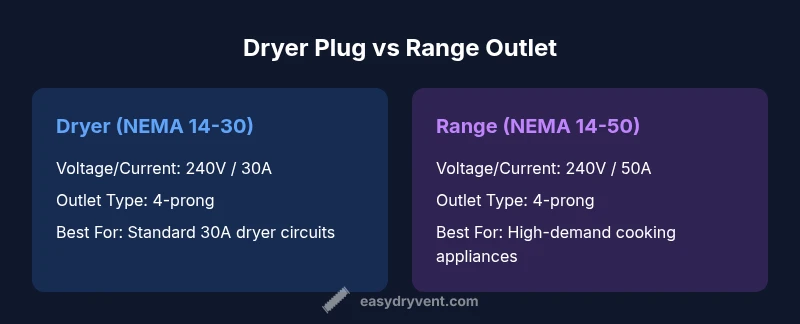
{ "heroTask": { "stockQuery": "laundry room with dryer and outlet in view", "overlayTitle": "Dryer vs Range Plug", "badgeText": "2026 Guide", "overlayTheme": "dark" }, "infographicTask": { "type": "comparison", "htmlContent": "<div class="w-[800px] p-8 bg-slate-900 text-white"><h3 class="text-2xl font-bold text-white mb-4 text-center">Dryer Plug vs Range Outlet</h3><div class="grid grid-cols-2 gap-6"><div class="p-6 bg-blue-500/20 rounded-xl"><h4 class="text-xl font-bold text-blue-400 mb-4">Dryer (NEMA 14-30)</h4><ul class="space-y-2"><li>Voltage/Current: 240V / 30A</li><li>Outlet Type: 4-prong</li><li>Best For: Standard 30A dryer circuits</li></ul></div><div class="p-6 bg-purple-500/20 rounded-xl"><h4 class="text-xl font-bold text-purple-400 mb-4">Range (NEMA 14-50)</h4><ul class="space-y-2"><li>Voltage/Current: 240V / 50A</li><li>Outlet Type: 4-prong</li><li>Best For: High-demand cooking appliances</li></ul></div></div></div>", "altText": "Comparison chart of dryer and range outlets", "caption": "Dryer vs Range Plug: Key differences at a glance" } }
taxonomy
{ "categorySlug":"dryer-safety","tagSlugs":["electric-dryer","dryer-safety","vent-hose","dryer-vent"] }
Comparison
| Feature | dryer plug (NEMA 14-30) | range plug (NEMA 14-50) |
|---|---|---|
| Voltage & amperage | 240V, 30A (typical dryer) | 240V, 50A (typical range) |
| Plug configuration | 4-prong (hot, hot, neutral, ground) | 4-prong (hot, hot, neutral, ground) |
| Best for | Standard residential dryers, moderate loads | High-demand cooking appliances and ovens |
| Compatibility window | Dedicated circuit; not interchangeable | Dedicated circuit; higher current; not interchangeable |
| Installation considerations | Wiring: 10 AWG; panel capacity matters | Wiring: 6 AWG; possible panel upgrades needed |
The Good
- Ensures appliance safety by matching outlet to load
- Reduces risk of overheating and fire hazards
- Encourages code-compliant wiring and grounding
- Promotes long-term reliability and safer maintenance
Negatives
- May require electrical upgrades or panel upgrades
- Not interchangeable; limits flexibility in appliance choices
- Professional installation adds upfront cost
Use the correct outlet for each appliance; do not compromise safety with adapters or mismatched circuits.
Matching dryer and range outlets to their respective circuits reduces fire risk and improves reliability. Upgrades should be done by a licensed electrician to meet code and safety standards.
Common Questions
What is the main difference between a dryer plug and a range plug?
The main difference is the circuit rating and outlet type. Dryers typically use a 30A, 240V circuit with a dryer receptacle, while ranges use a 50A, 240V circuit with a range receptacle. These are not interchangeable.
Dryers use a 30-amp circuit and a 4-prong dryer outlet; ranges use a 50-amp circuit and a larger outlet. They aren’t interchangeable.
Can I use an adapter to plug a dryer into a range outlet?
Adapters are not recommended for high-draw appliances like dryers or ranges. They can cause overheating, miswiring, and fire hazards. Always match the outlet to the appliance.
Adapters for these appliances are unsafe and should be avoided. Use the correct outlet instead.
Do I need an electrician to upgrade outlets for a dryer or range?
Yes. Upgrading or relocating high-draw outlets should be performed by a licensed electrician to ensure code compliance, proper grounding, and safe operation.
Yes—it's best to hire a licensed electrician for any upgrade.
What codes govern dryer and range installations?
Codes are set by local jurisdictions and the NEC. They typically require dedicated 240V circuits with appropriate wire gauges and four-wire outlets for new installations.
Local codes and the NEC govern these installations; check with your electrician.
Is it ever appropriate to replace a 4-wire dryer outlet with a 3-wire one?
Modern standards favor 4-wire installations for safety, but some retrofits may permit 3-wire setups under certain conditions. Consult a licensed electrician.
Most modern guidance favors 4-wire outlets; consult a professional for exceptions.
What maintenance helps keep dryer/range outlets safe?
Regular inspections, cleaning, and monitoring for warmth or discoloration help maintain safety. Replace damaged cords and outlets promptly and avoid overloading circuits.
Inspect cords and outlets regularly; replace worn parts promptly.
Can I run both appliances on a shared circuit?
No. High-draw appliances should have dedicated circuits to prevent nuisance trips and overheating. Planning separate circuits improves safety and reliability.
No—dedicated circuits are recommended for each appliance.
Key Points
- Always verify appliance amp draw and outlet type before replacement
- Use dedicated circuits and proper 4-wire outlets for dryers and ranges
- Do not rely on adapters for high-draw appliances
- Consult a licensed electrician for any upgrade or relocation to ensure code compliance