Dryer vs Stove Plug: A Homeowner's Guide to Safe Wiring
A thorough, analytical comparison of dryer plugs and stove plugs for homeowners. Learn plug types, circuits, safety steps, and upgrade paths with Easy DryVent guidance.


In most homes, a dedicated 240V outlet is required for either a clothes dryer or a kitchen stove, but they use different plug configurations and circuit ratings. This guide clarifies which outlet matches which appliance, why mismatch is risky, and how to safely upgrade or reconfigure wiring. Easy DryVent's analysis emphasizes checking local code before any changes.
Understanding the Dryer Plug vs Stove Plug
The phrase "dryer vs stove plug" is more than a label on a wall outlet—it signals two distinct electrical needs that live under the same 240V umbrella but diverge in connector design, circuit protection, and installation discipline. In practice, a clothes dryer and a kitchen stove rely on different plug configurations and wiring arrangements, even when both operate on 240 volts. For homeowners and DIYers, recognizing these distinctions helps prevent dangerous miswiring and ensures appliances operate reliably. According to Easy DryVent, the safest path starts with confirming the appliance’s label and the existing outlet’s type before attempting any change. This block lays the groundwork by outlining common plug shapes, typical circuit expectations, and the safety rationale behind keeping each appliance on its own dedicated outlet whenever possible. Readers should treat this as a practical reference rather than a theory exercise—real installations depend on local codes and the specific models involved.
Electrical Safety Principles in Plain Language
Safety is not a luxury in home electrical work; it is a prerequisite. The dryer-plug versus stove-plug distinction feeds into a broader safety framework that includes correct grounding, appropriate conductor sizing, and proper enclosure of outlets. Mismatched plugs can lead to overheating connectors, arcing, or nuisance tripping that disrupts daily life and risks fire. Easy DryVent emphasizes grounding integrity, the use of four-wire cords for new installations, and adherence to the National Electrical Code (or local equivalents) as baseline practices. In this section, you’ll learn why outlets, cords, and breakers must be coordinated for each appliance and how improper pairing could affect not just the appliance but the entire circuit it shares with other loads.
Plug Types You’re Likely to Encounter
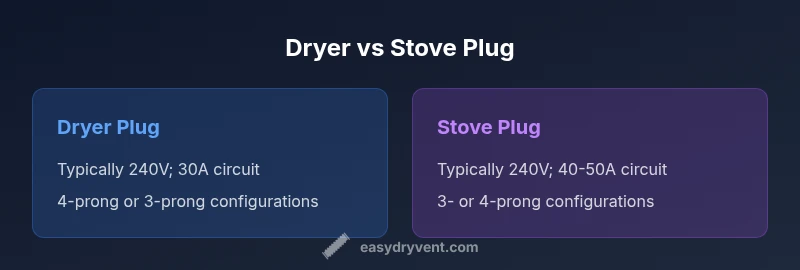
Two core configurations dominate residential 240V appliances: 30-amp dryer outlets and 40- or 50-amp range outlets. Dryers often use a 4-prong or 3-prong 240V plug depending on age and local code, whereas stoves ranges favor higher-amperage circuits and varied prong arrangements. The key difference is not just physical size, but the corresponding breaker rating, insulated conductors, and outlet receptacle geometry. It’s essential to verify the exact model requirements in the user manual and identify the matching outlet in the wall. If the existing wall outlet is the wrong type for your appliance, it should be upgraded by a qualified electrician to a code-compliant configuration rather than attempting a DIY swap.
Why Mismatch Is a Real Risk
A incorrect outlet pairing can cause overheating, loose connections, or aggravating arc faults that trigger nuisance trips or dangerous heating. Mismatches may also bypass protective features designed to shut down or limit current in fault conditions. In addition, some older installations use legacy three-wire configurations that do not provide a separate ground, increasing shock risk and complicating modern safety requirements. Easy DryVent highlights that addressing these risks begins with a proper outlet and cord assessment, followed by a careful upgrade plan aligned with current standards.
Practical Assessment Steps for Homeowners
Start with the appliance label and the wall outlet. Take photos of the plug configuration, read the wiring diagram if accessible, and note the breaker size in the panel. Check whether the outlet matches the appliance’s needs (number of prongs, grounding, and voltage rating). If you’re unsure, consult a licensed electrician for a formal compatibility check. A simple misstep during this phase can cascade into safety problems, including incorrect cord replacement or inadequate grounding. Easy DryVent recommends documenting all findings to inform any subsequent work—this helps you communicate clearly with a professional and reduces the risk of misinterpretation.
Upgrading or Replacing Outlets: What to Expect
Upgrading an outlet for a dryer or stove typically involves selecting a code-compliant 240V receptacle that matches the appliance and the circuit’s capacity. In many cases, this means installing a four-wire outlet with an appropriately sized breaker and wiring. Upgrades might also necessitate panel work or even service-fee adjustments if the current service panel cannot safely accommodate the added load. This section outlines the general sequence professionals follow: a load assessment, panel clearance verification, wiring replacement to meet four-wire standards (if required), receptacle installation, and final testing. Always hire a licensed electrician to ensure workmanship meets safety and code requirements.
Load Calculations and What They Really Mean
Load calculations determine whether a home’s electrical system can safely support both a dryer and a stove simultaneously. They consider the appliance’s power draw, other connected loads, and the existing service capacity. Overloading a circuit can lead to frequent breaker trips and degraded insulation over time. In practice, electricians balance loads by dedicating separate circuits where advisable and by choosing outlets and cords that fit the appliance’s duty cycle. Easy DryVent notes that local variations exist, so a professional assessment is essential for accurate results.
How a DIYer Might Prepare for a Licensed Electrician Visit
If you’re planning to bring in a pro, prepare a concise brief that includes appliance models, current outlet types, observed issues (such as warm outlets or buzzing sounds), and any prior attempts to change plugs. Gather the manual pages showing voltage, amperage, and plug configuration, plus a general description of your home’s panel and main service rating. This prep saves time, reduces costs, and helps the electrician deliver an exact, code-compliant solution. It also reinforces the safety-first approach that Easy DryVent advocates, ensuring you’re ready to discuss options with confidence.
Common Myths Debunked: What Not to Believe
There are several myths surrounding dryer plugs and stove outlets that can mislead homeowners into unsafe practices. For example, some people assume any 240V outlet can power any 240V appliance, which is false and dangerous. Others think upgrading to a larger breaker is a quick fix for any outlet problem, ignoring wire sizing and panel constraints. Reality favors adherence to codes, proper conductor sizing, and matching plug designs to their respective appliances. Debunking these myths helps prevent risky shortcuts and focuses attention on legitimate, code-compliant upgrades.
Comparison
| Feature | electric clothes dryer | electric range/stove |
|---|---|---|
| Plug type | Typically 4-prong 240V dryer plug (older 3-prong may exist) | Typically 3- or 4-prong 240V range plug depending on model |
| Circuit rating | Commonly on a 30A circuit (varies by model and region) | Commonly on 40-50A circuits (varies by model) |
| Outlet compatibility | Dryer outlet designed to handle dryer cord grounding | Stove outlet configured for higher-load range cord |
| Installation complexity | Medium: often requires dedicated 240V outlet and appropriate cord | Medium-high: may require panel checks and wiring adjustments |
| Code compliance | Four-wire grounding recommended for new installations | Code-dependent; many new installs require four-wire cords |
| Best for | Clothes drying needs and household laundry cycles | Cooking and heating major loads in kitchen |
The Good
- Promotes safer, appliance-specific wiring when matched correctly
- Clearer electrical load management for home systems
- Improved safety through code-compliant upgrades
- Prevents nuisance breaker trips and outlet overheating
- Long-term reliability with proper outlet-cord matching
Negatives
- Upfront cost for upgrading outlets and wiring
- May require professional assessment and permitting
- Potential panel upgrades if service capacity is limited
- Disruption during installation in busy homes
Choose code-compliant, dedicated outlets for each appliance; avoid interchanging dryer and stove plugs.
A correctly matched dryer plug and stove plug reduce fire risk and protect appliance performance. When in doubt, hire a licensed electrician to confirm wiring, outlets, and panel capacity align with local code and manufacturer specs.
Common Questions
Can I interchange a dryer plug with a stove plug to save space or outlets?
No. Dryer plugs and stove plugs are designed for different loads and safety protections. Interchanging them can cause overheating, arcing, and fire risk. Always install the correct outlet for each appliance.
No. Dryer and stove plugs are not interchangeable due to different loads and safety protections. Install the correct outlet for each appliance.
Are dryer and stove outlets the same in North America?
Not always. While both can be 240V, the prong configurations and ampacity often differ. Check the appliance label and the existing wall outlet to determine compatibility and whether an upgrade is needed.
Not always. They often differ in prongs and ampacity; verify with the appliance label and outlet.
Can I convert a 3-prong dryer outlet to a 4-prong safely?
Conversion is possible in some cases but requires rewiring, proper grounding, and code-compliant components. A licensed electrician should perform the modification to ensure grounding and safety.
Conversion requires rewiring and grounding; have a licensed electrician handle it to stay safe and up to code.
What’s the typical amperage difference between dryer and stove outlets?
Dryers commonly operate on a 30A circuit, while stoves often require higher-load circuits around 40-50A. Exact values depend on model and local code, so verify the specs on each appliance.
Dryers usually use 30A; stoves typically need 40-50A. Check your model’s specs and local code.
Do modern stoves require GFCI protection?
Some jurisdictions require GFCI protection in kitchens for certain outlets, but many traditional stove circuits are not GFCI-protected. Verify local rules and appliance manuals for exact requirements.
It depends on local rules; kitchens may require GFCI in some cases, so check your area’s code.
How do I know what outlet I need for my appliance?
Consult the appliance manual and the rear label on the plug or cord. Match the voltage, amperage, and plug configuration to the wall outlet and panel capacity. When in doubt, ask a licensed electrician to confirm.
Check the manual and label, match to outlet, and if unsure, consult an electrician.
Key Points
- Inspect your appliance label and wall outlet before any work
- Don’t swap plugs between dryer and stove; use proper outlets
- Consult a licensed electrician for upgrades and panel checks
- Expect dedicated 240V circuits for most dryers and stoves
- Plan for future-proofing with four-wire outlets when feasible