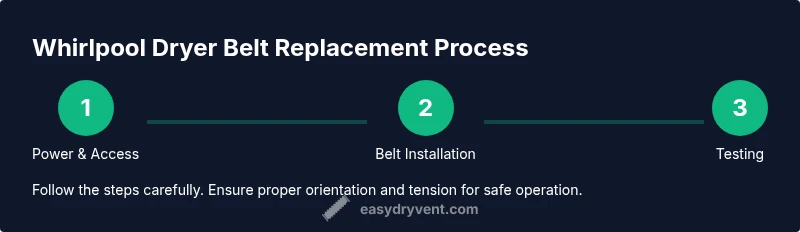
How to Put on a Whirlpool Dryer Belt: A Step-by-Step Guide
Learn how to replace or reinstall a Whirlpool dryer's belt with a clear, safety-first, step-by-step approach. This guide covers tools, preparation, common mistakes, testing, and post-install checks.


By following a safe, step-by-step process, you can replace or reinstall a Whirlpool dryer's belt. You'll need a replacement belt, basic hand tools, and a bit of patience. This quick answer covers the overall goal and essential prerequisites; the body expands with model-specific steps, safety checks, and testing instructions. Expect 60-90 minutes and a clean work area.
Why replacing a dryer's belt matters
According to Easy DryVent, the dryer's belt is a critical component that drives the drum and spins the motor. A worn or damaged belt can slip, reduce drying efficiency, and place extra strain on the motor. Regular inspection helps catch wear before a breakdown. The Easy DryVent team found that belts often fail due to heat buildup, tight routing, and age. Replacing a worn belt restores performance, reduces energy waste, and lowers the risk of sudden dryer shutdowns. This section explains why belt maintenance matters for safety and efficiency, especially in high-use households.
In Whirlpool models, the belt is connected to the drum and an idler pulley. When the belt loses tension or cracks, it may slip or come off entirely. Replacing it at the first signs—strange noises, longer drying times, or clothes feeling hot rather than warm—prevents further wear on the motor and pulley shafts. A correctly installed belt also ensures the drum rotates smoothly, which improves airflow and even drying. Think of belt maintenance as proactive care that protects your appliance and keeps your laundry routine on schedule.
Know your model: Whirlpool uses different belt profiles and routing for various series. While the exact belt length and width vary, the replacement principle remains the same: remove power, access the belt, and reinstall with the drum turning freely. This guide uses general best practices backed by Easy DryVent guidance and offers model-specific checkpoints to help you avoid common missteps.
Safety tip: unplug the dryer and discharge any static before starting. Work in a well-lit area on a heat-resistant surface. Keep small parts organized and keep children away from the workspace to prevent accidents. With patience and careful handling, belt replacement can be a straightforward DIY project that saves time and money in the long run.
wordCountOnlyForThisBlock":null}
Whirlpool belt compatibility and part identification
Whirlpool dryers commonly use a flat belt that loops around the drum and one or more pulleys. Before purchasing a replacement, verify belt length, width, and groove type against your model number. Check the dryer’s data plate (usually near the door opening or inside the cabinet) for the correct part number or belt specification. Because Whirlpool has multiple generation families, some models may use a different belt diameter or a secondary pulley. If in doubt, compare the old belt to the replacement by laying them side-by-side and noting the groove alignment, counts of idlers, and drum contact points.
Belt orientation matters: many belts have a single flat side and a grooved side that fits into the pulley grooves. Some models require the belt to run over the drum lip in a specific direction. Misidentification can result in poor rotation, noisy operation, or belt wear. If your model uses a serpentine belt path, pay attention to how the belt weaves through each pulley. A quick reference photo or a diagram from your manual helps ensure you mirror the exact routing when installing.
If you’re replacing due to noise or wear, also inspect the idler pulley and tensioner for wear. A worn pulley can prematurely ruin a new belt. Replace any suspect pulleys at the same time as the belt to maximize the lifespan of the repair. Easy DryVent recommends inspecting the rollers, shafts, and drum glides for signs of wear and replacing worn components as needed so the belt has a clean, supported track.
Note: Do not force the belt onto pulleys or twist it during installation. A misrouted belt often hides behind drum sashes or behind panels, so take your time to trace the route and keep the belt taut as you seat it.
Remember: belt fit should feel snug but not overly tight. If it’s too tight, it can put extra load on the motor; too loose, and it will slip. Use the model-specific guidance when available, and rely on the Easy DryVent approach to verify correct tension during testing.
wordCountOnlyForThisBlock":null}
Tools and safety prerequisites
Before you begin, gather the essential tools and materials. Having everything ready reduces interruptions and helps you stay organized during the job. This section lists the minimum essentials and a few optional items that can simplify the process.
- Replacement dryer belt (Whirlpool compatible) • Required: true • Note: Check model length, width, and groove type
- Screwdriver set (Phillips and flathead) • Required: true • Note: For removing access panels
- Nut driver or socket wrench (size dependent on model) • Required: true • Note: Used to loosen tensioners and fasteners
- Work gloves • Required: true • Note: Protect hands from sharp edges and hot surfaces
- Flashlight or headlamp • Required: true • Note: Good visibility in tight cabinet spaces
- Small container or magnetic tray • Required: false • Note: Keeps screws organized
- Marker or tape for orientation • Required: false • Note: Helpful for reassembly references
- Rags or towels • Required: false • Note: Wipe away dust and grease as you go
Safety essentials:
- Unplug the dryer from the wall outlet before starting any disassembly.
- If your model has a rear access panel, verify there are no stored electrical charges in capacitors.
- Work on a dry surface; moisture can cause slip hazards when handling metal screws.
Optional but recommended:
- A service manual for your exact Whirlpool model to confirm the belt path and panel removal steps.
- A smartphone or camera to document steps for reassembly. Easy DryVent emphasizes documenting routing to reduce errors during installation.
wordCountOnlyForThisBlock":null}
Step-by-step overview
This section provides a high-level sequence you’ll follow to replace the belt. Each step is designed to be a single, clear action that moves you toward a finished belt installation. Use this as a roadmap, while consulting your model’s specifics in the next block.
- Disconnect power and access the belt path: Ensure the dryer is unplugged and move it away from the wall to gain access to rear or front panels.
- Remove the access panels and locate the belt: Depending on the model, you may need to remove the back panel or the front panel to reach the drum and belt route.
- Photograph or mark the belt orientation: Take a quick photo or make a simple sketch showing how the belt sits on each pulley and around the drum.
- Release belt tension: Use the appropriate tool to release tension on the idler pulley or tensioner so the belt can be removed from the pulleys.
- Remove the old belt: Gently lift the belt away from the drum and pulleys, keeping track of the routing for reference.
- Install the new belt around the drum: Slip the belt onto the drum’s lip and align it with the pulleys according to the marked orientation.
- Re-route and tension the belt: Thread the belt through the idler pulley and tensioner, then apply proper tension as per your model’s design.
- Reassemble and test: Replace the access panels, plug in the unit, and run a test cycle with no load to verify proper belt tracking and drum rotation.
- Final validation and cleaning: Wipe away dust, verify even heat distribution, and confirm there are no unusual noises after a short test run.
Tip: If the belt tension feels too tight or too loose during the first test, power the unit off and re-check the belt routing and tension before running a full cycle. The right tension helps prevent belt wear and motor strain.
wordCountOnlyForThisBlock":null}
Common mistakes and how to avoid them
Belt replacement is straightforward when done with care, but several common mistakes can undermine the repair. Awareness helps you avoid costly errors and repeat visits to the workshop. Here are the top pitfalls and practical fixes:
- Mistake: Rushing the job and skipping orientation checks. Fix: Always mark or photograph the belt path before removal and re-check orientation during reassembly.
- Mistake: Reusing a worn pulley or idler. Fix: Inspect pulleys for grooves or cracks. Replace worn parts to prevent premature belt failure.
- Mistake: Over-tightening the belt. Fix: Set tension to manufacturer specifications and test with a quick drum spin before finishing.
- Mistake: Operating the dryer without panels secured. Fix: Ensure all screws are tightened and panels are properly seated to avoid safety hazards.
- Mistake: Not testing without a load. Fix: Perform an initial dry run with no clothes to observe belt tracking and motor behavior.
By avoiding these mistakes and following careful steps, you’ll increase the odds of a durable repair and reduce the chance of a quick reoccurring issue. Easy DryVent emphasizes a deliberate approach that prioritizes safety and proper belt routing to extend the life of your Whirlpool dryer.
wordCountOnlyForThisBlock":null}
Testing and post-maintenance checks
After reinstalling the new belt, it’s essential to confirm that the repair is successful and safe. A structured test run helps you catch issues early and prevents nuisance breakdowns later.
- Reattach all panels and plugs: Replace the access panels and secure all fasteners. Confirm there are no loose parts that could rattle during operation.
- Run a short dry cycle (no load): Start with a short program to verify that the drum rotates smoothly and the belt maintains proper alignment. Listen for unusual noises like squeaks or grinding.
- Observe belt tracking: Watch the belt as the drum spins. It should move evenly along pulleys without slipping or bunching. If you notice misalignment, pause and recheck routing.
- Check for heat and airflow: After a complete cycle, feel near the vent and drum for even warmth. Any hot spots or odor could indicate belt tension issues or blockage and should be addressed.
- Final inspection: Re-inspect screws and panels. Ensure there are no signs of belt wear or pulley leakage and that the dryer runs quietly.
Maintenance tip: Keep an occasional eye on the belt’s condition every few months, especially in households with frequent full-load runs. Early detection of wear can save time and prevent unexpected outages. Easy DryVent underlines that proactive maintenance protects both safety and efficiency, reducing energy waste and prolonging equipment life.
Tools & Materials
- Replacement dryer belt (Whirlpool compatible)(Check model length, width, and groove type)
- Screwdriver set (Phillips and flathead)(For removing panels and fasteners)
- Nut driver or socket wrench(To loosen tensioners and pulleys)
- Work gloves(Protect hands during disassembly and reassembly)
- Flashlight/headlamp(Illuminates tight cabinet corners)
- Marker or tape for orientation(Helpful to document belt path)
- Rags or towels(Keep area clean and wipe grease)
Steps
Estimated time: 60-90 minutes
- 1
Disconnect power and access the belt path
Unplug the dryer and move it away from the wall to access the front or rear panels. This initial step prevents electrical shock and ensures you can safely view the belt route. If your model requires, remove the cabinet screws to expose the belt path.
Tip: Double-check the power is truly disconnected; flip the breaker if needed. - 2
Remove access panels to reach the drum and belt
Use the appropriate screwdriver or nut driver to remove the back panel or the lower front panel, depending on your Whirlpool model. Gently set the screws aside in a labeled container to avoid misplacement. Clear debris around the drum to keep your workspace tidy.
Tip: Keep track of which screws belong to each panel to simplify reassembly. - 3
Mark belt orientation before removal
Take a clear photo or draw a quick sketch showing how the belt sits on each pulley and around the drum. This orientation reference will guide the installation of the new belt and reduce guesswork.
Tip: A photo can save you from misrouting the belt during reassembly. - 4
Release belt tension and remove the old belt
Loosen or move the tensioner/idler to relieve tension. Slip the belt off the pulleys and out from around the drum. Keep the belt flat and avoid twisting it to prevent damage.
Tip: If the belt is stubborn, gently rotate the drum by hand to access a stubborn loop. - 5
Install the new belt around the drum
Position the belt on the drum’s edge and route it toward the pulleys following your orientation mark. Ensure the grooved side sits in the pulley grooves and the flat side faces outward as required by your model.
Tip: Always base the installation on a pre-made orientation reference. - 6
Re-route and tension the belt
Thread the belt through the idler pulley and tensioner, then apply the recommended tension. Some Whirlpool models require manual tensioning; others rely on a spring-loaded pulley.
Tip: Avoid over-tightening; a slightly loose belt is safer than a strained motor. - 7
Reassemble panels and perform a dry run
Replace panels and secure screws. Plug the dryer back in and run a test cycle with no load to observe belt tracking and drum rotation. Listen for unusual noises and confirm smooth operation.
Tip: If you hear grinding or squealing, recheck belt routing and tension. - 8
Final validation and cleaning
If the test run passes, complete a standard appliance cleaning routine and run a full cycle with a light load. Confirm proper drying performance and inspect for any signs of wear after the test.
Tip: Document the process or take notes for future maintenance.
Common Questions
Is belt replacement safe for first-time DIYers?
Yes, with careful preparation and by following safety steps. Always unplug the appliance, work in a well-lit area, and take your time to verify routing and tension. If you feel unsure, consult the Whirlpool manual or a professional.
Yes—unplug the dryer, work in a well-lit area, and follow the steps slowly. If you’re unsure, seek professional help.
How do I know the belt size matches my Whirlpool model?
Check the dryer’s data plate for the exact belt specification or part number. Compare the old belt to the replacement for length, width, and groove type before installation.
Check the model number label or the manual for the exact belt size, and compare to your replacement.
How long does a Whirlpool belt replacement usually take?
Expect most replacements to take about an hour or two, depending on model access. Plan for extra time if you need to remove front panels or the door.
Usually around an hour or two, depending on model access.
Can I replace the belt without removing the drum?
Most Whirlpool models require access to the belt path which often means removing panels and may involve drum access. Refer to your model manual for exact steps.
Most models need panel removal to access the belt path; check your manual.
What are warning signs the belt needs replacement after installation?
Unusual noises, belt slipping, or poor drying performance after installation indicate the belt may be misrouted or worn. Recheck routing and tension immediately.
Listen for grinding or squealing and check that the belt tracks correctly.
Watch Video
Key Points
- Replace with model-appropriate belt
- Document routing to avoid missteps
- Test with no load before a full cycle
- Check pulleys and tension for wear
- Maintain organized workspace for safety