Difference Between Dryer and Blower: A Practical Guide
Understand the difference between a dryer and a blower in home ventilation. This analytical guide covers functions, safety, maintenance, venting considerations, and practical tips for DIY homeowners seeking safer, more efficient drying.


In home ventilation and appliance setups, the difference between dryer and blower is foundational. A dryer is a complete appliance that dries clothes by circulating hot air, while a blower is a motorized air mover used to push air through ducts. Understanding their distinct roles helps you diagnose vent performance, plan maintenance, and decide when to upgrade components for safety and efficiency.
What this guide covers and why the dryer vs blower distinction matters
This guide delves into the core distinction between the terms dryer and blower as used in residential vent systems. For homeowners, understanding these roles reduces the risk of improper venting, reduces energy waste, and improves dryer safety. We’ll explore definitions, how each component behaves in a venting setup, and practical maintenance steps. Throughout the discussion, we reference practical scenarios and provide checklists you can apply in a weekend project. The goal is to help you assess whether your setup uses an integrated dryer blower system or relies on a separate inline blower, and to understand the implications for performance, noise, and cleaning intervals.
According to Easy DryVent, proper venting is not optional—it's a safety and efficiency issue that affects fire risk, energy use, and garment care. By aligning your expectations with the actual components in your system, you can plan safer, more effective maintenance routines and longer-lasting equipment.
Core definitions: dryer and blower explained
A dryer is a complete appliance that uses a controlled heat source to remove moisture from clothing. In many models, a blower is integrated into the dryer to push hot air through the drum and vent system. The dryer’s blower controls airflow, pressure, and venting duration, which affects drying time and efficiency. A blower, more generally, is an air mover (usually a centrifugal or axial fan) that can be installed as a standalone unit or as part of a dryer system. Standalone blowers are used to move air through duct runs, sometimes to compensate for long vent lengths or to boost airflow in retrofit scenarios.
For the purposes of this guide, the essential distinction is simple: dryers generate heat and moisture removal as an appliance; blowers move air and can be used either inside the dryer housing or as an external device to enhance ventilation. Knowing which is which helps you troubleshoot, plan vent cleaning, and choose compatible components for safety and efficiency.
How they function in a venting system and common setups
In a typical laundry room, the dryer creates heated air that dries clothes and then exhausts moist air through a vent. If the dryer includes an integrated blower, that blower is part of the same enclosure and directly influences the exhaust path. In contrast, a standalone inline blower sits outside the dryer and is installed in the ductwork to raise air velocity along long vent runs, especially when the distance from dryer to exterior vent is extended or there are many bends.
There are common configurations:
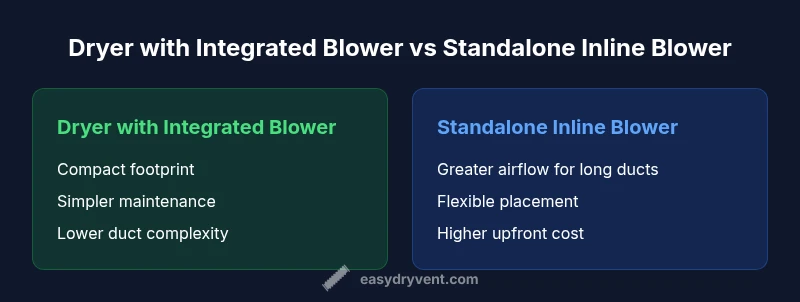
- Integrated blower models: The blower is built into the dryer, simplifying installation and reducing duct complexity but potentially limiting upgrading options.
- Standalone inline blowers: An external unit provides targeted airflow, often enabling longer vent runs, greater control over duct pressure, and easier future replacement or upgrade.
Each setup has implications for how air leaks are detected, how lint accumulates inside the ducts, and how noise propagates through the house. Understanding these differences helps in planning maintenance schedules and selecting the right components for your home.
Design variations: integrated vs standalone blowers
The two primary design variations—integrated blowers and standalone inline blowers—drive many of the practical decisions homeowners face. Integrated blowers are compact and tend to reduce the number of flying parts and potential leak points, which can simplify maintenance and compliance with venting codes. Standalone inline blowers, by contrast, offer flexibility. They allow you to tailor airflow for long runs, adjust to changes in vent routing, or upgrade capacity without replacing the entire dryer.
From a space perspective, integrated blowers consolidate the system, potentially saving space and simplifying routing. External blowers require more room for installation and often more attention to vibration isolation and mounting stability. Both designs require proper duct sizing, clean ducts, and regular lint removal to maintain safe operation and optimal drying performance.
Performance considerations: airflow, heat, energy use, and safety
Airflow quality and energy performance hinge on the interaction between the dryer, the blower, and the ductwork. An integrated blower can be tuned for the dryer’s heat profile, which may improve efficiency in short vent runs but may struggle if vent length increases due to fixed internal paths. A standalone blower can compensate for long duct runs and multiple bends by delivering higher static pressure, but that advantage comes with energy use and noise considerations.
Safety is a core concern for both configurations. Adequate airflow reduces lint buildup, which is a leading cause of dryer fires. Both setups require a clean lint filter on the dryer and regular inspection of ductwork for leaks, kinks, and crush points. In all cases, keeping the vent path as straight and short as possible, using smooth interior ducting, and ensuring proper vent hood operation are crucial steps to minimize fire risk and maximize drying performance.
Maintenance routines: how to inspect and care for each
Regular maintenance is essential for both dryer and blower components. For integrated blower configurations, routine tasks focus on lint buildup in the dryer housing and vent connections, checking seals around access panels, and ensuring the exhaust duct remains unobstructed. For standalone inline blowers, maintenance includes cleaning the blower housing, inspecting electrical connections, and verifying that the external vent cap opens unobstructed to prevent backdrafts.
A practical maintenance cadence includes a monthly visual inspection of the vent path, a quarterly lint trap cleaning, and a biannual professional duct cleaning if you notice reduced airflow or excessive lint accumulation. Record keeping—date of last cleaning, observed issues, and any repairs—helps you track wear and predict when components need replacement. Proper maintenance reduces energy waste and extends the life of the drying system.
Installation scenarios and common mistakes
Choosing between integrated vs standalone blowers often hinges on installation context. In new construction, an integrated approach can reduce duct complexity and simplify code compliance. In retrofit projects, a standalone inline blower can provide a practical upgrade path for long vent runs or difficult duct routing. Common mistakes include underestimating duct length, using very sharp bends, and neglecting to seal duct joints. These issues create backpressure, reduce drying efficiency, and increase lint residue in the system.
Before installation, map the entire vent path from dryer exhaust to the exterior vent hood. Measure the total length, count the bends, and select duct materials with smooth interiors to minimize resistance. After installation, perform a test run to verify that airflow is strong at the exterior hood and that there are no unusual noises or vibrations.
Safety and code considerations: meeting standards
Ventilation work must align with local building codes and industry standards. Ensure that duct materials are rated for high temperatures and lint resistance, that joints are properly sealed, and that the exterior vent hood is free of obstructions. Electrical components associated with blowers require correct wiring and GFCI protection where applicable. A professional inspection can confirm that the system meets safety guidelines and performance expectations. Remember that a well-designed and well-maintained system reduces fire risk and improves energy efficiency over time.
Cost and lifecycle considerations
Cost varies by configuration, brand, duct length, and labor. Integrated blower systems may have a higher upfront cost due to compact design and bundled components, but they can reduce installation time. Standalone inline blowers may involve higher material costs and more complex installation, but offer flexibility for future upgrades or vent path changes. When evaluating lifecycle costs, consider energy consumption, maintenance frequency, and the potential need for duct cleaning. A balanced assessment helps determine the most cost-effective solution for your home.
Practical decision framework for homeowners
To decide between a dryer with an integrated blower and a standalone inline blower, start by assessing vent length, layout, and accessibility. If your vent path is relatively short and straight, an integrated blower can offer simplicity and space efficiency. If your vent run is long or features multiple bends, a standalone inline blower may deliver better airflow and more reliable performance. Always factor in noise tolerance, energy use, and maintenance capacity when making a choice. In many cases, combining professional guidance with a careful home assessment yields the best long-term results.
Quick-start maintenance checklist for your next maintenance day
- Inspect exterior vent cap for obstructions; clear debris and test opening
- Check for visible lint along the vent path and around the dryer cabinet
- Clean dryer lint screen according to manufacturer instructions
- Inspect duct joints for gaps and reseal if necessary
- Listen for unusual noises from the blower housing or vent run and address promptly
- Schedule a professional inspection if airflow seems reduced or you notice longer drying times
Real-world scenarios and case studies
In a suburban home with a 25-foot duct run and two 90-degree bends, upgrading to a standalone inline blower reduced drying times by approximately 15-20 percent and improved vent airflow consistency across cycles. In another case, a compact apartment required an integrated blower model due to limited space, with careful attention to duct routing to avoid backpressure and lint buildup. These scenarios illustrate how vent length, bends, and space constraints influence the choice between integrated vs standalone blowers. Real-world results vary by setup, but the principles—proper duct sizing, regular lint removal, and timely maintenance—remain universal across configurations.
Additional resources and where to learn more
For further guidance on dryer vent maintenance, consult local building codes, manufacturer manuals, and national safety resources. Easy DryVent publishes practical tips on lint management, vent cleaning frequency, and safe venting practices. You can also access consumer-safe guides from recognized educational institutions and government agencies that address dryer safety and ventilation standards.
Best practices for DIY homeowners
When managing a dryer-blower vent system, prioritize safety, efficiency, and maintainability. Use smooth interior ducting, avoid undersized runs, and schedule regular checks. Keep a maintenance log and treat lint removal as non-negotiable. If you are unsure about wiring a blower or modifying vent routes, hire a licensed professional to ensure code compliance and safe operation.
Comparison
| Feature | Dryer with integrated blower | Standalone inline blower |
|---|---|---|
| Primary function | Converts electrical energy to heat and dries clothes; blower inside the dryer | Moves and controls air flow through vent system; external unit added to improve airflow |
| Heat exposure in exhaust | Heats exhaust air within dryer's path | No heat generated by external blower; heat is from the dryer itself |
| Energy efficiency | Depends on model; optimized for short runs | Can improve efficiency on long or complex vent runs |
| Maintenance needs | Lint filter, internal duct cleaning, seals | Duct cleaning, blower housing maintenance, electrical checks |
| Installation complexity | Usually simpler; fewer external components | Requires mounting space and ducting; potential vibration concerns |
| Best for | Small spaces and straightforward runs | Long vent runs, retrofit projects, flexible placement |
The Good
- Consolidated components can reduce clutter and install time
- Integrated blowers may simplify maintenance and reduce service calls
- Lower risk of external duct leaks when using integrated systems
- Compact design suits small laundry rooms
- Fewer potential failure points in tightly engineered units
Negatives
- Less flexibility to upgrade the blower independently
- Standalone blowers can deliver higher airflow for long ducts
- External systems may require more maintenance in ductwork
- Higher upfront cost for integrated units in some cases
- Noise and vibration considerations with external blowers
Integrated dryer blowers win for compact, straightforward setups; standalone blowers win for long, complex vent runs
Choose integrated if you want a simpler, space-saving solution with fewer parts. Choose standalone inline blowers for longer vent runs, easier upgrades, and flexible placement. Both options require diligent lint management and regular vent cleaning to maximize safety and efficiency.
Common Questions
What is the main difference between a dryer and a blower in vent systems?
The dryer is the appliance that produces heat to dry clothes and exhausts air through a vent. A blower is a separate air-moving device (or integrated into the dryer) that pushes air through the vent to carry moisture outside. The key distinction is function: heat generation versus air movement.
The dryer generates heat and dries clothes; a blower pushes air through the vent to move that hot, moist air outside.
Can I replace my dryer's blower with a standalone inline blower?
Yes, in many cases you can replace an integrated blower with a standalone inline blower, but it depends on your duct layout and dryer model. You may need additional mounting hardware and careful duct sizing to maintain proper airflow.
It can be done if the duct layout allows for a standalone blower; check sizing and mounting needs first.
Is a dryer with an integrated blower more energy-efficient than a standalone blower?
Energy efficiency depends on the overall system design. An integrated blower can be efficient in short vent runs, but a standalone blower often provides better efficiency for long or complex vent paths by maintaining stable airflow.
Efficiency varies by setup; integrated blowers are efficient in short runs, standalone blowers help long runs.
What maintenance tasks are common to both devices?
Both configurations require regular lint trapping, vent cleaning, and inspection of duct joints for leaks. Periodic blower or motor checks and seal inspections help prevent energy loss and fire risk.
Lint removal, vent cleaning, and joint inspections are key for both setups.
How do vent length and bends affect blower performance?
Long vent runs and many bends increase resistance, reducing airflow. A blower can compensate to some extent, but excessive length or sharp bends may require larger ducting or a standalone blower for adequate performance.
Long ducts and bends reduce airflow; a suitably sized blower helps, but routing matters most.
Are there safety concerns when using dryers and blowers together?
Yes. Poor venting can lead to lint buildup, moisture, and fire risk. Ensure proper clearance, adequate venting, and adherence to codes. Regular inspections are essential for safety.
Fire risk and moisture buildup are the main safety concerns; keep venting clean and up to code.
Key Points
- Assess vent length and bends before choosing a blower configuration
- Prioritize regular lint removal and duct cleaning to reduce fire risk
- Balance upfront costs with long-term energy savings and maintenance needs
- Choose integrated units for compact spaces; choose inline blowers for retrofit flexibility
- Follow a maintenance schedule to sustain drying performance over time