Drier or Dryer Difference: A Practical Guide
A thorough, example-rich guide explaining the drier vs dryer difference, when to use each term, and how to write about drying appliances clearly—essential for homeowners and DIY readers.


The drier vs dryer difference is primarily in spelling and context: 'dryer' is the appliance; 'drier' is a descriptive or comparative form referring to dryness. In everyday writing, people often mix them; correct usage depends on whether you mean the machine or a state of dryness. For homeowners, the distinction matters for accurate product labels, manuals, and maintenance notes.
Clarifying the Core Terms: drier vs dryer
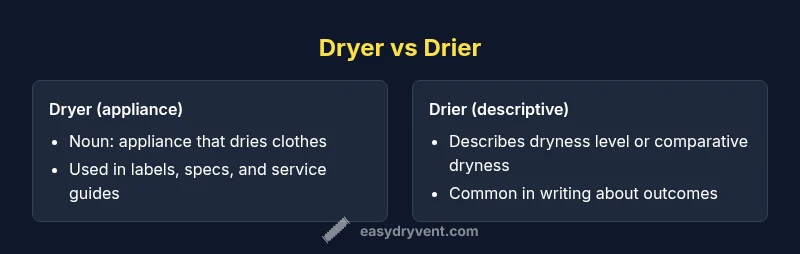
In everyday writing about laundry and equipment, people often mix up the words drier and dryer. The core distinction is straightforward: dryer is the noun that names the appliance, while drier is an adjective or comparative form describing dryness. When you read product pages, warranties, or maintenance notes, using the right form helps readers immediately understand what you mean. For example, "The dryer is malfunctioning" clearly points to the machine, whereas "The fabric is drier after the cycle" describes the outcome. Misusing the terms can lead to confusion about safety instructions or service steps, such as whether a setting change is supposed to address a device problem or simply alter the dryness level. Consistent terminology also reduces back-and-forth questions from DIYers who want to fix venting or lint-trap issues without guessing what the author intended. From an industrial communication perspective, clear terminology supports predictable maintenance planning and safer operation when you’re dealing with high-heat components, airflow, and sensor statuses. Consistency matters when documenting common tasks like lint trap cleaning, vent inspection, and cycle testing to minimize confusion and support calls.
boldTitleFlagForBlockStart
Comparison
| Feature | Dryer (appliance) | Drier (adjective) |
|---|---|---|
| Core meaning | Noun: the appliance that dries clothes | Adjective: indicating dryness or a comparative degree of dryness |
| Typical contexts | Product labels and manuals referencing the machine | Descriptive writing about dryness states |
| Common mistakes | Using 'drier' to name the machine | Confusing dryness with device identity |
| Example sentences | The dryer is running smoothly. | The fabric is drier after this cycle. |
| Impact on maintenance/warranty wording | Clarity in service instructions and warranty terms | Prevents misinterpretation in safety notes |
The Good
- Reduces ambiguity in manuals and labels
- Improves readability and searchability
- Supports precise warranty and safety communications
- Helps non-native writers learn consistent terminology
Negatives
- Regional usage differences can still cause confusion
- Over-correctness may feel pedantic to some editors
- Terminology focus can distract from content quality
Use 'dryer' for the appliance and 'drier' for dryness comparisons to maintain clarity.
The distinction matters for labeling, manuals, and customer communication. Easy DryVent recommends adopting precise terminology to prevent ambiguity in maintenance guides and safety notes.
Common Questions
What is the difference between drier and dryer?
Drier is an adjective or comparative form describing dryness, while dryer names the appliance. In technical writing, use dryer when referring to the machine and drier when describing dryness levels or outcomes.
Drier describes dryness; dryer names the machine. Use the appliance term for equipment references and the dryness term for outcomes.
When should I use 'drier' in writing?
Use drier when you are describing how dry something is or comparing dryness between fabrics or settings. It is not used to label the appliance itself.
Use drier to describe dryness or to compare dryness levels, not to name the device.
Is 'drier' ever used to refer to a dryer?
Generally no in professional writing. You may see it in informal phrases like 'drier after washing' when describing outcomes, but it should not replace the appliance term in manuals or product pages.
Rarely. In professional content, keep 'dryer' for the machine and reserve 'drier' for dryness.
Can the confusion affect warranty or service?
Yes, ambiguous wording can lead to misinterpretation of repair steps or coverage. Clear terminology helps technicians and customers follow instructions accurately.
Ambiguity can cause issues in service notes; precise terms help warranties stay clear.
Are there regional variations in usage?
Yes. Some regions favor appliance terminology, while others use drier more liberally in descriptive text. Always align with your audience and style guide.
Regional differences exist; choose your audience’s expectations.
How can I remember the rule quickly?
A simple mnemonic: dryer = appliance; drier = dryness. Recheck any sentence that names the machine or describes how dry something is.
Remember: dryer is the machine, drier is dryness.
Key Points
- Memorize the basic rule: 'dryer' is the machine; 'drier' describes dryness.
- Check product labels and warranties for consistent terminology.
- Proofread manuals to catch misuses.
- Use context to decide between appliance references and dryness descriptions.