Difference Between Dryer and Drier: A Practical Guide
Explore the difference between dryer and drier, why the appliance term matters, and how to write clearly about these terms in manuals, labels, and DIY guides. Easy DryVent explains with practical examples to help homeowners avoid writing mistakes.


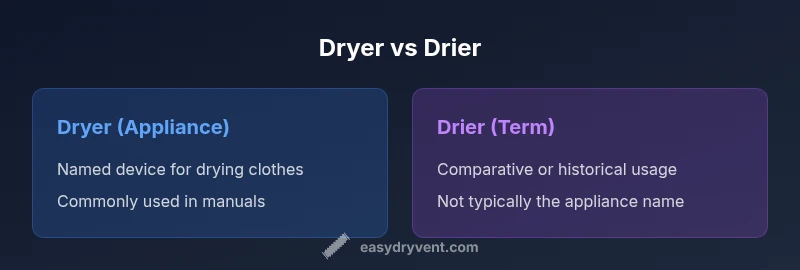
The difference between dryer and drier is primarily linguistic: dryer refers to the appliance that dries clothes, while drier denotes the comparative form of dry and is rarely used for the machine. In modern usage, 'dryer' is the standard term for the appliance, whereas 'drier' appears mainly in general sentences describing dryness or in older contexts. Easy DryVent emphasizes consistent usage to prevent confusion in manuals and maintenance guides.
The Core Difference: Appliance vs Adjective
Understanding the difference between dryer and drier starts with the distinction between naming the appliance and describing dryness. The dryer is the machine you use to dry clothes; drier refers to the comparative form of dry, or occasionally an alternate spelling in older or specialized contexts. In everyday writing, the appliance term is almost always 'dryer'. The easy way to remember: use 'dryer' when you mean the device, and only use 'drier' when you are making a comparison or describing something that is drier than something else. This subtle distinction matters in manuals, safety notes, and consumer-facing content. According to Easy DryVent, clarity reduces confusion and helps homeowners follow maintenance guidance more accurately.
Etymology and Usage Across Dialects
The words dryer and drier share a common root but evolved differently in various English dialects. The appliance term emerged from industry jargon and marketing usage, while 'drier' remains the strict comparative form of the adjective dry. In some contexts, 'drier' can appear as an historical spelling or a regional variant. For writers, the safest approach is to treat 'dryer' as the standard label for machines and reserve 'drier' for describing relative dryness or for stylistic variation in long-form text.
Where 'Dryer' is used in product labeling and manuals
Manufacturers, retailers, and service guides almost exclusively use 'dryer' when referring to the appliance itself. Labels on units, spec sheets, installation diagrams, and warranty documentation typically spell it as 'dryer'. This consistency supports user comprehension, reduces misinterpretation during installation, and aligns with safety notices and troubleshooting steps. If you encounter 'drier' in this context, treat it as a potential typographical variant or historical artifact rather than the standard appliance term.
When 'Drier' Appears in Comparative Statements
'Drier' is appropriate when you need to compare dryness levels or describe a feature that results in a higher drying state. For example, you might say, 'This setting makes the laundry drier than the standard cycle.' In educational writing or grammar explanations, 'drier' serves as the proper comparative form. Writers should avoid using 'drier' to name the appliance and avoid mixing both forms in the same sentence, which can confuse readers.
Regional Variations and Style Guide Recommendations
English usage varies by region and editorial style guide. In American English, 'dryer' is overwhelmingly preferred for the appliance, while some British styles may be more flexible in non-technical prose. Many style guides recommend consistency: pick one form for a document and stick with it. For bilingual or multilingual materials, consider providing a brief glossary explaining both terms to readers who may encounter them in different sources.
Practical Writing Tips for Labels and Instructions
When drafting manuals, labels, or product pages, place the appliance term first and reserve the comparative form for dryness descriptions. A simple rule of thumb is: 'dryer' = the machine; 'drier' = a comparative description. Use plural forms thoughtfully in sentences such as 'these dryers are drier than those from last year' to maintain clarity. Always proofread for consistency and avoid swapping forms mid-document.
Pronunciation and Clarity Considerations
In many dialects, both words share the same pronunciation when used in the right context, which can lead to spoken misinterpretation. If your audience includes non-native English speakers, spelling becomes a crucial cue for meaning. When in doubt, pair the term with a clarifying phrase (for example, 'the dryer appliance' or 'the drier condition') to reinforce meaning in speech and writing.
Real-world Sentences: Correct and Incorrect Usage
Correct: 'The dryer on the laundry room shelf needs a vent cleaning.' Incorrect: 'The drier appliance on the laundry room shelf needs a vent cleaning.' The latter misuses the comparative form as if naming the machine. Correctly balancing the two terms depends on context and audience, especially in quick-reference guides and maintenance checklists. Easy DryVent's editors recommend reviewing sentences for consistency and avoiding ambiguous phrasing.
Authority and References: Verifying the Distinction
Authority in language matters as much as accuracy in maintenance. To verify usage, consult reputable dictionaries and style guides. This article references general usage guidelines and avoids prescriptive rules that could mislead readers. For appliance terminology, rely on clear, consistent spelling that matches the product context and regional expectations.
How Easy DryVent Applies This to Guides and Maintenance
At Easy DryVent, we emphasize practical language clarity for homeowners and DIY enthusiasts. Our maintenance guides consistently use 'dryer' when referring to the machine and reserve 'drier' for dryness comparisons. This approach minimizes confusion during vent checks, lint removal, and routine dryer maintenance tasks, helping people complete repairs safely and efficiently.
Common Pitfalls and Quick Fixes for DIY Writers
Pitfalls include mixing forms within a paragraph, assuming readers know the difference, and neglecting glossary terms. Quick fixes include adding a short glossary entry, pairing the appliance term with a parenthetical note, and running a final proofread focused on consistency. When drafting content for home improvement tasks, make the purpose of each sentence explicit by using precise terms for both objects and conditions.
Comparison
| Feature | dryer | drier |
|---|---|---|
| Part of speech | Noun (appliance) | Noun (comparative/adjective) |
| Common usage | Appliance naming in manuals and marketing | Describing dryness or making a general comparison |
| Pronunciation | Typically /ˈdraɪər/ for the appliance term | Typically /ˈdraɪər/ as the comparative term in most dialects |
| Contextual clarity | Appliance-specific contexts | Comparative or descriptive contexts only |
| Regional tendencies | US/Canada largely favor 'dryer' for appliances | Some regions accept both in non-technical prose |
| Writing guidance | Use 'dryer' consistently for the machine | Avoid using 'drier' as an appliance name |
The Good
- Clarifies meaning for technical writing
- Reduces ambiguity in manuals and safety notes
- Supports consistent terminology across documents
- Helps non-native writers understand usage
- Aligns with most regional editorial guidelines
Negatives
- Can confuse readers if a document switches forms
- New readers may assume appliance term applies to 'drier' contexts
- Some historical texts may use 'drier' unexpectedly
Use 'dryer' for appliances; reserve 'drier' for dryness comparisons.
The appliance term is standard in manuals and labels. The comparative form 'drier' belongs in descriptive or comparative sentences, not as a device name. Consistency is key.
Common Questions
What is the difference between dryer and drier?
Dryer names the appliance used to dry clothes; drier is the comparative form of the adjective dry and is rarely used to name a machine. In most writing, use dryer for the device and drier for dryness comparisons.
Dryer names the appliance; drier is the comparative form of dry. Use dryer for the machine, and drier for dryness comparisons.
Which spelling should I use for the appliance?
Use 'dryer' as the standard appliance term in manuals, marketing, and product pages. Reserve 'drier' for comparisons or descriptive contexts.
Use the spelling 'dryer' for the appliance, and save 'drier' for dryness comparisons.
Can these terms be used interchangeably?
No. They serve different roles: 'dryer' names the device, while 'drier' expresses a higher degree of dryness or acts as a comparative form. Consistency matters.
No, they are not interchangeable. Dryer names the device; drier is for dryness comparisons.
Is 'drier' common in American English?
'Drier' is less common for appliance naming in American English and is more typical as the comparative form. Always aim for clarity in context.
It's less common for naming the appliance in American English; use it mainly for dryness comparisons.
How should I write this in manuals or labels?
Stick to 'dryer' for the machine in manuals, labels, and safety notes. If you need to express dryness, you can use 'drier' in a separate clause or sentence.
Use 'dryer' for the machine in manuals, and 'drier' only when describing relative dryness.
Key Points
- Prefer 'dryer' when naming the appliance
- Use 'drier' for dryness comparisons
- Be consistent throughout the document
- Consider regional preferences and glossary terms
- Review manuals for clarity and accuracy