Tumble Dryer vs Dryer: A Practical Side-by-Side Guide
A practical, analytical comparison of tumble dryer vs dryer, covering venting, energy use, costs, and installation. Learn how to choose the right dryer for safe, efficient drying with Easy DryVent insights.


TL;DR: When comparing tumble dryer vs dryer, the key differences hinge on venting, energy use, and upfront costs. A tumble dryer (often vented) can be cheaper to buy but may cost more to run and require proper venting. A newer non-vented dryer (condensing/heat pump) typically saves energy but may have higher upfront costs and installation constraints. This guide breaks down the trade-offs.
Definition and Core Difference
According to Easy DryVent, the term tumble dryer refers to a clothes dryer that uses tumbling action to agitate fabrics while heat is applied. In many markets this contrasts with static or non-tumble options like rack drying or non-tumble compact dryers. The essential difference for homeowners is that tumble dryers cycle between heat and tumbling to remove moisture from garments, whereas other dryer variants might use different moisture handling methods or venting configurations. The reader should understand that venting plays a critical role in performance: vented tumble dryers expel hot, humid air through a duct to the outdoors, while ventless models condense moisture inside the unit and drain it away. The two broad families also differ in energy profiles and installation requirements. Importantly, the landscape has evolved: modern tumble dryers may include heat pump technology, condensers, or dual-vent options, affecting capacity, cycle times, and long-term operating costs. For Easy DryVent, practical guidance always starts with your space, utility hookups, and laundry load patterns.
Comparison
| Feature | tumble dryer | other dryer (non-tumble) |
|---|---|---|
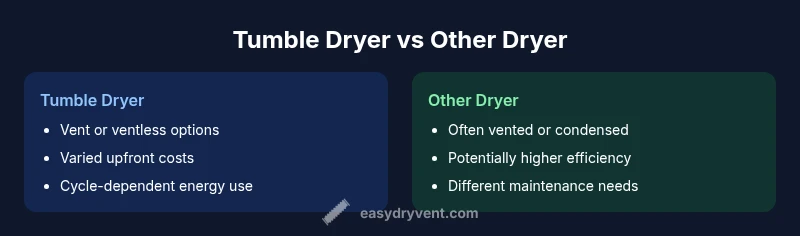
| Ventilation/Exhaust | Requires external vent or condensation setup | Typically vented to outside or uses built-in condensation/water removal |
| Energy Efficiency | Varies by model; heat pump variants are generally most efficient | Varies; higher energy use in many traditional vented models |
| Initial Cost | Mid-range to high upfront | Lower upfront for older vented models, but varies widely |
| Running Cost | Potentially higher for vented models depending on usage | Often lower for heat pump/condensing models due to efficiency |
| Drying Time | Typically longer in energy-efficient models | May have faster cycles but depends on moisture load |
| Maintenance | Lint trapping and vent cleaning required | Condenser maintenance required; self-cleaning options vary |
| Space and Installation | Can require vent ducting and clearance | Compact or built-in options available |
| Best For | Homes with established venting and energy concerns | Smaller spaces or moisture-sensitive homes |
The Good
- Lower upfront cost for traditional vented models
- Waster heat and moisture management is straightforward with existing venting
- Wide availability and faster drying cycles in many vented options
- Easy replacement with standard dimensions and hookups
- Good performance for households with high-volume loads
Negatives
- Higher long-term energy costs for older vented models
- Requires regular vent and lint cleaning to maintain safety
- Vent paths can limit where you can place the machine
- Reliance on venting means exterior installation constraints
Tumble dryer remains a strong baseline option for vented spaces; non-vented, energy-efficient models appeal for long-term savings
Choose a tumble dryer if you have ready venting and want lower upfront costs. Opt for a ventless/heat-pump dryer when energy savings and space flexibility matter most, accepting a higher initial price.
Common Questions
What is the fundamental difference between a tumble dryer and a non-tumble dryer?
A tumble dryer uses rotating drums to tumble clothes while applying heat to remove moisture. Non-tumble drying methods, such as racks or air-drying, do not use a rotating drum or heated air as part of a mechanical drying cycle. In the dryer context, most “non-tumble” references are variants of vented vs ventless drying that manage moisture differently.
The key difference is motion and heat: tumblers tumble with heat, while non-tumble methods rely on other drying methods or passive air drying.
Do tumble dryers require venting to the outdoors?
Many traditional tumble dryers require venting to the outdoors to expel humid air. Ventless or condenser models condense moisture internally and drain it away, removing the need for an external vent. Always check your model’s venting requirements and local building codes.
Most traditional tumbles need venting outside, but ventless options exist if venting isn’t feasible.
Are heat-pump dryers worth the extra upfront cost?
Heat-pump dryers are generally more energy-efficient and can reduce running costs over time, especially with frequent use. The payback period depends on usage, electricity prices, and the specific model.
If you dry a lot and want lower energy bills, heat-pump may be worth it in the long run.
Which dryer is cheaper to run for a busy household?
For high-volume use, energy-efficient, ventless heat-pump models typically offer lower running costs over time, while traditional vented units may be cheaper upfront but cost more to operate.
Energy-efficient options tend to be cheaper to run over time, especially with frequent use.
Can I convert a vented tumble dryer into a ventless model after purchase?
Conversion is not typically feasible for most units. If venting constraints exist, consider replacing with a ventless or heat-pump model. Check the manufacturer’s guidance and installation requirements.
Converting is usually not an option; you’ll likely need a different model.
Key Points
- Assess existing venting before choosing.
- Energy-efficient ventless options offer long-term savings.
- Expect installation constraints with vented models.
- Heat-pump variants provide higher upfront costs but lower running costs.
- Regular maintenance reduces fire risk and improves performance.