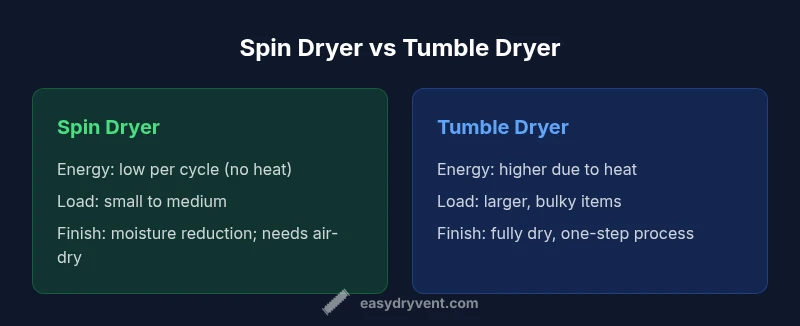
Spin Dryer vs Tumble Dryer: A Practical Guide
An objective, in-depth comparison of spin dryer vs tumble dryer, covering how they work, energy use, capacity, space needs, costs, and ideal use cases for homeowners and DIY enthusiasts.


Spin dryer vs tumble dryer: spin dryers remove water by centrifugal force without heat, while tumble dryers use heated air to dry clothes completely. Spin dryers are energy-efficient for quick moisture reduction and are ideal for small spaces or apartments. Tumble dryers deliver full, convenient drying for larger loads but typically consume more energy. Your choice depends on space, energy goals, and how you dry most days.
Understanding Spin Dryer vs Tumble Dryer: Scope and Context
According to Easy DryVent, choosing between a spin dryer and a tumble dryer hinges on your drying goals, available space, and energy priorities. This guide compares the two types beyond simplistic cost analyses, focusing on how they fit into real-world laundry routines. Spin dryers excel at removing moisture quickly through centrifugal action without heat, making them ideal for compact homes, while tumble dryers rely on heated air to finish the job in a single, convenient cycle. For homeowners who already air-dry or line-dry part of their laundry, a spin dryer can be a strategic component that reduces energy use by cutting moisture before any final warm-air drying. The broader decision often revolves around balance: space, time, and the size of typical loads. Throughout this article we use the term spin dryer vs tumble dryer to reflect the two core approaches so you can compare them on a like-for-like basis and decide what really matters to you.
How Spin Dryers Work: The Power of Centrifugal Water Removal
Spin dryers operate by spinning clothes at high speeds, forcing water out of fabrics and into the collection chamber via centrifugal force. Since no heat is applied during the primary cycle, electricity use tends to be lower per minute of operation than heated dryers. The resulting moisture level is reduced significantly, but most spin-drying cycles stop before complete dryness to avoid fabric damage. This is where air-drying or rack-drying comes in to finish the job. For compact homes, a spin dryer offers a practical way to cut damp weight and reduce subsequent drying time without committing to a larger heated appliance. In settings where space and energy are at a premium, spin drying becomes a valuable partner in the laundry workflow.
How Tumble Dryers Work: Heat-Driven Drying for Convenience
Tumble dryers rely on heated air circulated through a rotating drum to evaporate moisture from textiles. This heat-based convection process is designed to dry a full load in a single cycle, including bulky items like towels or bedding. The appliance’s efficiency depends on heat source (electric or gas), drum design, and venting efficiency. While tumble dryers provide the most convenient, one-step drying solution for many households, they generally consume more energy and may require regular vent maintenance or condenser cleaning. Understanding the mechanism helps homeowners weigh the trade-offs between speed, energy use, and fabric care.
Energy Use and Efficiency: Spin vs Heat in Real Homes
In typical home usage, a spin dryer consumes less energy per minute than a heated tumble dryer, but the total energy footprint depends on what happens after the spin cycle. If you air-dry or rack-dry the remaining moisture, you may achieve a lower overall energy bill than running a full heat-based cycle. Easy DryVent analysis shows that combining a spin dryer with strategic air-drying can dramatically reduce electricity consumption for small- to medium-sized loads. However, for households with heavy weekly loads or bulky fabrics, a tumble dryer may still be more energy-efficient on a per-item basis due to the time saved and the ability to dry larger quantities in fewer cycles. The key is to match your energy goals with your typical laundry profile.
Drying Time and Load Capacity: What to Expect in Daily Use
Spin dryers excel at reducing moisture quickly for small to medium loads, but they do not deliver full dryness for most fabrics. Expect longer total drying times if you rely solely on a spin cycle paired with air drying. Tumble dryers, by contrast, can complete drying in fewer overall hours per cycle for medium to large loads, provided you have access to electricity and proper venting. The difference matters most when you have a busy household or frequent large washes. In many households, the optimal strategy is a hybrid approach: use the spin cycle to extract moisture, then finish with a shorter heated cycle in the tumble dryer. This hybrid approach can balance energy use with convenience.
Space, Noise, and Installation Considerations for Small Homes
Space constraints strongly influence which option makes sense for your home. Spin dryers tend to be more compact, can often be placed on a countertop or stacked with careful engineering, and generally produce less heat in the room. Tumble dryers require more footprint and, if vented, venting routing that must be considered during installation. Noise profiles vary by model but are typically modest with properly chosen front-loading designs. If you are tight on space or share walls with living areas, a spin dryer plus air-drying setup may minimize disruption while still delivering cleaner clothing.
Cost and Total Ownership: Upfront and Operating Costs to Consider
Purchase price and operating costs are major factors in the spin dryer vs tumble dryer decision. Spin dryers usually sit at a lower upfront cost and lower ongoing energy use per cycle when finishing with air drying, while tumble dryers command higher upfront prices and higher energy consumption per cycle due to heating. However, if you routinely wash large volumes, a larger capacity tumble dryer may offer lower cost-per-item over time thanks to reduced cycle frequency. Consider your local electricity rates, typical load size, and whether you plan to upgrade ventilation or add external drying spaces. A well-planned hybrid approach can lower overall energy usage while delivering acceptable convenience.
Best Use Cases: Spin Dryer Scenarios That Shine
Spin dryers shine when you live in a small apartment, rely on line-drying for most items, or want to minimize energy use for many daily loads. They are particularly helpful for delicates or sportswear where gentle handling is a benefit and the load is not overly large. For households with larger families, frequent heavy loads, or towels and bedding that demand reliable full dryness, a heated tumble dryer provides decisive convenience and speed. The spin-dryer-plus-air-dry combination often yields the best balance between energy use and practicality in mixed laundry environments.
Best Use Scenarios for Tumble Dryers: When Full Dryness Wins
Tumble dryers are most valuable when you need consistent, complete dryness in a single cycle, especially for large blankets, towels, or a full family wash. They are well-suited to households with limited outdoor drying space or unpredictable weather. If your priority is simplicity, speed, and minimal manual handling of wet items, a tumble dryer reduces the overall effort required to cycle through laundry. In this context, the spin dryer serves as an energy-saving pre-dryer rather than a full replacement.
Combining Spin Drying with Air Drying and Rack Systems
A practical strategy for energy-conscious households is to use a spin dryer to remove the majority of moisture before finalizing the dry with air drying or a short heated cycle in a tumble dryer. This approach minimizes heat exposure and reduces total energy consumption while maintaining fabric integrity. Integrate this workflow with a small laundry setup that includes a drying rack or a compact clothesline. The combined system helps you adapt to weather, time constraints, and energy goals without sacrificing cleanliness or fabric care.
Comparison
| Feature | Spin Dryer | Tumble Dryer | |
|---|---|---|---|
| Drying Method | Centrifugal moisture removal (no heat) | Heat-based convection with moisture removal | |
| Energy Efficiency | Lower energy per cycle; overall energy savings when paired with air drying | Higher energy use due to heating; efficient models exist but consume more energy | |
| Load Capacity | Typically smaller loads | Larger loads including bulky items | |
| Drying Time | Faster moisture removal but often longer final finish | Faster complete dryness in single cycle | |
| Space Requirements | Compact footprint; flexible placement | Larger footprint; venting or condenser options | |
| Maintenance | Fewer moving parts; ventless variants available | Regular vent/condenser cleaning required | |
| Upfront Cost | Low to mid price range | Mid to high price range depending on capacity | Best For |
The Good
- Spin dryer reduces moisture without heat, cutting energy use for small loads
- Compact footprint makes it suitable for apartments
- Can be paired with air-drying to minimize energy impact
- Delivers quicker initial moisture removal, easing subsequent drying
Negatives
- Cannot fully dry most fabrics; requires air drying or a second step
- Limited load capacity and longer total cycle time for bulky items
- Not ideal for towels or heavy bedding without a final heated step
- May require additional space for a drying rack or air-dry setup
Spin dryer is a strong energy-saving option for small loads and limited spaces; tumble dryer remains the more convenient full-dry solution for larger households.
Use a spin dryer when space and energy are your top concerns and you frequently air-dry. For busy households with large or bulky laundry, a tumble dryer offers reliable, one-step drying. A hybrid approach often delivers the best balance of energy, time, and fabric care.
Common Questions
Can a spin dryer replace a tumble dryer in a home laundry setup?
In many cases, a spin dryer cannot fully replace a tumble dryer because it typically finishes moisture reduction rather than complete drying. For households that air-dry or use rack-drying, a spin dryer can dramatically cut overall drying time and energy use. If you need one-step drying for towels and bulky items, a tumble dryer remains more practical.
Spin dryers cut moisture, but usually you still need air-drying or a heated cycle for full dryness.
Is a spin dryer energy-efficient compared to a traditional heated dryer?
Yes, spin drying generally uses less energy per cycle since it doesn’t heat the air. The total energy savings depend on how you complete the final drying step. In energy-conscious households, pairing a spin dryer with air drying can be significantly more efficient than running a heated tumble dryer for every load.
Spin drying uses less energy per cycle, especially when paired with air-drying.
What fabrics work best in a spin dryer?
Delicates, synthetics, and lightweight cottons that tolerate high spin speeds dry well after moisture is extracted. Avoid extremely delicate or heavily linting fabrics that may snag or deform if spun aggressively. Always follow garment care labels and test on a small piece first.
Lightweight fabrics dry well after spinning; check care labels for delicate items.
How much space do spin and tumble dryers typically require?
Spin dryers require less space and can often fit in compact laundry areas or be stacked with a line-drying setup. Tumble dryers need a larger footprint and, if vented, room for venting. If space is tight, a spin dryer plus air-drying setup is appealing.
Spin dryers fit smaller spaces; tumble dryers need more room and venting space.
What should I look for when buying spin vs tumble dryers?
For spin dryers, prioritize drum speed, capacity, and ease of draining water. For tumble dryers, look at energy efficiency, drum size, heat source, and venting or condenser configuration. Consider your typical laundry volume and whether you plan to air-dry part of your loads.
Check speed, capacity, and energy features that match your laundry habits.
Are spin dryers suitable for towels and bedding?
Spin dryers can handle towels after washing but usually do not achieve full dryness on their own. A tumble dryer or extended air-drying finish is often necessary for bulky items like towels and bedding.
Towels may need a final heated or extended air-dry cycle after spinning.
Key Points
- Evaluate space and energy goals before choosing
- Spin dryers excel at moisture reduction without heat
- Tumble dryers offer full, convenient drying for larger loads
- Hybrid setups can minimize energy use while maintaining convenience