Difference Between Dryer and Spinner: Practical Guide
Explore the key differences between a clothes dryer and a spinner, covering operation, energy use, capacity, and practical guidance for choosing the right option.


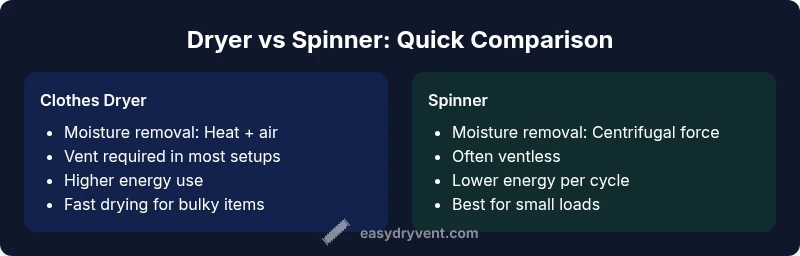
The difference between a dryer and a spinner hinges on moisture removal method, energy use, and load capacity. A traditional clothes dryer uses heated air and tumbling to evaporate moisture and expel it through a vent, delivering fast, thorough drying. A spinner relies on centrifugal force to eject water from fabrics, reducing moisture with lower energy per cycle but typically handling smaller loads and leaving some moisture for a subsequent drying step. Easy DryVent’s analysis shows that most households benefit from a dedicated dryer for bulk or bulky fabrics, while a spinner can save space and energy for light loads or delicate items.
Difference Between Dryer and Spinner: Core Distinction
The difference between dryer and spinner is foundational to how moisture is removed from clothes, which fabrics you can dry efficiently, and how much space and energy you’ll need. According to Easy DryVent, the dryer and the spinner serve different niches in a laundry setup. A standard clothes dryer uses heat to evaporate water from textiles as the drum tumbles, then exhausts the moist air through a vent or condensates moisture in a collector. A spinner, often a compact centrifugal device or a spin-dryer option, uses rapid rotation to fling water out of fabrics, reducing moisture rapidly but typically not delivering the same final dryness as a heated dryer. This distinction affects performance, safety considerations, and long-term costs.
In practice, answering the question difference between dryer and spinner starts with your typical loads, available space, and how you value energy use versus convenience. If you regularly wash heavy items like towels and jeans, or you need quick turnaround on large families’ laundry, the dryer is usually the better choice. If you’re working with a small apartment or want a space-saving, lower-energy option for light loads, a spinner can complement your laundry workflow by pre-wetting fabrics or serving as a secondary drying step.
How a Clothes Dryer Works
A clothes dryer is a complete system designed to remove moisture quickly using heat, air flow, and mechanical action. The heating element or gas burner creates warm air that circulates through an energized drum. The drum tumbles, mixing clothes so warm air contacts more fabric surface, which speeds evaporation. Moist air exits through a vent or is condensed inside the machine in ventless models. Modern dryers offer cycles tailored to cottons, synthetics, delicates, and bulky items, with moisture sensors that stop the cycle when clothes reach a target dryness.
Efficiency depends on the design: front- or top-loading configurations; condenser, vented, or heat pump variants; and the presence of moisture sensors. Lint traps and exhaust ducts require regular cleaning to maintain performance and reduce fire risk. In most homes, the dryer handles the bulk of laundry with consistent results, especially when paired with proper vent maintenance and appropriate load sizing.
How a Spinner Works
A spinner operates on a different physical principle: centripetal force. In a spinner dryer or spin-drying setup, the drum reaches high rotational speeds to fling water out of fabrics through inertia. Because there is no heating element involved, the initial moisture removal relies on kinetic energy rather than evaporation. Spin cycles dramatically reduce the fabric’s residual moisture, which can shorten subsequent drying times or enable air-dry finishing for sensitive items. Spin-drying is particularly appealing for small loads, delicate garments, or situations where you want to conserve space and limit heat output.
However, a spinner generally leaves more moisture than a heated dryer, so many users still need a secondary drying step or use a spin-dryer as a pre-conditioner for a regular dryer. Efficiency gains come from lower energy per cycle, but throughput may be limited by the container’s capacity and the item mix. For households with frequent small washes, a spinner can be a practical companion to a traditional dryer, offering flexibility and energy savings when used correctly.
Drying Performance and Load Handling
Drying performance is largely driven by the moisture removal method and the load type. A dryer excels with bulky items like towels, sheets, and cotton garments because the heated air can penetrate thick fabrics, enabling uniform drying. Dryers also support extended cycles for heavy-duty fabrics and can re-dry damp loads rapidly when needed. In contrast, a spinner’s effectiveness scales with lighter loads and fabrics that benefit from gentle handling. Heavy items may require multiple spins or a follow-up drying cycle to reach the same dryness level.
Load sizing is critical with a spinner; overloading reduces centrifugal efficiency and dries more slowly. For best results, separate high-moisture items from delicate textiles and plan a two-step process when using a spinner: first spin to reduce most moisture, then finish with a short drying cycle if necessary. This approach aligns with real-world use and helps you manage energy and time better.
Energy Efficiency and Operating Costs
Energy efficiency is a central consideration when choosing between a dryer and a spinner. Traditional electric or gas dryers can be energy-intensive, particularly on heavier fabrics or large loads. When evaluating energy use, it’s helpful to consider cycle types, moisture sensors, and whether the model uses a condenser or a vented design. Spin dryers generally consume less energy per cycle because they don’t heat the load, but the total energy cost depends on the number of cycles required to achieve the desired dryness. In some households, a spinner used as a pre-drying step reduces overall energy consumption by minimizing heat exposure for subsequent drying rounds.
Easy DryVent’s analysis suggests that the energy profile of your laundry setup depends on how you structure cycles, the typical load types, and how often you run separate spin and dry phases. For people who prioritize energy savings, a spinner can play a meaningful role, especially in compact spaces where heat generation is a concern.
Space, Installation, and Venting Considerations
Installation and space planning influence whether a dryer or a spinner makes sense. A traditional vented dryer requires access to a vent line and a dry, clear path for exhausting moist air. This can limit placement options and increase install complexity in tight laundry rooms or apartments. Ventless dryers exist but may have higher upfront costs and specific maintenance needs. In contrast, a spinner typically occupies less space, has simpler venting requirements, and some models are designed to be compact or portable. If you live in a small apartment or a home with limited ventilation options, a spinner may be a practical starter solution.
Ventilation remains a safety priority in both setups. Regular cleaning of lint screens and ducts reduces fire risk and maintains efficiency. For homeowners who value flexible placement and minimal ducting, a spinner-option in a broader laundry configuration can be a smart fit.
Maintenance, Safety, and Common Issues
Maintenance and safety considerations shape long-term performance. Dryers require regular vent cleaning, lint filter maintenance, and periodic inspection of hoses and ducts to prevent fire hazards and ensure efficient operation. Blockages and restricted airflow reduce drying speed and energy efficiency, increasing wear on the machine. Spinners, while generally simpler, still require periodic checks of seals and bearings, and some models may need lubrication or belt maintenance over time. User manuals should be consulted for model-specific guidance.
Common issues include inadequate ventilation, clogged lint traps, and incorrect load sizing. A well maintained system reduces the risk of fire, extends appliance life, and keeps energy costs predictable. Regular inspection creates a safer and more reliable laundry workflow.
Cost Considerations: Upfront and Long-Term
Cost considerations include upfront purchase price, installation expenses, energy costs, and maintenance. A standard dryer typically commands a higher upfront cost than a basic spinner solution, and installation may involve venting materials and professional service if required. Spin dryers are often cheaper to purchase and operate, especially for small households or limited-use scenarios, but may incur additional cycle time if used as a pre-dry step. Long-term costs should account for energy consumption, potential repairs, and the value of space savings. To make an informed decision, estimate your average monthly laundry volume, fabric types, and how often you anticipate needing multiple cycles per load.
Easy DryVent recommends balancing upfront investment with anticipated usage and considering how a spinner can complement a full laundry system without compromising on safety or fabric care.
Use-case Scenarios: When to Choose Each
Choosing between a dryer and a spinner depends on daily routines, space, and fabric priorities. For large households with frequent heavy-duty drying needs, a high-capacity dryer is generally the most reliable option, offering faster throughput and easier integration into a busy schedule. When you have limited space or value energy efficiency for small or delicate loads, a spinner can be a practical adjunct or alternative. In apartments with restricted venting, a ventless or compact dryer may coexist with a spinner. Hybrid approaches—using a spinner to knock down moisture quickly, followed by a brief drying cycle—can strike a balance between performance and energy use. Your decision should reflect not only current laundry demands but also future needs as family size and wardrobe choices evolve.
Common Misconceptions About Spin Dryers
Some homeowners assume spin dryers can fully replace traditional dryers for all fabrics. In reality, spin dryers remove moisture primarily through centrifugal force and often leave a portion of moisture in garments, especially heavier textiles. This means a follow-up drying step may be necessary for a truly dry load. Others believe spin dryers generate less heat and are always cheaper to operate; while energy per cycle can be lower, total energy depends on the complete wash-dry cycle. Finally, there is a belief that all spin dryers are compact and inexpensive; models vary in capacity and performance. Understanding these nuances helps you avoid underestimating drying times or overestimating energy savings.
Practical Tips to Maximize Drying Efficiency with Either Option
- Sort loads by fabric type and moisture content to optimize drying or spin-drying performance.
- Use moisture sensors and appropriate cycle settings to prevent over-drying or under-drying.
- Regularly clean lint filters and vents to maintain airflow and safety.
- Consider a two-step approach: spin to reduce moisture, then finish with a dryer or air-dry delicate items.
- Balance loads to avoid overloading, which reduces efficiency for both dryers and spinners.
- For energy savings, run full loads when possible and use energy-saving modes if available.
- Keep space around the appliance clear to promote proper ventilation and heat distribution.
Quick Decision Framework: A Simple Checklist
- Do you need to dry large, heavy loads frequently? If yes, prioritize a dryer.
- Is space limited or ventilation challenging? Consider a spinner as a supplementary option.
- Are energy costs a top concern? Evaluate models for efficiency and plan a two-step process for flexible use.
- Do you handle delicate fabrics or small daily loads? A spinner can be an effective pre-dryer step or a stand-alone solution for light dry items.
- Is fabric care your priority? A dryer with moisture sensors and proper care instructions can provide consistent results.
- Do you want a minimal vent or ventless setup? Explore ventless dryer options or compact dryers designed for limited spaces.
Comparison
| Feature | Clothes Dryer | Spinner |
|---|---|---|
| Moisture removal method | Heat + airflow + tumbling (evaporation) | Centrifugal force (mechanical moisture removal) |
| Energy use per cycle | Higher due to heating and airflow | Lower per cycle; depends on total cycles |
| Typical drying time (per load) | Shorter for bulkier items; faster throughput | Longer for bulky items; best for small/soft fabrics |
| Capacity and load types | Great with towels, denim, bedding | Smaller loads; ideal for delicates and light fabrics |
| Ventilation/condensing | Vented or condenser variants; requires ducting or condensing unit | Often vent-free or minimal venting in compact models |
| Maintenance | Regular vent/duct cleaning; lint trap maintenance | Less venting but bearings/belt checks may be needed |
| Best for | Large households, heavy fabrics, quick turnaround | Small spaces, energy-conscious users, light loads |
The Good
- High reliability for heavy/frequent loads
- Flexibility with cycle options and fabrics
- Clear long-term value for households with steady laundry demand
- Spin dryers offer space savings and lower per-cycle energy when used wisely
- Ventless or compact options can fit tight spaces
Negatives
- Dryers require venting and can have higher running costs
- Spin dryers may leave moisture requiring a follow-up cycle
- Spin drying cycles can increase total cycle time for large loads
- Limited capacity for spin dryers compared to standard dryers
Dryer wins for consistent, bulk drying; spinner excels as a space-saving, energy-light option for small loads
If you regularly handle large loads or heavy fabrics, a traditional dryer is the most practical choice. A spinner is a valuable complement in tight spaces or for energy-conscious users drying light loads. A blended approach can maximize efficiency.
Common Questions
What is a spinner and how does it differ from a dryer?
A spinner dries clothes by centrifugal force, removing moisture without heat. A dryer uses heat and airflow to evaporate moisture and then vents it away. The main difference is moisture removal method, energy use profile, and typical load capacity.
A spinner uses spinning to fling water out of clothes, while a dryer uses heat to evaporate water.
Are spin dryers energy-efficient compared to traditional dryers?
Spin dryers generally use less energy per cycle since they don’t heat the load. However, you may need extra cycles to reach a fully dry load, so total energy can vary based on usage pattern.
Spin dryers save energy per cycle, but total energy depends on how many cycles you run to finish drying.
Can a spinner fully replace a dryer for everyday laundry?
Not always. Spin dryers remove moisture but often don’t achieve complete dryness for heavy fabrics. Consider using a spinner for small or delicate loads and finish with a dryer if full dryness is required.
A spinner isn’t a full replacement for a dryer for all loads.
What fabrics are best suited for a spinner?
Delicate items and lightweight fabrics benefit most from spinning since there’s less risk of heat damage and shorter drying times. Heavy fabrics may still require a traditional dryer.
Delicates and light fabrics dry well with a spinner.
What safety precautions should I follow for spin dryers?
Follow manufacturer guidelines, ensure stable placement, and keep lint-free filters clean if present. Avoid overfilling the drum to maintain balance during spinning.
Always follow the safety guide and keep filters clean.
Do spin dryers require venting like traditional dryers?
Most spin dryers don’t require venting, which makes installation easier in tight spaces. Traditional dryers typically need venting unless you use a ventless model with a condenser.
Spin dryers usually don’t need exterior venting.
Key Points
- Assess your typical laundry volume and fabric mix before choosing.
- Expect dryers to be faster with bulky items; spin dryers save space and energy per cycle for light loads.
- Regular vent maintenance is essential for dryers to ensure safety and efficiency.
- A two-step approach (spin then dry) can optimize energy use for mixed loads.
- There are viable ventless and compact options to fit small spaces.