Repair dryer or buy new: A practical comparison for homeowners
A thorough, objective guide to weighing repair vs replacement for your dryer, with a clear decision framework, energy and safety considerations, and practical steps for homeowners and DIY enthusiasts.


Deciding whether to repair dryer or buy new hinges on cost, reliability, and energy use. According to Easy DryVent, repair is sensible when the fix is inexpensive and the dryer is still reasonably young, while replacement makes sense for older units with repeated failures or rising energy bills. This TL;DR helps homeowners estimate long-term value before diving into detailed checks.
The repair-or-replace dilemma: why homeowners face this choice
When a dryer malfunctions, homeowners confront a practical crossroad: repair the current unit or replace it with a newer model. The decision is rarely about a single factor; it blends upfront cost, expected lifespan, energy efficiency, and safety considerations. The central question—repair dryer or buy new—depends on how soon you can recoup the investment through reliability and energy savings. Easy DryVent notes that the best choice balances immediate needs with long-term value, rather than chasing the lowest price in the moment. In practice, a structured evaluation helps avoid waste and reduces the chance of repeated breakdowns. A well-informed decision also reduces environmental impact by keeping the waste stream manageable and ensuring venting and safety systems remain up to date.
Key takeaways: assess the repair cost versus new model price, consider how old the unit is and whether you’re facing recurring failures, and weigh potential energy savings. This approach aligns with safe, efficient drying and minimizes future headaches.
Comparison
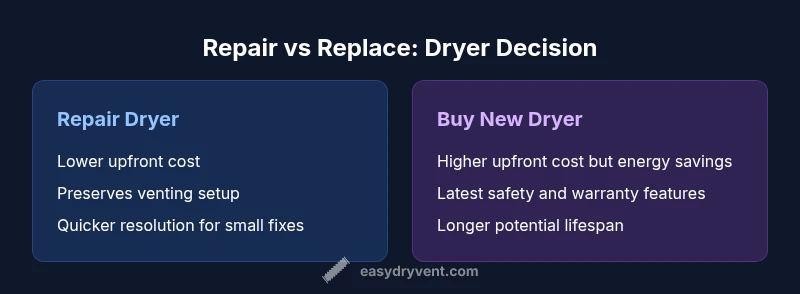
| Feature | Repair dryer | Buy new dryer |
|---|---|---|
| Upfront cost | Low-to-moderate repair expense | High upfront cost for a new unit |
| Long-term costs | Potential for more repairs later if problems recur | Typically lower maintenance after a new installation |
| Lifespan after decision | Depends on subsequent repairs and usage | La rger expected lifespan with new unit (subject to model) |
| Energy efficiency | Maintains existing efficiency level (may be outdated) | Often significantly more efficient with modern models |
| Warranty coverage | Repair work may have limited or no warranty | New dryer usually includes manufacturer warranty |
| Ventilation compatibility | Uses existing vent if intact | May require vent checks and possible upgrades |
| Environmental impact | Smaller immediate waste if repair suffices | Higher upfront production impact but less risk of constant failures |
The Good
- Lower upfront cost if the repair is minor
- Preserves existing venting setup and space
- Quicker resolution for simple fixes
- Less waste if components are salvaged
- Can preserve familiar controls and cycle settings
Negatives
- Uncertain reliability if multiple issues appear
- Older units may be far less energy-efficient
- Repair costs can accumulate with repeated failures
- Future repairs may be disruptive or time-consuming
- Replacement often brings manufacturer warranties and updated safety features
Repair if the unit is reasonably recent and the repair is minor; replace if reliability, safety, or energy savings are a priority.
A careful assessment of repair costs vs. replacement benefits is essential. If the dryer is older and prone to frequent breakdowns, replacement reduces risk and often lowers energy bills over time. If the unit is younger and the fix is small, repair preserves value and minimizes waste.
Common Questions
How do I determine if a dryer repair is cost-effective?
Start with the repair estimate and compare it to the price of a comparable new model. Consider the unit’s age, the likelihood of future failures, and any safety or energy efficiency gains from a new unit. If the repair represents a substantial share of replacement cost or if failures are likely to recur, replacement may be the wiser choice.
If the repair cost is high relative to a new model and the dryer is older, replacement is often the better option.
What factors indicate I should replace rather than repair?
Frequent breakdowns, rising energy bills, outdated safety features, and a model beyond its expected lifespan are strong indicators to replace. If the repair would require multiple parts or extended downtime, replacement tends to offer better long-term value.
Frequent problems and high energy use usually point to replacement.
Is it worth repairing a gas dryer?
Gas dryers involve safety considerations related to gas lines and ventilation. If a professional confirms a minor fix and the unit is relatively new, repair can be sensible. For older gas models, replacement may be safer and more efficient.
Gas-dryer repairs should be evaluated with a pro due to safety concerns.
Can I fix a dryer myself, or should I hire a pro?
Simple clogs or belt replacements can be DIY with proper instructions and safety precautions. Complex issues like heating elements, gas lines, or venting should be handled by a licensed technician to avoid safety risks.
Tackle only simple fixes yourself; call a pro for complex problems.
How long do repairs typically last?
Durability after a repair depends on the problem, the quality of parts, and usage. Some repairs extend the appliance’s life by months or years, but recurrent issues may indicate the need for replacement.
Repairs vary, but repeated issues suggest replacement might be wiser.
What is the expected lifespan of a new dryer?
A new dryer’s lifespan generally extends into several years of reliable operation, especially with sensible use and regular maintenance. Energy-efficient models tend to hold up well under typical family workloads.
New models typically offer several years of dependable service.
Key Points
- Assess upfront repair vs replacement costs without rushing to a decision
- Prioritize energy efficiency gains when considering new models
- Factor in appliance age and likelihood of future failures
- Ensure venting and safety systems are up to date
- Choose replacement to maximize long-term reliability and safety