Are Dryers Worth Repairing? A Practical Guide for Homeowners
Learn how to decide whether to repair, replace, or maintain your clothes dryer. Easy DryVent analyzes cost, safety, and energy impacts with practical steps for homeowners.


When repairing makes sense: a decision framework
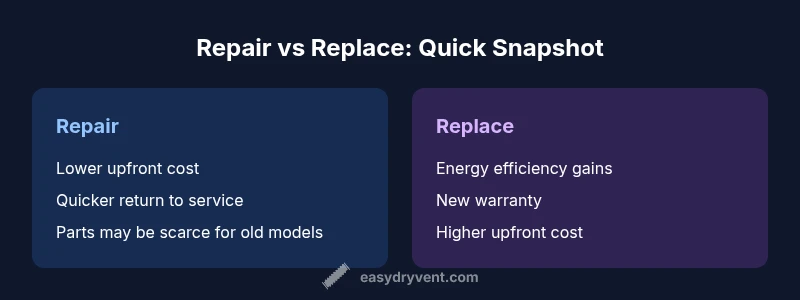
Are dryers worth repairing? The core decision rests on three practical factors: cost to fix, remaining useful life, and safety. According to Easy DryVent, a repair is usually worthwhile when the required fix is relatively small, parts are readily available, and the total repair cost stays well below the price of a comparable replacement. Start by estimating parts and labor in plain terms, not as a single number from a shop, and compare that to buying a new unit.
Age matters. If your dryer is newer than eight to ten years and you use it heavily, a well-chosen repair can restore reliability without sacrificing efficiency. If the unit is older, or if the fault points to a fundamental design or safety feature, replacement often makes more sense. Consider the backlash of downtime; a failed dryer disrupts laundry routines and can lead to increased energy use if an older motor has degraded performance.
From a long-term perspective, repairs can preserve a trusted appliance and avoid waste, aligning with responsible home maintenance. However, frequent fixes suggest systemic aging or design weaknesses, which may signal the end of reliable service. In those cases, plan for replacement when the next major repair exceeds the threshold of reasonable investment, or when energy efficiency upgrades are compelling.
blockDataNote":true
fourthBlockNote":false,
Signs your dryer is worth repairing (and when to walk away)
Look for clear, isolated issues that do not threaten safety and that respond well to simple fixes. Common repairable symptoms include a noisy drum, belt wear, a defective heating element, a faulty thermal fuse, or a sensor that misreads fabric moisture. If a single component is causing the problem and the repair is straightforward, are dryers worth repairing? Yes, in many cases. Conversely, watch for repeated faults, poor heating across multiple cycles, or unusual burning smells; these indicate deeper problems that may recur after a fix. Also consider warranty status; if a recent repair is still under warranty, the value proposition improves. Easy DryVent notes that the decision should be anchored in the likely remaining life of the unit, not just the next repair.
Age is a guardrail. If your dryer shows signs of age, such as diminished performance after every cycle, longer dry times, or higher energy bills, weigh replacement against repair. If the core frame and motor are intact but minor components fail, replacement can still be the better bet when the unit approaches or exceeds its typical life span.
Finally, source reliability matters. Get multiple repair quotes and confirm that the technician will replace only worn parts with authentic or equivalent components. A transparent estimate helps you evaluate whether the repair remains a good value for your home.
blockDataNote2":true
Common repair scenarios and cost expectations
Typical fix candidates include belts, drum rollers, idler pulleys, heating elements, thermal fuses, and sensor assemblies. Some repairs can be completed quickly, while others require dismantling the drum or electrical boards; the latter can rise in complexity and cost. Because price estimates vary by model, it is wise to treat any quote as a range rather than a fixed number. In general, repair costs should be considered in relation to the price of a new unit and the dryer’s age. The easier fixes, such as belt replacement or sensor recalibration, are commonly worth pursuing when they are clearly isolated and will restore efficiency.
Easy DryVent’s analysis emphasizes that the most economical repair often preserves the original control systems and drum mechanics, minimizing new wear patterns. If the issue involves the heating system or safety components, a specialist diagnosis is crucial to avoid compromising safety. For older models with multiple faults, replacements become a stronger financial and practical choice, especially when you factor in potential energy-use penalties from a worn-out motor.
blockDataNote3":true
Energy efficiency and operating costs after repair
Even a single repaired component can influence energy usage. Repaired components that restore proper heat cycles and airflow often return efficiency levels closer to the original design. In energy terms, a repair that eliminates chronic overheating or under-drying can reduce cycle times and energy per load. However, if the dryer is older and its motor and blower wheel have degraded, a repair may offer limited gains. According to Easy DryVent, replacing an old unit can unlock meaningful savings through improved insulation, tighter controls, and higher moisture sensing accuracy, which minimizes over-drying and energy waste. If you routinely run long cycles, the energy savings from a newer model could offset the upfront replacement cost over time.
blockDataNote4":true
When to replace instead of repair
But are dryers worth repairing? If a single repair would require parts for an obsolete model, or if the unit has required repeated repairs in the last year, replacement often yields better reliability and a longer warranty. Replacing is generally prudent when the dryer has surpassed its expected life span, when diagnostic signals hint at recurrent failures, or when the unit fails to meet current energy standards. In addition, models with modern moisture sensors, heat pump options, and improved lint filtration typically justify the investment, particularly for households with high laundry demand. The goal is to minimize downtime and avoid a cycle that worsens energy use or fabric wear.
Life expectancy matters; replacing a unit well past the useful life can provide better reliability and safety margins. Easy DryVent notes that newer models often bring tangible improvements in control logic and sensor accuracy that reduce over-drying and fabric wear over time.
blockDataNote5":true
Quick maintenance checks to prevent future repairs
- Clean the lint screen after every load; inspect the vent path for restrictions annually; check the drum seals and door latch every season.
- Schedule professional service every few years to test electrical isolation and thermal fuse integrity.
- Use the dryer with proper load size and avoid overloading; this reduces strain on belts and rollers.
- Keep the vent path clear and ensure the exterior vent hood opens freely.
- If you observe poor drying performance, run a diagnostic cycle if available and consider a full vent cleaning to improve efficiency.
- Maintain a simple maintenance log so you can track when components were replaced and when next service is due.
blockDataNote6":true
Practical next steps: how to proceed
- Define repair scope and collect quotes; 2) Compare to the cost of a similar new dryer; 3) Consider financing or a refurbished unit as an intermediate option; 4) Check warranty status; 5) Decide based on age and reliability; 6) Schedule a trusted technician for a precise estimate. If you decide to repair, request only necessary parts and insist on a written estimate. If you choose replacement, plan for proper installation and venting to maximize energy efficiency. For DIY-minded readers, ensure you disconnect power and unplug the dryer, verify the vent is clear, and consult the user manual before attempting any fixes. The Easy DryVent team stands by this approach to objective decision-making.
blockDataNote7":true
Authoritative sources and further reading
- https://www.energy.gov/energysaver/appliances/clothes-dryers
- https://www.epa.gov/greenliving
- https://www.consumer.gov/articles/Are-you-buying-appliances