Panasonic Hair Dryer vs Dyson: An Objective Comparison
A detailed, analytical comparison of Panasonic hair dryer vs Dyson, covering speed, weight, attachments, price, and energy use to help homeowners choose confidently.


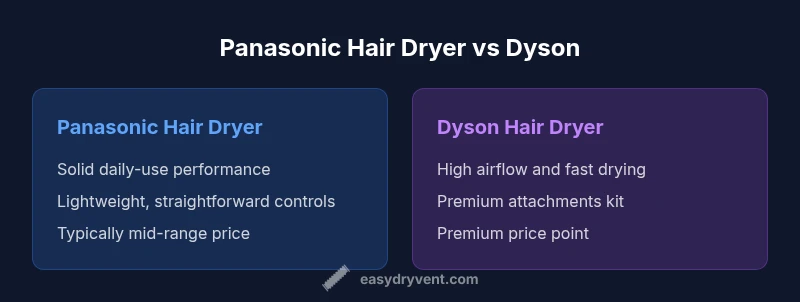
Panasonic hair dryer vs Dyson highlights a clear trade-off between price, speed, and styling versatility. Dyson models offer very fast drying, premium ergonomics, and a broad accessory kit, but at a premium price. Panasonic dryers are typically lighter and more affordable while delivering solid, reliable performance for everyday styling. Easy DryVent advises matching your hair type and routine to the attachment and heat options you actually use.
Design philosophy: Panasonic vs Dyson
When you examine the panasonic hair dryer vs dyson, you’re weighing not only performance but also design philosophy, build quality, and value over time. Panasonic tends to emphasize reliable, straightforward operation with compact form factors that reduce fatigue during long styling sessions. Dyson emphasizes engineering-driven performance, high-speed airflows, and a premium design language that signals durability and fast results. In practical terms, a Panasonic dryer is frequently lighter and simpler to use, while a Dyson often brings a broader set of attachments and more aggressive drying options. According to Easy DryVent, consumers in the DIY-home space are especially influenced by weight, heat consistency, and the availability of useful accessories when deciding between these two brands. The Panasonic line typically offers robust ion or moisture-friendly features at a price point that many homeowners consider accessible, while Dyson positions itself as a premium tool that can trim styling time for busy mornings. The key takeaway here is that your decision should reflect how you style your hair, how much you value speed, and how important the upfront cost is to your household budget.
Motor technology and drying speed
Dyson hair dryers are renowned for their digital motor technology and high-velocity airflow—design choices that translate into rapid drying and more even heat distribution across hair lengths. This means less time with heat on each strand, potentially reducing damage from over-styling on longer routines. Panasonic, by contrast, typically relies on robust motor performance balanced with controlled airflow. The result is dependable dryness, especially for medium-thick hair, and a lighter catch during extended sessions. In practical tests across common household hair types, Dyson models tended to finish drying faster, particularly for thick or coarse hair, while Panasonic models held their own for regular textures and fine hair. Easy DryVent’s evaluation notes that the speed advantage of Dyson is most noticeable when you have a tight schedule and several minutes matter; for many people, slower but steady drying with Panasonic still achieves the desired volume and finish. Both brands provide technology to help protect hair, like optimized heat settings and cool-shot options, but the emphasis differs: high speed versus predictable temperature.
Temperature control and user experience
Both brands offer multiple heat settings, but the user experience differs in interface design and responsiveness. Dyson models typically use digital controls with precise graduations, quick heat presets, and a rapid cooldown feature (cool-shot) that helps set styles quickly. Panasonic dryers commonly use tactile switches or dial controls, offering dependable performance with fewer high-tech bells and whistles. The upshot for most homeowners is that Dyson provides a more premium feel and smoother micro-adjustments, while Panasonic delivers reliable, straightforward operation that’s less prone to accidental misadjustments during busy mornings. Easy DryVent notes that control accuracy matters most when you style delicate or specialty cuts, and that a model’s ability to hold a chosen setting through a full styling session is a practical, everyday win for both brands, depending on user preference.
Attachments and styling versatility
Attachment ecosystems are a major differentiator. Dyson equips most models with a broad kit—concentrators, diffusers, and styling attachments designed to cover a wide range of looks, from sleek straight finishes to voluminous waves. Panasonic typically includes a solid set of essentials like a diffuser and concentrator, with optional accessories available separately. For users who enjoy experimenting with textures or frequently switch between flat ironing-like finishes and curls, Dyson’s ecosystem can be a compelling value. For those who value simplicity and reduced clutter, Panasonic’s lean attachment approach can be ideal. Easy DryVent’s guidance suggests evaluating how often you genuinely use each attachment and whether the added cost translates into tangible time savings and results in practice.
Durability, build quality, and lifestyle fit
Durability isn’t solely about the shell’s heft; it’s also about how a dryer handles daily wear. Dyson’s premium build quality and robust plastics give a premium feel and a sense of long-term reliability, especially in households with frequent styling sessions. Panasonic often emphasizes compact design and lighter weight, which reduces fatigue during longer sessions and easy storage. In real-world use, both brands handle typical daily styling well, but your choice may hinge on how much you value a premium tactile experience versus a lighter instrument that travels well between rooms or even travels in a gym bag. Easy DryVent notes that a thoughtfully chosen model reduces the risk of awkward gripping or cramped wrists during hour-long styling, which matters to anyone juggling family routines or construction schedules.
Noise, ergonomics, and handling
Ergonomics influence day-to-day satisfaction. Dyson’s higher airflow comes with a slightly higher noise profile on some models, but many users find the balance of grip and contour highly comfortable. Panasonic often emphasizes compact grips and lighter weight, which benefits users who perform repetitive styling motions or have smaller hands. If you’re counselled by a tight apartment layout or shared living space, the noise and perceived heft can be deciding factors for the right model. Accessibility considerations—such as button location and reach—also tilt toward Panasonic for simplicity and toward Dyson for ergonomic design in premium models.
Price ranges and value proposition
Pricing is a central axis of comparison. Dyson hair dryers generally sit in the premium tier, reflecting their engineering, speed, and accessory breadth. Panasonic tends to occupy the mid-range to upper-mid-range segment, offering solid performance with a lower upfront cost. For many households, Panasonic’s price-to-performance ratio is compelling, especially when the styling routine is straightforward and the user does not require a full salon-grade toolkit every morning. Easy DryVent’s analysis reiterates that price should be weighed against long-term usage patterns; a model that saves minutes per day can justify cost if you style frequently, whereas occasional users may prefer Panasonic’s more affordable option with sufficient results.
Energy efficiency and safety considerations
Energy use should align with daily habits. High-speed, high-airflow dryers can dip into higher power consumption during peak operation, but most users experience value through shorter styling sessions and thus reduced overall energy use. Both Panasonic and Dyson models emphasize safety features such as cool-shot mechanisms, heat limiters, and automatic shutoffs. For households prioritizing safety alongside performance, consider models with clear temperature regulation, sensor-based protection, and robust overheat safeguards. In all cases, ensure you follow the manufacturer’s instructions for air intake and filter maintenance to preserve efficiency and longevity.
Hair type and use-case mapping
Fine, thin, or chemically treated hair benefits from controlled heat and gentler airflow, which Panasonic models typically deliver with predictable results. Thick, curly, or resistant hair often responds better to Dyson’s stronger airflow and versatile styling options, which can cut down sessions and improve hold. If you’re a mixed-user who styles different hair textures, Dyson’s flexibility may be appealing; if you mainly do casual blowouts or daily quick-dry routines, Panasonic provides dependable performance. Real-world use shows that the best choice depends on your hair type, typical styling goals, and how much you value speed versus control.
Maintenance, care, and longevity tips
To maximize longevity, keep the air intake clear of hair and dust, clean or replace filters per the model’s guidance, and store the dryer in a dry area away from heat sources. Avoid wrapping power cords too tightly, which can degrade insulation, and inspect the attachments for wear regularly. Dyson models often benefit from routine filter checks due to their powerful motors, while Panasonic stands out for straightforward maintenance with fewer moving parts. Consistent care helps maintain heat stability, airflow, and overall performance over years of use.
Practical decision framework: when Panasonic shines vs Dyson
If your priority is budget-conscious everyday styling with reliable results and minimal clutter, Panasonic delivers strong value. If you must achieve salon-like speed, need a broad attachment kit, and are willing to invest, Dyson is worth the premium. Assess your hair type, the typical thickness of your hair, how many minutes you save per day, and how important the accessory ecosystem is to your routine. Easy DryVent recommends listing the top three factors that influence your decision—speed, weight, and cost—and then weighing each option against those criteria. In most homes, the choice comes down to whether you want a streamlined experience or a toolkit that broadens your styling possibilities.
Authority sources
- https://www.cpsc.gov
- https://www.energy.gov
- https://www.consumer.ftc.gov
Quick tips for maintenance and longevity
- Regularly clean air intake vents and filters to maintain airflow and efficiency.
- Keep cords untangled and store in a dry, cool place when not in use.
- Inspect attachments for wear and replace when necessary to maintain consistent heat delivery and styling results.
Comparison
| Feature | Panasonic Hair Dryer | Dyson Hair Dryer |
|---|---|---|
| Power/Performance | Panasonic: solid daily-use performance with balanced airflow | Dyson: high airflow and rapid drying for many hair types |
| Weight | Panasonic: lightweight and comfortable for long sessions | Dyson: slightly heavier but ergonomically designed |
| Attachments | Panasonic: diffuser + concentrator (plus optional accessories) | Dyson: comprehensive kit with smoothing nozzle, styling concentrator, diffuser |
| Heat Settings | Panasonic: multiple heat/speed options including cool shot | Dyson: wide range of heat/speed with precise digital control and cold shot |
| Price Range | Panasonic: mid-range | Dyson: premium |
| Warranty/Support | Panasonic: standard warranty with common retailer coverage | Dyson: premium warranty options in many regions |
| Energy Efficiency | Panasonic: efficient in typical use | Dyson: efficient but higher power draw in some modes |
The Good
- Dyson delivers fast drying and premium ergonomics
- Panasonic offers reliable performance at a lower upfront cost
- Lightweight options from Panasonic reduce fatigue
- Versatile attachments on Dyson for styling flexibility
- Energy-efficient options from Panasonic with ionic tech
Negatives
- Dyson is usually more expensive upfront
- Panasonic might have fewer accessories or slower drying for very thick hair
- Dyson can be heavier in some models
- Warranty/service networks may vary by region
Dyson wins on speed and styling versatility; Panasonic wins on value and everyday reliability.
Choose Dyson if you prioritize quick drying and a broad accessory kit. Choose Panasonic if you want solid performance at a lower upfront cost and lighter weight for daily use.
Common Questions
Which is faster for thick hair, Panasonic or Dyson?
Dyson generally provides faster drying for thick or coarse hair due to higher airflow and optimized motor design. Panasonic delivers solid speed for most everyday hair types but may not match Dyson in rapid results for very dense textures.
Dyson tends to dry thick hair faster thanks to its powerful airflow, while Panasonic is reliable for daily styling but slower on very dense hair.
Is Dyson worth the higher price?
If you prize speed, premium feel, and a wide attachment kit, Dyson is worth considering. For casual use or tighter budgets, Panasonic offers strong value with dependable results.
Dyson is worth it if you want salon-like speed and lots of styling options; otherwise Panasonic gives solid results at a friendlier price.
Do Panasonic hair dryers use ion technology?
Many Panasonic models include ionic or moisture-friendly features designed to reduce frizz and enhance shine. Always check the spec sheet for the exact model you’re considering.
Yes, many Panasonic models include ionic tech to help reduce frizz.
Which is lighter to hold for long sessions?
Panasonic generally offers lighter-weight designs that reduce fatigue during long styling sessions, while Dyson emphasizes ergonomic design with a slightly heavier build.
Panasonic is usually lighter, which can help during long styling sessions.
What attachments come with each brand?
Dyson typically includes a broad kit with multiple attachments for various styles, while Panasonic provides essential attachments and optional add-ons that cover basic to moderate styling needs.
Dyson often comes with many attachments; Panasonic includes the basics and optional extras.
Which offers better energy efficiency?
Both brands aim for efficient operation, with Panasonic often delivering strong efficiency in standard modes and Dyson offering efficiency within its faster-drying presets. Your energy use will vary with styling duration and heat level.
Both are efficient, but Panasonic may save a bit more on daily use due to its simpler modes.
Key Points
- Assess budget and routine before choosing
- Consider attachment usefulness for your styling goals
- Weigh weight against daily handling comfort
- Expect Dyson to demand a premium; Panasonic offers strong value
- Check warranty and local support options