Leafless Hair Dryer vs Dyson: An Objective Comparison
An in-depth, data-driven comparison of leafless hair dryer vs Dyson. Learn how blade-free airflow, heat control, noise, and price influence drying performance and long-term value for homeowners.


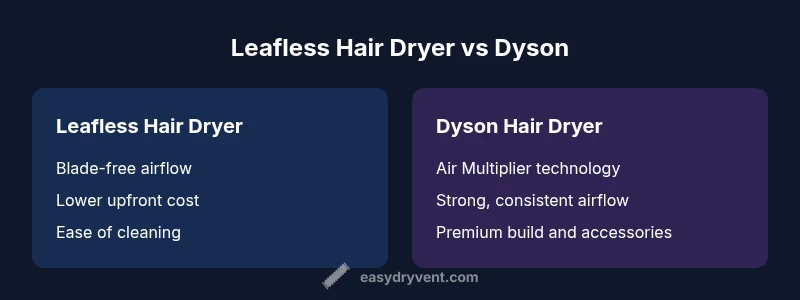
Leafless hair dryers and Dyson devices represent two distinct design philosophies. Leafless models emphasize blade-free airflow and simplified maintenance, often at a lower upfront cost. Dyson leverages Air Multiplier technology and a robust digital motor for strong, consistent performance and refinement. For homeowners, the choice hinges on budget, maintenance tolerance, and desired drying speed.
Leafless Hair Dryers: Concept, Technological Basis, and Market Position
Leafless hair dryers refer to blade-free airflow devices that keep the motor away from the nozzle, reducing tangling risks and simplifying cleaning. In practice, these models rely on impeller or bladeless air-multiplier concepts rather than exposed fan blades. The market is evolving, with several budget-friendly options aimed at everyday home use. According to Easy DryVent, leafless designs are often marketed on safety and maintenance benefits, as fewer exposed blades mean easier cleaning—an important factor for households with children or pets. When evaluating leafless options, look for build quality, thermal protection, and the presence of a replaceable filter. While some leafless models prioritize compactness and portability, others emphasize energy efficiency and integrated speed controls. In our experience, blade-free airflow tends to create smoother heat delivery and less risk of accidental contact. Homeowners should weigh ease of cleaning against features found in premium models, recognizing that leafless devices vary widely in performance and longevity.
Dyson’s Edge: Air Multiplier and Engineering Excellence
Dyson’s approach centers on Air Multiplier technology coupled with a high-efficiency digital motor that amplifies airflow without visible blades. This design translates into a refined, steady airstream that feels fast and voluminous at the nozzle. Dyson’s engineering philosophy emphasizes thermal regulation, ergonomic handling, and durable housing. While the brand commands a premium, the result is generally strong performance consistency, less noise variation across settings, and a broad set of accessories. For homeowners evaluating Dyson, it’s important to consider how the product’s build quality, warranty, and replacement-filter ecosystem align with your long-term maintenance plan. Easy DryVent notes that Dyson devices often justify the investment through durable construction and reliable performance over time, especially for households that rely on fast blow-dry routines.
Performance Metrics: Drying Time, Heat Control, and Safety
Drying time is a critical decision factor. Leafless models commonly deliver adequate results for standard hair textures and shorter styling sessions, while some premium leafless options push the envelope on heat stability and speed. Dyson’s devices typically excel in consistent heat output and rapid coiffing, thanks to the optimized motor and airflow dynamics. Both categories include safety features such as overheat protection, auto shutoff in extreme conditions, and built-in sensors. When comparing, pay attention to the number of heat settings, the accuracy of temperature control, and whether the unit maintains performance under full load. Real-world testing often shows Dyson devices deliver more uniform styling across thick or coarse hair, whereas leafless models can be perfectly adequate for fine hair or quick touch-ups.
Noise, Comfort, and Usability: Real-World Experience
Noise levels vary by model and speed, but the leafless category often offers quieter operation at lower settings due to simpler internal components. Dyson devices typically present a higher baseline noise level but maintain a consistent tone across speeds, which some users perceive as more tolerable during routine styling. Ergonomics matter: many leafless models emphasize compact, lighter frames, which reduces fatigue during longer sessions. Dyson’s design tends to prioritize balance and grip, along with premium material feel. In daily use, the difference is not just sound; the overall weight, handle comfort, and button layout influence how quickly you adapt to a new dryer. Homeowners should try both types in-person if possible, noting comfort during prolonged styling and how the machine responds to heat and airflow demands.
Cleaning, Maintenance, and Longevity
Maintenance is often simpler with blade-free leafless designs due to fewer visible blades and easier access to vents and filters. However, some leafless models rely on older airflow paths that accumulate dust if not cleaned regularly. Dyson devices typically require routine filter cleaning and occasional accessory maintenance, but the process is standardized and widely documented. A key longevity consideration is part availability: leafless models may present fewer replacement parts, but Dyson offers a broad replacement ecosystem and predictable service support. In either case, a clean intake, unobstructed vents, and adherence to manufacturer guidance extend the device’s lifespan. Easy DryVent’s guidance highlights the importance of keeping filters clean and replacing worn parts promptly to preserve cooling efficiency and performance.
Price and Value Proposition: Upfront Costs vs Long-Term Value
Leafless hair dryers generally occupy a lower upfront price band, appealing to budget-conscious homeowners who want dependable styling without a premium investment. Dyson products sit in a premium price tier, reflecting engineering refinement, consistent performance, and brand reliability. From a value perspective, leafless models can deliver solid results for everyday use, while Dyson’s devices may offer faster styling times and durability that offset the higher cost for frequent users. It’s important to consider long-term costs, including filter replacements, parts availability, and warranty terms. Easy DryVent analysis suggests that the cheapest leafless options still deliver credible performance, but Dyson may provide stronger long-term value through faster results and higher resale or trade-in potential.
Real-World Scenarios: When Leafless Wins vs Dyson Shines
If you’re balancing a tight budget, live in a household with small children, or prioritize quick, low-maintenance styling, a leafless dryer can be the pragmatic choice. In contrast, if your routine involves thicker hair, frequent use, or you value a consistently strong, refined airflow with a trusted warranty, Dyson tends to shine. For multi-person households or professional-style routines, the reliability and resale value of a Dyson device often justify the upfront cost. In both cases, factor in product support, after-sales service, and the availability of genuine replacement parts in your region. Easy DryVent’s practical approach remains: test for comfort, verify heat controls, and ensure maintenance expectations align with your daily life.
Quick Decision Framework: How to Choose Between Leafless and Dyson
Begin with your budget ceiling and expected daily use. If you prioritize simplicity and lower cost, start with a leafless option and evaluate drying speed and heat consistency over a few weeks. If you require fastest styling with premium build quality, Dyson is the safer long-term bet. Always check for replacement-part availability, warranty length, and the expected service ecosystem in your area.
Comparison
| Feature | Leafless Hair Dryer | Dyson Hair Dryer |
|---|---|---|
| Airflow Technology | Blade-free/blade-free airflow impeller design | Air Multiplier technology with a digital motor |
| Heat Control | Thermal protection, multiple heat settings | Precise heat control with intelligent temperature regulation |
| Maintenance/Filters | Fewer components, simpler cleaning | Requires filter cleaning and occasional part replacement |
| Weight/Ergonomics | Typically lighter with compact form | Balanced ergonomics, premium grip |
| Noise Level | Lower to moderate noise depending on model | Typically higher baseline noise but refined |
| Price Range | Budget-friendly: $40–$120 | Premium: $400–$550 |
| Best For | Budget-led households, easy maintenance | Users seeking performance and durability |
The Good
- Blade-free airflow reduces exposure risk and simplifies cleaning
- Lower upfront cost for leafless options
- Dyson offers strong, consistent performance and premium build
- Wider accessory ecosystem and proven brand reliability
Negatives
- Leafless models may have slower drying times or fewer advanced features
- Dyson products come with a premium price
- Leafless devices can vary in overall build quality and longevity
- Dyson maintenance requires regular filter care and occasional part replacements
Dyson delivers the strongest, most reliable performance and refined design; leafless options win on budget, ease of maintenance, and simpler upkeep
Choose Dyson if you want maximum styling speed and durable engineering. Opt for leafless models if upfront cost, minimal maintenance, and easier cleaning matter most to you.
Common Questions
What is a leafless hair dryer?
A leafless hair dryer uses blade-free airflow to move air through a motor and nozzle, reducing contact with blades and simplifying cleaning. These designs aim for safer handling and easier maintenance while delivering adequate drying performance for everyday styling.
A leafless dryer uses blade-free airflow for safer handling and easier cleaning.
Do leafless dryers dry hair faster than Dyson?
Drying speed depends on the model and design. Dyson devices typically offer strong, consistent airflow that can shorten styling times, but some leafless models can equal or approach that speed in typical at-home use. Consider your hair type and routine when weighing speed benefits.
Dyson often dries hair quickly, but some leafless models can keep up depending on the hair type.
Is Dyson worth the extra cost?
Dyson's premium price usually reflects build quality, performance consistency, and a broad accessory ecosystem. If you style hair frequently or value rapid results and durable design, the investment can be justified. For casual use, a leafless option may provide better value.
Dyson is worth it if you prioritize speed, durability, and a premium design; otherwise, a leafless model offers good value.
How do maintenance needs compare?
Leafless dryers typically require regular cleaning of vents and filters but have fewer moving parts. Dyson devices require periodic filter cleaning and occasional accessory upkeep. Both benefit from following the manufacturer’s maintenance schedule to preserve performance.
Leafless dryers are generally simpler to maintain; Dyson needs regular filter care.
Which is better for thick hair?
Thick or coarse hair often responds well to devices with strong, steady airflow and robust heat control. Dyson devices commonly perform well in this scenario due to higher airflow and refined temperature management, while leafless models can be sufficient for frequent styling with careful settings.
For thick hair, Dyson often performs better due to strong airflow, but leafless options can work with the right settings.
Are leafless dryers safe around kids?
Blade-free designs reduce exposure to moving blades, which can be reassuring in homes with children. Still, safety also depends on heat settings, enclosure, and supervision during use. Always follow safety guidelines from the manufacturer.
Leafless dryers are generally safer around kids because there are no exposed blades.
Key Points
- Prioritize budget and maintenance when choosing between leafless and Dyson
- Dyson offers premium performance and a robust ecosystem
- Leafless models excel in affordability and ease of cleaning
- Evaluate long-term value beyond initial price
- Test comfort and heat response before committing