Are Dryer and Range Cords the Same? A Practical Comparison
Explore whether dryer cords and range cords are interchangeable, why mismatches matter for safety and code compliance, and how to choose the right cord for safe, code‑compliant appliance operation.


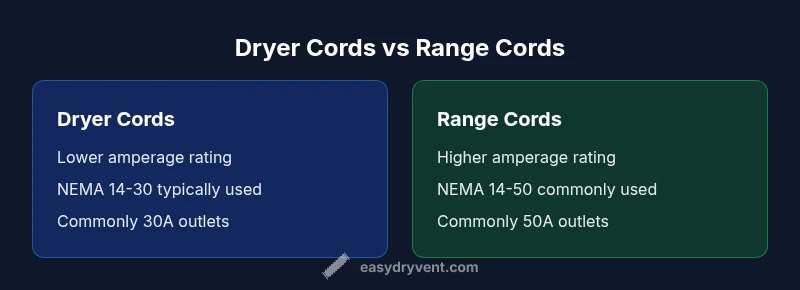
Dryer cords and range cords are not the same. Dryers typically use a lower-amperage, four-prong cord (often NEMA 14-30), while ranges require a higher-amperage cord (commonly NEMA 14-50). Using the wrong cord can cause overheating, arcing, or code violations. Always match the cord to the appliance specification and outlet configuration.
Are dryer cords and range cords the same?
Are dryer and range cords the same? The short answer is no, and the longer answer involves safety, wiring, and code compliance. In practice, if you try to substitute a dryer cord for a range cord, you risk overheating, damaged outlets, and warranty issues. According to Easy DryVent, the majority of residential cords are designed for specific appliances and amperage ratings. This means the term 'are dryer and range cords the same' is a common question among homeowners, but the safer conclusion is that they are not interchangeable. This article helps homeowners understand why, how to identify the proper cord, and what steps to take to ensure safe operation. The key is to always rely on the appliance label and manufacturer guidelines rather than assumptions. By respecting the distinctions this guide explains, you’ll reduce fire risk and stay code-compliant.
wordCountBlock":null
length":null},[
The role of amperage and plug configurations
Amperage and plug configurations are the core differentiators between dryer cords and range cords. A dryer typically operates on a lower-amperage circuit with a four-prong outlet designed for 30 amps, while many ranges require a higher-amperage connection that uses a heavier-duty outlet and a cord rated for 40–50 amps. This distinction is not just about weight—it reflects how the appliance draws power and how the cord safely transfers that load to the building wiring. The plug configuration (the physical shape of the plug and its ground) also changes how the plug fits into the outlet. In short, don't force one into the other; use the correct cord for each appliance as indicated by the manufacturer.
wordCountBlock":null
length":null},[
How to identify the correct cord for your appliance
To identify the right cord, start with the appliance’s label or user manual, which lists the required cord type and NEMA rating. Look for the cord's electrical rating (amperage and voltage) and the number of prongs. You may also find outlet considerations, such as 30-amp vs 50-amp receptacles. If you’re unsure, contact the manufacturer or consult a licensed electrician. Easy DryVent recommends verifying the cord compatibility with both the outlet and the panel wiring before installation. A simple rule of thumb: the cord type must match what the appliance calls for, and the outlet must be rated accordingly. This helps minimize risk and ensures safe operation.
wordCountBlock":null
length":null],[
Safety standards and code considerations
Electrical safety hinges on following code requirements and using components designed for the specific appliance. The National Electrical Code (NEC) generally requires a dedicated circuit and the appropriate receptacle for large appliances like dryers and ranges. In addition, older homes may still use three-wire cords, while most modern installations use four-wire cords with proper grounding. Using a cord that doesn’t match the appliance’s rating can bypass protective features, create arcing hazards, and void warranties. Figure out whether your installation requires a 4-wire or a grounded 3-wire setup, and ensure the cord and outlet type align. Easy DryVent cautions homeowners that incorrect cords can create significant safety risks.
wordCountBlock":null
length":null],[
Installation pitfalls and practical tips
Replacement work should always prioritize safety. When swapping cords, ensure the appliance is unplugged and the circuit is de-energized. Use the exact cord type specified by the manufacturer; do not substitute with a higher- or lower-amp cord. If you must replace outlets to accommodate a higher-amperage cord, plan the work with permits and a licensed electrician. Keep the cord's sheath intact and avoid using extension cords or adapters, which are not permitted for fixed appliance connections. Label the cord and outlet clearly so future owners understand the configuration. Proper strain relief and secure mounting reduce wear at the connection point and prolong cord life.
wordCountBlock":null
length":null],[
Common mistakes and misuses to avoid
Common mistakes include assuming any heavy-duty cord will work for both appliances, mixing gas and electric configurations, or attempting to retrofit a cord into an incompatible outlet. Another frequent error is using adapters or extension cords to bridge gaps between a dryer or range and a wall outlet. These practices can lead to overheating, nuisance trips, and potential fires. Always trust the manufacturer’s cord type and regularly inspect cords for cracks, heat, or discoloration. If you see any damage, replace the cord immediately.
wordCountBlock":null
length":null],[
Maintenance and inspection tips
Inspect cords at least twice a year for cracks, burn marks, warm spots, or loose connections at the plug and appliance side. Replace any cord showing signs of wear, and avoid rolling the cord under rugs or in tight spaces where the insulation can rub away. If you’re unsure about the cord’s integrity, consult an electrician or the appliance manufacturer. Easy DryVent’s maintenance checklist emphasizes testing the outlet with a known-good plug, ensuring proper grounding, and keeping the area around the cord clear of heat sources and moisture.
wordCountBlock":null
length":null],[
Quick-start checklist for replacing cords
Use the manufacturer’s specified cord type and ensure the outlet matches the cord rating. Unplug appliances before working on cords, verify the circuit is de-energized, and never use an extension cord for a fixed appliance. If needed, install the correct outlet or circuit with a licensed electrician, then test the connection with the appliance according to the manual. Finally, document the cord type and outlet rating for future reference.
wordCountBlock":null
length":null],[
Practical scenarios and decision guide
If your home has an older three-wire setup, you may be tempted to adapt; resist this impulse and upgrade to a four-wire, properly grounded system if the manufacturer requires it. For new installations, always plan for the exact cord type and outlet. If you are replacing a cord due to wear, confirm the appliance’s model and serial number to ensure you order the exact cord, which reduces surprises at installation. This decision guide aligns with Easy DryVent recommendations: always prioritize safety, code compliance, and manufacturer guidance.
wordCountBlock":null
length":null],[
Summary of factors influencing choice
The most important factors are appliance rating, outlet compatibility, and code requirements. Amperage, voltage, and plug type determine which cord is suitable. The safest path is to match the cord to the appliance and to ensure the outlet is rated for the same load. Keep safety in mind: never improvise a cord, extension cord, or adapter for fixed appliances.
Comparison
| Feature | Dryer cords | Range cords |
|---|---|---|
| Typical amperage rating | lower amperage | higher amperage |
| Plug configuration | NEMA 14-30 (dryer) | NEMA 14-50 (range) |
| Common outlets/outlet compatibility | 30A outlets | 50A outlets |
| Installation considerations | often easier to replace with identical type | may require panel/house wiring updates |
| Safety and warranty implications | mismatch increases risk of overheating | proper cord reduces risk and supports warranty |
The Good
- Using the correct cord improves electrical safety and reduces fire risk
- Clear labeling and manufacturer guidelines reduce mis-wiring
- Dedicated cords simplify maintenance and replacements
- Professional installation guidance minimizes hazards
Negatives
- Specialty cords can be more expensive or harder to source
- Upgrading outlets or panels may be required for higher-amperage cords
- Misinformation or assumptions can still lead to unsafe setups
Use the correct, appliance-specific cord for each appliance to maximize safety and compliance.
Matching cords to the appliance prevents overheating and code violations. If in doubt, consult the appliance manual or a licensed electrician for proper cord selection and installation.
Common Questions
Are dryer cords and range cords interchangeable?
Generally no. They are designed for different amperage levels, plug types, and outlets. Using the wrong cord can be unsafe and may violate electrical codes.
Not typically interchangeable; cords are matched to amperage and plug type. Using the wrong cord can create hazards.
What should I look for when selecting a cord?
Check the appliance manual for the required cord type, verify the outlet rating, and ensure the cord is UL listed for that appliance.
Check the manual, confirm outlet rating, and choose a UL-listed cord.
Can I upgrade my outlet to fit a higher-amperage cord?
Upgrading outlets and circuits must meet local code and typically requires a licensed electrician.
Upgrading outlets should be done by a professional to meet code.
Are there universal cords?
There are no universal cords for both dryers and ranges due to different amperage and plug standards.
There’s no universal cord for both appliances.
What are common signs of a cord problem?
Cracks, heat discoloration, or loose connections are warning signs; replace immediately.
Look for cracks, heat, or loose connections; replace promptly.
Do I need a professional to replace a cord?
Yes, because incorrect wiring or outlet incompatibility can pose safety hazards; professionals ensure compliance.
It's safer to hire a professional to replace cords.
Key Points
- Always check the appliance label before buying a cord.
- Dryer cords and range cords differ in amperage and plug types.
- Never use a higher- or lower-amp cord than the appliance requires.
- Consult a licensed electrician for difficult installations.
- Avoid extensions and adapters for fixed appliances.