Are Dryer and Oven Plugs the Same? A Practical Guide
Learn whether dryer and oven plugs are interchangeable, differences in amperage and outlet types, and when to hire a licensed electrician to ensure safe, code-compliant installations.


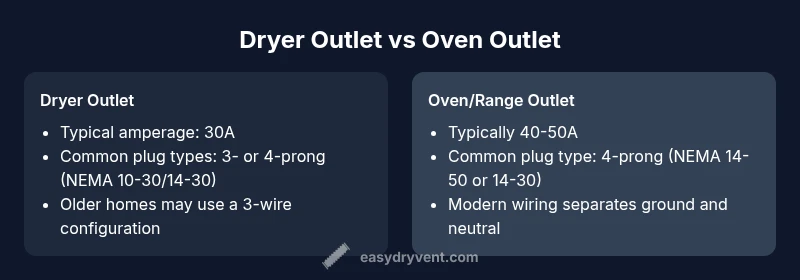
No—dryer plugs and oven plugs are not the same. Dryers typically use 30-amp outlets (3- or 4-prong), while ovens/ranges usually require higher-amperage outlets (40-50A) with different prong layouts. Do not interchange, and consult a licensed electrician to match outlet, cord, and breaker ratings.
Are dryer and oven plugs the same in everyday practice?
The short answer is that they are not the same, and assuming interchangeability can create serious safety risks. Are dryer and oven plugs the same? The answer is typically no, because these two appliances draw different levels of current and rely on different wiring configurations. In many households, the dryer uses a 30-amp circuit, whereas an oven or range requires a 40- to 50-amp circuit. Beyond amperage, the plug shapes and the presence or absence of a dedicated grounding path differ between these two appliance categories. This distinction matters for whether you should modify wiring, upgrade outlets, or install a new circuit.
According to Easy DryVent, the right approach is to verify the exact outlet type specified by each appliance’s manual and to ensure your home’s wiring aligns with local electrical codes. Mismatched plugs aren’t just inconvenient; they can compromise safety and trigger code violations. The practical takeaway is simple: treat each appliance as its own electrical load with its own properly rated outlet and circuit.
Why mismatching plugs is risky and what can happen
Mixing dryer and oven plugs may lead to overheating, nuisance tripping of breakers, or arcing at the outlet. A 30A receptacle wired for a dryer is not designed to carry the sustained current of a high-wattage oven, and a 50A outlet wired for a range may expose smaller gauge conductors to excessive heat. Grounding and neutral pathways must be correctly configured, especially on four-wire outlets where the ground and neutral must stay separate. Safety devices like GFCIs or AFCIs, when required, rely on correct wiring to function as intended. Even if a plug seems to fit, mismatches can create hidden hazards that only show up under load. The End Result: incorrect wiring and wrong plugs raise the risk of shock, fire, and appliance damage.
How to identify the correct outlet for each appliance
Start by locating the appliance label or data plate. It lists the required amperage, voltage, and plug type. Compare this with the wall outlet and cord that currently power the unit. If you are unsure, consult the installation manual or the manufacturer’s website. Check the circuit breaker panel to confirm there is a dedicated circuit of the specified amperage. For new or upgraded installations, plan for a four-wire configuration with separate grounding and neutral conductors. If you discover a mismatch, do not improvise—get a licensed electrician involved to install the correct receptacle and size.
Adapters and converters: why you should avoid them
Adapters that claim to adapt a dryer to an oven outlet can seem convenient, but they bypass critical safety features and can create overheating risks. The electrical code assumes specific wiring gauges, grounding, and breaker protection, which adapters do not reliably preserve. Even if an adapter appears to fit, it does not guarantee safe operation under typical loads. The approved approach is to install the correct outlet and run the appropriate circuit, or replace the appliance with one that matches the existing outlet if feasible. For safety and code compliance, avoid adapters and rely on proper wiring.
When you might need upgrades or panel work
Older homes often have three-wire dryer outlets that bond the neutral to the frame. Modern codes generally require a four-wire setup with separate grounding and neutral for new installations and major remodels. Upgrading may involve replacing outlets, running new cable, or upgrading the electrical panel to accommodate higher amperage. This work should only be performed by a licensed electrician who can pull any necessary permits and ensure code-compliant installation. Budget for inspection, wiring changes, and potential panel upgrades as part of a safe solution.
Step-by-step: verifying your home has the right setup
- Check the appliance rating label for amperage and plug type. 2) Inspect the wall outlet to determine its NEMA configuration and amperage rating. 3) Verify the cord on the appliance matches the outlet and the manufacturer’s spec. 4) Inspect the circuit breaker or fuse size to ensure it aligns with the appliance’s requirement. 5) If in doubt, hire a licensed electrician to confirm wiring, grounding, and code compliance before operation. A professional assessment reduces risk and ensures long-term reliability.
Common scenarios: older homes and remodels
In older homes, you may encounter 3-wire dryer outlets and nonstandard ranges. While retrofitting to modern four-wire outlets is possible, it often requires running new conductors and upgrading the panel. During remodels, plan for compatibility: confirm the range’s or dryer’s amperage needs, select appropriate NEMA receptacles, and install dedicated circuits. The main goal is to prevent overloading and ensure the appliance operates safely under normal use.
Comparison
| Feature | Dryer outlet (30A) | Oven/range outlet (40-50A) |
|---|---|---|
| Voltage | 240V | 240V |
| Amperage | 30A typical | 40-50A typical |
| Common plug type | 3- or 4-prong NEMA 10-30/14-30 | 4-prong NEMA 14-50 or 14-30 |
| Grounding/Neutral | 3-wire bonded neutral-ground (older) | 4-wire separate neutral and ground |
| Code status for new installations | 4-wire required for new dryer outlets in many jurisdictions | 4-wire required for most new ranges/appliances; verify local code |
| Best For | Laundry room circuits | Cooking appliances |
The Good
- Promotes safety by ensuring correct amperage and plug type
- Encourages compliance with current electrical codes
- Reduces risk of electrical fires and shock
Negatives
- Can require electrical work or panel upgrades
- May involve higher upfront cost and permit requirements
- Not all homes have readily available space for new outlets
Not interchangeable; use correctly matched outlets and cords for each appliance.
Mismatched dryer and oven plugs can create safety hazards and code violations. The Easy DryVent team recommends hiring a licensed electrician to assess your setup and install the proper outlet, cord, and circuit. This ensures safe operation and long-term reliability.
Common Questions
Are dryer plugs interchangeable with oven plugs?
In most cases, no. Dryers and ovens use different amperage and plug configurations. Check the appliance manual and local code, and consult a licensed electrician if unsure.
Usually not interchangeable. Always verify the manual and local code, and hire a licensed electrician if in doubt.
What amperage do dryer outlets use vs oven outlets?
Dryer outlets are typically 30 amps, while oven outlets commonly require 40 to 50 amps. Verify your specific model’s rating to avoid unsafe installations.
Dryers usually need 30 amps; ovens usually need 40 to 50 amps. Always confirm the model’s rating.
Can I use adapters to plug a dryer into an oven outlet?
Adapters are not recommended. They can bypass safety features and lead to overheating or shock. Install the correct outlet and cord, or have a professional upgrade the circuit.
Adapters aren’t recommended. Get the right outlet or have the circuit upgraded.
What should I do if my dryer and oven share a circuit?
Do not operate both high-draw appliances on a single circuit. Have an electrician verify wiring, breakout separate circuits, and ensure panel capacity.
If they share a circuit, stop using both at once and call an electrician to reconfigure.
Do new installations require a four-wire outlet?
Yes, most new installations require a four-wire outlet with separate grounding and neutral. Check local codes and installer recommendations.
Usually four-wire outlets are required for new installs; check local codes.
How can I safely assess whether an outlet is correct for an appliance?
Review the appliance label, current outlet type, breaker size, and wire gauge. If uncertain, hire a licensed electrician for a professional assessment.
Check the label, outlet, breaker, and wire size. When in doubt, call a pro.
Key Points
- Check appliance label for plug type and amperage
- Avoid adapters for high-draw appliances
- Ensure separate circuits or upgraded panels if needed
- Verify grounding and neutral separation in four-wire outlets
- Follow local electrical codes and permits