Should Dryer Thermistor Have Continuity? A Practical Troubleshooting Guide
Urgent guide to test your dryer's thermistor continuity, interpret readings, and fix heating issues safely. Easy DryVent shows homeowners how to diagnose and replace faults quickly in 2026.


Yes. A dryer thermistor should show measurable continuity (resistance) when tested with a multimeter at room temperature. If you read open circuit or a resistance value far outside the thermistor’s specification, the part is likely faulty and should be replaced. Always disconnect power and follow the dryer’s service manual for exact specs.
Should Dryer Thermistor Have Continuity?
The thermistor in a dryer is a small temperature sensor that helps the control board regulate heat. When you ask whether the thermistor should have continuity, the straightforward answer for DIY diagnosis is yes—there should be a measurable resistance between the two leads at room temperature. This continuity indicates the sensor is present and connected in the circuit, not a broken wire. However, continuity alone isn’t a guarantee the thermistor is perfect; it simply confirms the sensor is still part of the circuit and capable of reporting temperature data to the control board. According to Easy DryVent, a healthy thermistor should present a finite resistance within the device’s spec range, and readings outside that range point to a likely fault. In 2026, many homeowners rely on this quick check to decide whether to pursue replacement instead of chasing intermittent heating problems. Always compare your reading to the dryer’s service manual for the exact expected range, since thermistor values vary by model and design.
Should Dryer Thermistor Have Continuity?
The thermistor in a dryer is a small temperature sensor that helps the control board regulate heat. When you ask whether the thermistor should have continuity, the straightforward answer for DIY diagnosis is yes—there should be a measurable resistance between the two leads at room temperature. This continuity indicates the sensor is present and connected in the circuit, not a broken wire. However, continuity alone isn’t a guarantee the thermistor is perfect; it simply confirms the sensor is still part of the circuit and capable of reporting temperature data to the control board. According to Easy DryVent, a healthy thermistor should present a finite resistance within the device’s spec range, and readings outside that range point to a likely fault. In 2026, many homeowners rely on this quick check to decide whether to pursue replacement instead of chasing intermittent heating problems. Always compare your reading to the dryer’s service manual for the exact expected range, since thermistor values vary by model and design.
Steps
Estimated time: 30-45 minutes
- 1
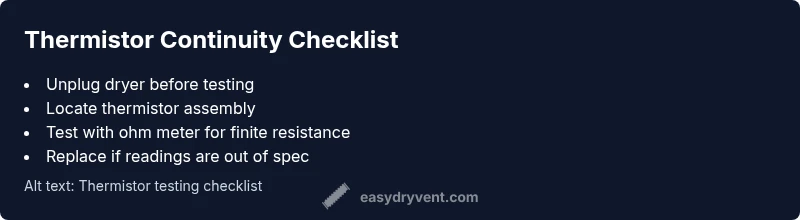
Power down and unplug
Ensure the dryer is completely disconnected from power before removing any panels. This protects you from shock and prevents accidental starts during testing.
Tip: Use a non-contact tester to confirm no live power before touching internal components. - 2
Locate the thermistor assembly
Thermistors are typically located in the blower housing or near the dryer’s vent path. Consult your model’s service manual for exact placement and part numbers.
Tip: Take a quick photo of surrounding wires before disconnecting anything. - 3
Disconnect the harness and isolate the thermistor
Gently unplug the thermistor connector and, if necessary, detach any mounting clips. Keep track of wires so you can reassemble correctly.
Tip: Label the connector if there are multiple sensors nearby. - 4
Test continuity with a multimeter
Set your meter to the ohms/continuity range and touch the two leads to each thermistor terminal. A reading should be finite and not infinite.
Tip: Test the same way at room temperature and after a brief warm-up to compare behavior. - 5
Compare readings to the service spec
Refer to the exact specifications in the model’s service manual. If the resistance is outside the allowed range or shows instability, the thermistor is suspect.
Tip: Document readings with model number and date of test for future reference. - 6
Replace the thermistor if needed
Install a new thermistor, re-seat the harness, and re-check all connections. Ensure the new part is compatible with your model.
Tip: Avoid overtightening fasteners that could crack the sensor housing. - 7
Reassemble and test-drive
Reconnect everything, plug in the dryer, and run a short cycle to verify proper heating behavior and sensor readings.
Tip: Watch for any odd smells or tripping breakers during the first test run.
Diagnosis: Dryer stops heating or runs incorrectly, with the control board showing temperature-related errors
Possible Causes
- highThermistor out of spec or open circuit
- mediumDamaged or loose wiring to the thermistor
- lowControl board misinterpreting sensor data
Fixes
- easyTest thermistor continuity with a multimeter and compare to the service manual range
- easyInspect wiring harness and connectors for damage, corrosion, or loose connections; reseat plugs
- easyReplace the thermistor if readings are outside spec, then re-test the circuit
- hardIf readings remain inconsistent after thermistor replacement, verify the control board and related sensors
Common Questions
What does it mean if the thermistor shows no continuity?
No continuity usually means the thermistor is open and defective. It won’t accurately sense temperature, which can cause improper heating. Replace the thermistor and re-test.
If there’s no continuity, the thermistor is likely defective and should be replaced.
Can damaged wiring mimic thermistor failure?
Yes. A damaged or loose wiring harness can mimic a bad thermistor by interrupting the signal. Inspect connectors and harnesses for wear and secure any loose connections.
Wiring issues can imitate sensor failure, so don’t skip harness checks.
Is it safe to DIY thermistor replacement?
Yes, if you are comfortable with appliance repair and follow safety steps. For complex models or uncertain conditions, hire a professional.
You can replace it yourself if you’re careful, but don’t hesitate to call a pro if unsure.
Should I test the thermistor only, or are other tests needed?
Testing the thermistor is important, but also check wiring, connectors, and the control board. A complete diagnosis minimizes return trips.
Test the sensor, but also verify wiring and the control board.
What readings indicate I should replace the thermistor?
Readings clearly outside the manual’s specified range or readings that drift with temperature typically indicate a replacement is needed.
Outside-spec readings usually mean replace the thermistor.
If the dryer overheats after replacement, what is next?
If overheating persists, the issue may involve the control board or venting. Recheck vent routing and consult a pro if needed.
If it still overheats, the problem may be elsewhere—get pro help.
Watch Video
Key Points
- Power off before testing or disassembling.
- Expect finite resistance, not an open circuit, for a healthy thermistor.
- Replace if readings fall outside the model’s spec.
- Re-test after replacement to confirm heating returns to normal.
- If problems persist, inspect the control board and related sensors.