What Dryer Cycle Is Low Heat? A Practical Guide for Laundry Care
Identify the lowest-heat dryer cycle, learn common labels (Delicate, Gentle, Air/Fluff), and get practical steps to protect fabrics and save energy.


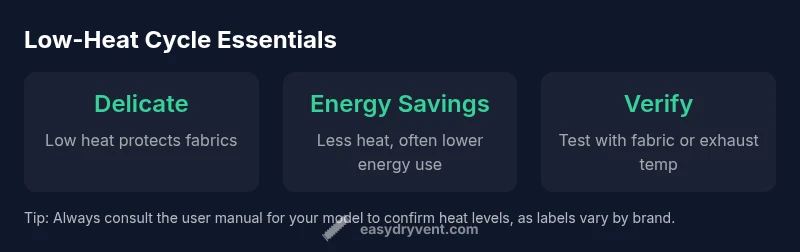
In most home dryers, the lowest-heat option is labeled Delicate or Gentle, and some models offer a dedicated Low or Air/Fluff setting for no-heat. Choose Delicate or Low for fabrics that require gentle drying, or Air/Fluff when you want to tumble-dry without heat. Using these settings reduces heat exposure, helps protect fibers, and can cut energy use over time.
What the term 'low heat' means in practical terms
When homeowners ask what dryer cycle is low heat, they are really asking which setting delivers the least heat while still tumbling and drying. In practice, the lowest heat level appears on cycles labeled Delicate or Gentle, and many brands provide a dedicated Low or Air/Fluff option for no-heat tumble drying. The exact name varies by model, but the concept is consistent: reduce exhaust temperature and limit high-heat exposure to protect fabrics, especially delicate textiles like lingerie, silk blends, and rayon. For everyday loads that aren’t delicate, you’ll still benefit from using these settings on small or medium loads, particularly when garments have fiber blends or prints that can fade with heat.
To maximize fabric longevity, pair a low-heat cycle with proper load sizes and gentle agitation. Avoid overloading, which can force longer drying times and negate some efficiency gains. If your dryer lacks a clearly labeled low-heat option, check for a “Delicate,” “Gentle,” or “Air/Fluff” setting and use it with light to medium loads. Easy DryVent recommends starting with a short test run on a few items to gauge dryness and fabric response.
How to identify low-heat settings on common dryer brands
Identifying a true low-heat cycle is often brand-specific, but there are common patterns you can rely on. Look for labels such as Delicate, Gentle, Low, or Air/Fluff (the last often indicating no heat or very minimal airflow). On many modern machines, you’ll find a temperature option within the cycle settings—set it to the lowest available temperature and pair it with a short or medium dry time. If you own a heat pump dryer or an energy-efficient model, those cycles often emphasize lower temperatures by design. If in doubt, consult the user manual or the manufacturer’s online support page for your exact model. A practical tip from Easy DryVent is to run a small test load after selecting a purported low-heat cycle to confirm you’re achieving cooler exhaust temps and a gentler tumble.
Why low heat matters for fabric care and energy efficiency
Low-heat cycles minimize fiber damage, reduce color fading, and lower the likelihood of shrinkage compared with high-heat cycles. They also tend to be gentler on garment elastics and finishes, extending the life of everyday wardrobe staples. From an energy perspective, lower temperatures generally consume less energy per minute, and when combined with appropriate load sizes, can reduce overall cycle time and energy use for small to medium loads. For bulky items like towels or blankets, the balance shifts toward longer cycles or higher heat—use low heat for delicate items and reserve higher heat for heavier fabrics when needed. Easy DryVent’s analysis highlights that consistency matters: use the same cycle for similar fabrics to avoid repeated heat-ups and cooling losses.
Practical steps to ensure you're running on low heat
First, verify you’re selecting a true low-heat setting by checking the cycle label and temperature option. When possible, run a test on a small load of similar fabrics and observe the drying time versus a standard cycle. Use a light to medium load to prevent over-drying, which wastes energy and can overwork the machine. If your dryer supports a direct temperature display, note the temperature at the exhaust during the cycle—lower temperatures typically indicate a true low-heat setting. Regular maintenance, such as cleaning the lint trap and vent, also helps ensure efficient airflow, which supports effective drying at lower heat. Finally, document which cycles work best for which fabrics so you can repeat the results reliably.
Common myths and misconfigurations
A frequent misconception is that all Delicate cycles are identical across brands. In reality, heat levels and tumble patterns vary; one model’s Delicate may actually run warmer than another’s Low setting. Another misperception is that you must never use heat for delicate fabrics—some fabrics tolerate low heat well and benefit from it, especially when combined with shorter cycles. Misconfiguration can also occur when users select a low-heat label but bunch items into a heavy load. The result may be longer drying times and higher energy use. Always tailor the load size to the cycle you choose.
Tools and checks to verify heat level
If you want an extra layer of verification, you can use a basic infrared thermometer aimed at the dryer vent outlet to estimate exhaust temperature. While not every consumer has this tool, it can help confirm that you are operating at a low temperature when using Delicate or Air/Fluff cycles. Another practical check is to place a light-weight fabric swatch in the load and observe its dryness and feel after the cycle ends— fabrics that emerge cool to the touch and with minimal stiffness are a good sign of low-heat effectiveness.
Tip: document results so you can compare across models or over time as your dryer ages.
Troubleshooting when low heat isn’t happening
If you notice your clothes stay damp, the cycle may be too short, the load too large, or venting compromised. Start by reducing the load size and cleaning the lint screen and vent ducts. Confirm you’re not using a high-heat setting by mistake, and inspect any brand-specific options such as moisture sensors that can extend cycles to finish the load. If the dryer still runs hot on a cycle labeled Delicate or Low, the heating element or control board may require service. In that case, contact a qualified technician or the manufacturer’s support line for diagnostics.
Typical low-heat and related cycle ranges by fabric type
| Cycle Type | Temp Range (°F) | Ideal For Fabrics |
|---|---|---|
| Delicate | 85-125 | Lingerie, silk blends |
| Regular/Normal | 125-145 | Cotton blends, everyday wear |
| Permanent Press | 110-135 | Synthetic blends, wrinkle-prone fabrics |
Common Questions
What is considered a low-heat setting on most dryers?
Most dryers use labels like Delicate, Gentle, Low, or Air/Fluff to indicate low heat or no-heat options. Start with these labels and pair them with smaller loads for best results.
Most dryers mark low heat as Delicate, Gentle, Low, or Air/Fluff—perfect for small, soft loads.
Will using low heat dry clothes faster or slower?
Low-heat cycles are typically gentler and can take longer to reach dryness than high-heat cycles, especially with bulky or heavy fabrics. The trade-off is better fabric care and lower energy use.
Low heat usually takes longer to dry bulky items, but it protects fabrics and saves energy.
Is Air/Fluff the same as low heat?
Air/Fluff generally means tumble-drying without heat or with only minimal airflow. It’s useful for finishing touches and odor removal but isn’t a heat-setting option for drying damp loads.
Air/Fluff is usually no-heat tumble drying; it’s not the same as a standard low-heat cycle.
How can I verify my dryer is actually on low heat?
Check the cycle label and temperature setting; run a small test load and observe drying time and fabric feel. For models with a temperature display, note the low-end temperature during the cycle.
Check the label, run a test load, and feel the fabrics to confirm low heat.
Do low-heat cycles save energy?
Yes, using low-heat cycles generally reduces energy per minute and minimizes over-drying. Savings vary by model, load size, and fabric type, but the principle is consistent: less heat usually means less energy.
Low heat saves energy, especially with appropriately sized loads.
What should I do if clothes stay damp after a low-heat cycle?
Try smaller loads, shorter cycles, or a longer final cycle on low heat. Check the lint filter and vent for obstructions. If dampness persists, a service check may be needed for heating or sensor issues.
If clothes stay damp, reduce load size and check vents; consider a follow-up cycle on low heat.
“Low-heat drying protects fibers and reduces energy use when you choose the right cycle for the fabric and load.”
Key Points
- Use Delicate or Low for fabrics that need gentler drying
- Air/Fluff can provide no-heat tumbles when appropriate
- Verify heat with a quick test load to avoid over-drying
- Regular maintenance improves low-heat effectiveness