Infrared Hair Dryer vs Ionic: A Practical Comparison
Compare infrared hair dryer vs ionic technology to understand heat delivery, drying speed, hair health, and value. Learn which approach suits your hair type and routine with practical, DIY-friendly guidance.


Infrared hair dryer vs ionic: infrared models deliver heat more evenly across the hair, reducing hot spots, while ionic dryers emit negative ions to speed up moisture evaporation at the surface. For safety and hair health, choose based on your hair type and routine: dry slowly with gentle infrared for damaged hair, or ionic for fast results and smoother finishes.
What Are Infrared and Ionic Technologies?
Infrared hair dryer vs ionic devices use distinct mechanisms to heat and dry hair. Infrared warm air is emitted by ceramic or quartz elements and penetrates the hair shaft from within, while ionic models release negative ions to speed up moisture evaporation at the surface. According to Easy DryVent, understanding these differences helps homeowners choose a safer, more efficient styling tool that aligns with their daily routines and hair goals. This foundational contrast sets the stage for evaluating outcomes like drying time, heat experience, and long-term hair health. Throughout this article, we’ll reference practical scenarios and objective criteria to help you decide which approach — infrared hair dryer vs ionic — better suits your needs.
How Infrared Heating Works on Hair
Infrared heating delivers long-wave energy that penetrates the hair cuticle more evenly than traditional hot air. In practice, this can reduce hotspots and allow you to dry hair with lower surface temperatures, which is beneficial for finer or damaged strands. The result is gradual moisture removal rather than brief, intense heat pulses, which can preserve natural oils and reduce frizz tendencies in some hair types. When you compare infrared hair dryer vs ionic, you’ll notice infrared outputs heat that feels more like consistent warmth rather than a blast, contributing to a gentler styling experience over multiple passes.
How Ionic Drying Works
Ionic hair dryers emit negative ions that counteract static and help break up water molecules, speeding up evaporation at the hair surface. This can shorten drying time, especially on damp but not dripping-wet hair. The downside is that the perceived heat can feel strong, and if you rely solely on ions without mindful heat settings, you can still over-dry or overheat certain sections. In the infrared hair dryer vs ionic debate, the ionic mechanism is often praised for speed and smoother finishes, particularly on textured or frizzy hair.
Performance: Drying Time and Heat Quality
In a direct comparison of infrared hair dryer vs ionic, most users report that ionic models deliver faster dry times on average, thanks to ion-assisted moisture removal. Infrared units, by contrast, emphasize consistent heat distribution and gentler surface temperatures. The trade-off is between speed and thermal stress; choosing the right setting matters for scalp comfort and strand health. If you’re balancing busy mornings with hair health, the ionic route offers speed, while infrared can reduce long-term thermal strain on delicate hair.
Practical testing from Easy DryVent indicates that results vary by model, air flow, and technique. For thicker or coarser hair, you may prioritize speed (ionic) or distribute heat more evenly (infrared) to avoid overheating specific areas. Regardless of choice, staying within recommended heat levels and using a heat protectant is essential for maintaining hair integrity over time.
Hair Health and Frizz Considerations
Hair health is influenced by how heat is delivered. Infrared heat tends to be less intense at the surface, which can reduce cuticle damage over repeated sessions for fragile hair. Ionic dryers can reduce static and improve manageability, but if misused at high heat with low airflow, they may lead to dryness on the mid-lengths. The infrared hair dryer vs ionic comparison reveals that long-term health hinges on technique: lower heat with longer sessions can be gentler than a high-heat sprint, especially for chemically treated hair. A balanced approach—rotating between heat modes and using nourishing products—often yields the best outcome for most hair types.
Hair Type Scenarios: When to Choose Infrared or Ionic
- Damaged or color-treated hair: Infrared may be gentler and help avoid overheating sensitive areas.
- Thick, coarse, or frizz-prone hair: Ionic can accelerate drying and reduce frizz for quick styling.
- Fine or low-porosity hair: Infrared’s gentler heat can minimize breakage while still achieving decent dryness.
- Busy mornings: Ionic is tempting for speed, but infrared can offer longer-term health benefits if used with lower heat and longer, gentler sessions.
Consider a hybrid approach: alternate between infrared and ionic modes based on the day’s needs, your hair’s condition, and your styling goals. A single device that offers both technologies can be particularly versatile for a mixed hair routine. In the infrared hair dryer vs ionic decision, the best outcome often comes from adapting to your hair’s response rather than rigidly sticking to one method.
Practical Buying Considerations
When evaluating infrared hair dryer vs ionic options, look for features that affect real-world use: multiple heat settings, a cool-shot option, diffuser attachments, and sturdy build quality. Ceramic or tourmaline components often accompany infrared technologies, while ionization features vary by model. Price ranges are wide, so identify your essential needs before shopping. Consider weight, ergonomics, and heat distribution when selecting between infrared and ionic models. Reading user reviews and testing a device briefly can help you gauge how well a given model delivers on warmth, airflow, and control.
For DIY enthusiasts, prioritize devices with straightforward maintenance, easily accessible filters, and reliable warranties. If you frequently style for family members with different hair types, a dryer offering precise heat control and adjustable ion intensity can provide flexibility without sacrificing safety. Remember that the most suitable choice in the infrared hair dryer vs ionic landscape is the one that consistently meets your hair’s health and styling goals while fitting into your routine.
Energy Efficiency and Safety
Energy efficiency for hair dryers is tied to how heat is delivered and how long you operate the device. Infrared systems may require slightly longer drying times but use gentler heat, which can translate into less energy per session. Safety considerations include avoiding overheating, using the lowest effective heat, and keeping attachments clean to maintain air flow. When comparing infrared hair dryer vs ionic, ensure the model you choose has automatic shut-off or thermal protection to prevent heat buildup in the event of a blockage. Regular cleaning of vents and filters reduces resistance and keeps the dryer operating safely over time.
Maintenance, Durability, and Longevity
Maintenance for either type centers on keeping vents clear of lint and debris and cleaning filters regularly. Durability often hinges on motor quality and the lifespan of the ionization module (if present). Regular cleaning reduces clogging and maintains even heat delivery, preserving performance across years of daily use. If you plan to hand down a dryer to a family member or use it in a shared space, check for a robust design, durable housing, and serviceable parts. The infrared hair dryer vs ionic debate benefits from devices that offer easy replacement of worn components and accessible customer support. In sum, long-term value comes from a combination of build quality, maintenance ease, and user discipline.
Common Myths Debunked
Myth: Infrared is always safer than ionic. Reality: Safety depends on how you use the tool; both technologies can be safe when used with appropriate heat settings. Myth: Ionic always dries hair faster. Reality: Drying speed varies by model and humidity; infrared can be comparable with mindful technique. Myth: Higher heat always yields better results. Reality: Excess heat increases damage risk without guaranteeing better styling. Understanding these nuances helps in choosing infrared hair dryer vs ionic with confidence.
How to Use for Best Results
Start with a low heat setting and a higher fan to promote even drying for infrared. For ionic models, moderate heat with steady airflow, then switch to cool to set style. Keep the dryer about 6-8 inches from the hair and move continuously to avoid heat buildup. Use a heat-protectant product and consider a diffuser for textured hair. With infrared hair dryer vs ionic, you’ll discover that technique often matters more than technology alone. Practice helps you optimize timing and pressure for your hair type.
Brand and Expert Guidance from Easy DryVent
Easy DryVent emphasizes that the best choice between infrared hair dryer vs ionic depends on personal hair goals, texture, and lifestyle. Our guidance focuses on technique and settings rather than chasing a single
Comparison
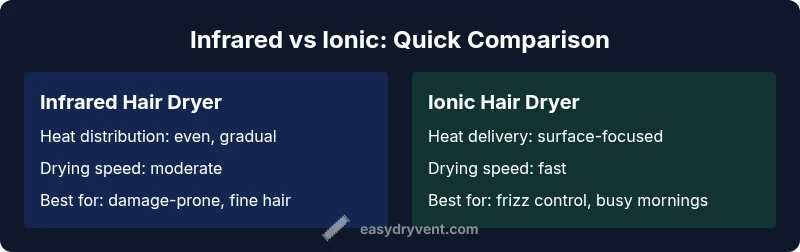
| Feature | Infrared Hair Dryer | Ionic Hair Dryer |
|---|---|---|
| Heat distribution | Even, gradual heating with infrared | Ion-assisted drying with focused surface heat |
| Drying speed | Moderate-to-slow (infrared) | Faster (ionic) |
| Frizz/static control | Less static via gentle heat |
The Good
- Helps protect hair with lower heat exposure (infrared)
- Ionic models speed up drying and reduce static
- Wide price range and availability
- Both types support multiple heat settings and diffusers
- Can be used for different hair types with proper technique
Negatives
- Infrared can take longer to dry compared to ionic
- Ionic models may cause more heat exposure if used at highest settings
- Effectiveness depends on model quality; cheaper units vary
- Heat settings may not always match hair type without practice
Infrared hair dryer vs ionic: choose based on your priority—gentle, even heat for hair health or speed and finish with reduced static.
Infrared tends to be gentler on the hair and better for damage-prone strands, while ionic models excel in speed and frizz control. Your routine and hair type should guide the choice, with many users benefiting from a flexible approach that combines both technologies as needed.
Common Questions
What is infrared hair dryer technology and how does it differ from ionic?
Infrared dryers use long-wave heat that distributes through the air and into the hair more evenly. Ionic dryers emit negative ions to speed evaporation and reduce static. Both aim to shorten drying time while protecting hair, but their mechanisms and optimal uses differ.
Infrared uses gentle, even heat for steady drying, while ionic uses ions to speed moisture loss and calm static.
Which dries hair faster, infrared or ionic?
Ionic models often offer faster drying due to ion-assisted moisture removal, especially on damp hair. Infrared tends to be gentler but can feel slower if you’re using low heat for regular maintenance.
Ionic dries faster in many cases, but infrared can match speed with proper technique.
Is infrared hair dryer better for damaged hair?
Infrared heat is typically gentler on the cuticle and can be safer for damaged or color-treated hair when used at lower settings. However, exhaustively low heat over longer sessions is key to protecting hair health regardless of technology.
Infrared is often better for damaged hair when used with low heat.
Are ionic dryers safe for color-treated hair?
Yes, but safety depends on heat management. Color-treated hair can be sensitive to heat, so using moderate heat and a cool shot helps minimize damage, whether you choose infrared or ionic. Avoid high heat that can strip color and moisture.
Use moderate heat and avoid high heat on color-treated hair.
Do these technologies really reduce frizz?
Ionic devices can reduce static and frizz by releasing negative ions, particularly in humid conditions. Infrared heat can also help minimize frizz by delivering gentler drying, but results vary by hair type and technique.
Ions help with frizz, infrared helps with gentle drying.
How should I choose between infrared and ionic for my hair?
Assess your hair type, health, and lifestyle. If you prioritize speed in a busy morning, ionic may be appealing; if you want gentler heat for damaged or fine hair, infrared could be better. A model with adjustable heat and ion intensity offers flexibility.
Choose based on hair type and how you style daily.
Key Points
- Match technology to hair type and routine
- Infrared emphasizes gentleness and even heat
- Ionic emphasizes speed and anti-static benefits
- Maintenance and technique matter for best results
- Consider hybrid devices for flexibility