Ionic Hair Dryer vs Regular: A Practical 2026 Comparison
Compare ionic hair dryers and regular models to understand drying speed, frizz control, heat safety, and value. Learn which option fits your hair type and budget in 2026.


Ionic hair dryers typically reduce static and may dry hair faster with less heat exposure compared to regular dryers. The benefits vary by hair type, texture, and styling goals, but overall ionic models excel at smoothness and frizz control. Costs, maintenance needs, and warranty can shift the value. This guide contrasts performance, safety, and price to help you choose.
Why ionic technology matters for hair health
According to Easy DryVent, ionic technology uses negative ions to break apart water molecules, speeding up evaporation and reducing surface moisture on the hair shaft. This mechanism can cut drying time slightly and, in many cases, help tame static and flyaway frizz. In practice, the benefits hinge on hair type, texture, and how you use the tool—heat settings, distance from the scalp, and attachment choices all matter. In this section, we unpack the science behind ionic dryers and compare it to regular models, highlighting where users typically see the biggest difference. The goal is to give you a clear sense of when ionic tech adds real value and when a conventional dryer suffices. Beyond the science, design decisions—such as airflow patterns, diffuser compatibility, and cooling cycles—shape performance in everyday styling. The result is a practical framework you can rely on when shopping, testing, or upgrading your home setup.
From a maintenance perspective, ionic devices often include built-in sensors and longer-lasting heating elements, but the efficiency depends on consistent cleaning of filters and vents. For households where air quality matters or residents have humidity-prone climates, ionic technology can be a meaningful upgrade. Remember that the best choice still depends on your routine—whether you’re chasing salon-worthy smoothness or a straightforward, budget-friendly dryer. In the end, the decision hinges on how much you value frizz control, drying speed, and long-term durability.
How ionic technology changes drying dynamics
Ionic dryers accelerate the drying process by promoting moisture removal with a high-velocity airflow while using negative ions to neutralize static and reduce surface tension. The combination can yield a smoother cuticle and less puffiness as the hair dries, especially for fine or frizz-prone textures. Regular dryers rely on heat and airflow alone, which can lead to more rapid loss of moisture balance or more static in some environments. However, the practical gap depends on the model, the chosen heat setting, and the technique you use—holding the dryer at an appropriate distance, using a cool shot to seal the cuticle, and choosing the right nozzle or diffuser. We also consider how padding, weight, and ergonomics influence real-world performance; a heavier ionic model may reduce user fatigue, but it can feel unwieldy during long sessions. In short, ionic technology isn't a universal fix, but for many users it changes the drying equation in meaningful ways when paired with proper styling practices.
To evaluate drying dynamics, begin by setting a comfortable temperature and test a small hair section first. Note the time required to reach near-dry status and whether the strand feels balanced or tense to the touch. Compare the feel of the finished strand with and without a diffuser or concentrator. Finally, assess the finish: is there less frizz, a smoother cuticle, and a healthier appearance? These observations help you judge whether the ionic approach aligns with your hair goals.
Safety considerations when choosing between ionic and regular
Safety first matters when selecting any hair-drying tool. Ionic dryers are not inherently safer or more dangerous than regular models; the key is temperature management, build quality, and user habits. High heat applied too closely to the scalp can cause dryness or damage over time, regardless of whether ions are involved. Look for models with real-time temperature sensors, automatic shutoff at overheat, and a cool-shot feature to seal the cuticle without prolonged heat exposure. Ergonomics also play a safety role: heavier units can cause arm fatigue, leading to poorer technique that increases the risk of accidental contact with the scalp or neck. Regular dryers with simple heat controls may reduce risk for beginners but can require more attentive handling to prevent heat hotspots.
When you compare ionic and non-ionic options, consider the nozzle types and attachments. A narrow concentrator can focus heat, increasing the chance of heat marks if used improperly, while a diffuser helps distribute heat more evenly. Using the diffuser with an ionic model often yields smoother results at a slightly lower temperature, reducing the chance of heat damage. If you have a sensitive scalp or color-treated hair, verify that the device supports a lower heat range and features like a built-in filter guard to prevent debris intrusion, which can compromise safety and performance over time.
Cost, warranty, and maintenance implications
Cost is a practical differentiator between ionic and regular hair dryers. Ionic models tend to sit in the mid-to-premium range due to their added components and ion-generating system. Regular dryers offer budget-friendly options that cover essential drying functions but may lack advanced features like sensor-based heat control or premium attachments. Warranty length and service options also vary; higher-end ionic units often come with longer warranties and more comprehensive coverage, which can be valuable if you plan to use the tool frequently. Maintenance is another factor: ionic devices sometimes require more frequent filter cleaning, periodic replacement of ionizing elements, and careful storage to protect delicate components. On the other hand, a simple regular dryer with basic filters can be easier to maintain for busy households. Easy DryVent suggests balancing upfront cost against long-term value, including how often you’ll use the dryer and how much you value frizz control and shine.
Hair type by hair goals: who benefits most
Hair texture and styling goals hugely influence whether an ionic or regular dryer is the better fit. For fine or color-treated hair, the smoother finish and reduced static associated with ionic models can translate into visible improvement in gloss and manageability. People with naturally curly or thick textures may still appreciate ionic benefits, but the results can vary depending on the level of heat and the styling technique used. Those chasing quick, budget-conscious results may find a basic regular dryer perfectly adequate when paired with a good brush and proper technique. If you’re dealing with frizz-prone hair or you live in a humid climate, ionic technologies often provide a noticeable advantage, especially when combined with a diffuser for even heat distribution. Ultimately, the choice should align with your daily routine, willingness to invest in high-quality attachments, and how much you value consistent, salon-like results.
How to test at home: side-by-side comparison steps
An at-home test is the most reliable way to decide. Start with two identical hair sections: one dried with an ionic model and one with a conventional dryer. Use the same heat setting, airflow, and distance from the scalp for each run. Document the time to reach 80-90% dryness, the tactile feel of the strand, and the final appearance—pay attention to frizz, shine, and overall smoothness. If possible, try different attachments (diffuser vs concentrator) and note which setup yields the best combination of speed and finish. A control test with a neutral brush can help verify whether differences arise from the dryer or the technique. Finally, assess comfort and weight during a longer drying session, since ergonomics can influence your ability to maintain proper form. This method reduces bias and gives you practical, personal data to guide your purchase.
Real-world scenarios: travel, gym, daily use
For frequent travelers, a compact ionic dryer can be appealing due to its potential efficiency gains and ability to tame flyaways quickly in hotel bathrooms. However, travel-focused models are often lighter with fewer attachments, so you should weigh weight against performance. In gym or studio environments, a reliable dryer that balances speed with heat control is essential, and ionic options may help technicians deliver consistent results when time is limited. For daily use at home, consider your typical hair length, desired style, and climate. If you style daily, an ionic dryer with a quality diffuser can reduce frizz and provide a more forgiving finish, especially if you struggle with static in dry indoor air. If you mostly need a quick dry between workouts, a lighter, regular dryer with a good brush can be perfectly adequate. In all cases, pairing the tool with proper technique remains the biggest driver of outcomes.
Common myths debunked
Myth 1: Ionic dryers cure all hair problems. Reality: They can reduce static and enhance smoothness for many textures, but results depend on technique and hair type. Myth 2: More expensive means better results. Reality: Value comes from overall performance, durability, and how well the device fits your routine, not just price. Myth 3: Ionic technology replaces proper brush work. Reality: A good brush and technique are essential regardless of the dryer type. Myth 4: Heavier means worse. Reality: Some heavier models offer better heat control and longer-lasting components, which can be worth the trade-off for frequent styling.
Understanding these myths helps you evaluate products based on your real needs rather than marketing claims. Always test models in your own setting and consider how they integrate with your current styling tools.
Maintenance tips to keep ionic vs regular performing
Maintenance is a practical differentiator for long-term satisfaction. For ionic dryers, clean filters and vents weekly to maintain airflow and ion efficiency. Check the diffuser or concentrator attachments for wear and replace if grime or heat marks appear. If your model uses a replaceable ionizer element, follow the manufacturer’s guidance for periodic replacement to sustain performance. For regular dryers, focus on filter cleanliness and clearance from dust or hair buildup that can affect motor longevity. Regardless of the type, store your dryer in a cool, dry place and avoid wrapping cords tightly around the unit, which can damage internal components. Regular inspections are a simple, effective habit that pays dividends in durability and consistent results.
Final note on choosing between ionic and regular
The decision between an ionic and a regular hair dryer hinges on your hair type, styling goals, and willingness to invest in features beyond basic drying. Ionic models are most compelling for frizz reduction and smoothness, particularly for fine or color-treated hair, while regular dryers offer straightforward performance at often lower upfront cost. The best approach is to test models under your typical routine, evaluate finish and speed, and consider long-term maintenance, warranty, and ergonomic comfort. With careful testing and a clear sense of priorities, you can select a dryer that aligns with both hair health and your budget.
Practical takeaway: what to buy now
Start by listing your top priorities: frizz control, drying speed, noise level, weight, and price. If frizz and shine are paramount and you style daily, an ionic dryer with a high-quality diffuser is likely the best fit. If you want a simple, light, budget-friendly tool for quick dries, a regular model with solid heat management can suffice. Remember to factor in attachments, warranty length, and filter maintenance into your overall cost of ownership. Easy DryVent encourages readers to balance immediate needs with long-term value, ensuring you don’t overspend on features you won’t use while still achieving the healthiest possible results for your hair.
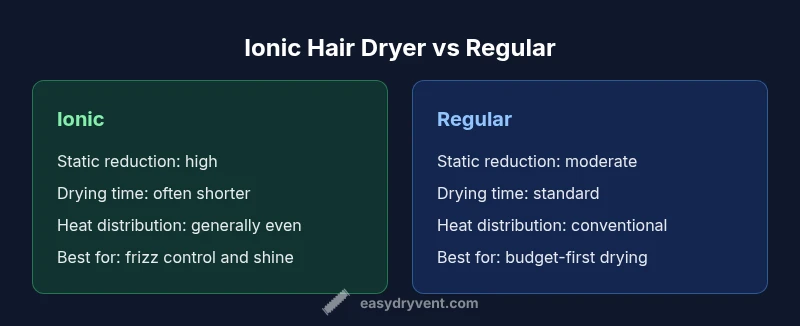
Comparison
| Feature | Ionic hair dryer | Regular hair dryer |
|---|---|---|
| Static reduction | strong reduction | moderate reduction |
| Drying time (per session) | often shorter with ionic | typical drying time |
| Heat distribution | more even with ionic | standard heat distribution |
| Weight | slightly heavier due to ion components | lighter |
| Price range | mid-to-premium | budget-friendly to mid-range |
| Best for | frizz control and smoothness | budget-first drying or simplicity |
The Good
- Reduces static and frizz for many hair types
- Can speed up drying by improving moisture removal
- Leaves hair with a smoother, shinier finish
- Wide range of attachments for styling
Negatives
- Typically higher upfront cost
- Weighs more than basic models
- Benefits vary by hair type and technique
- Some models require more maintenance
Ionic dryers are generally worth it for frizz-prone or fine hair, while regular dryers suffice for budget-focused users.
If frizz control and smoother finish matter, choose ionic. If budget and simplicity trump features, go regular.
Common Questions
Do ionic hair dryers really reduce frizz?
For many hair types, ionic dryers can reduce static and provide a smoother finish. Results depend on hair texture and styling technique, not just the tool. Testing with your routine is the best way to confirm.
Ionic dryers can reduce frizz for many people, but results depend on your hair, technique, and settings. Try a side-by-side test to see what works for you.
Are ionic dryers safer for hair health than regular ones?
Safety is mainly about heat control and technique. Both types can be safe if you use proper temperatures, spacing, and a cool shot. Choose models with sensors and automatic shutoff for extra peace of mind.
Both can be safe as long as you manage heat well. Look for features like temperature sensors and automatic shutoff.
Will ionic dryers work well on color-treated hair?
Color-treated hair benefits from reduced heat stress and smoother finishes, which many ionic dryers provide. However, the most important factors are using lower heat and proper technique to preserve color and shine.
Color-treated hair often benefits from the smoother finish of ionic dryers, but avoid high heat and follow proper technique.
Is there a noticeable weight difference between models?
Yes, some ionic dryers are slightly heavier due to the additional components. If you style for long sessions, weight and ergonomics matter for comfort and technique.
Ionic models can be a bit heavier; if you style a lot, check weight and grip comfort.
Do I need special maintenance for ionic dryers?
Maintenance basics apply to both types: clean filters regularly and inspect attachments. Ionic models may require occasional care of ionizing elements if your unit uses replaceable parts.
Keep filters clean and check attachments; some ionic parts may need occasional care.
Which should I buy for quick daily drying?
If quick daily drying is your priority and frizz control is less important, a reliable regular dryer with good heat control may be the best fit. For smoother results, consider an ionic model with suitable attachments.
For quick daily use, a good regular dryer works well; for smoother results, ionic could be better.
Key Points
- Assess your hair type before choosing.
- Consider heat settings and attachments.
- Ionic tech often improves frizz control.
- Budget and maintenance are key factors.
- Perform a side-by-side test if possible.