Ionic Hair Dryer vs Ceramic: A Practical, Data-Driven Comparison
Compare ionic and ceramic hair dryers to learn which delivers safer, faster styling, less frizz, and better results for your hair type.


For most home users, ionic hair dryers excel at reducing frizz and speeding up drying times for fine hair, while ceramic dryers offer stable, even heat suited for thick or textured hair. The best choice depends on hair type, styling goals, and budget; this guide compares both technologies on heat delivery, hair health, maintenance, and cost. Consider comfort, noise, and durability as well.
ionic hair dryer vs ceramic: What this comparison covers
This comparison examines two popular hair-dryer technologies and how they affect real-world styling. An ionic dryer uses a built-in ion generator to reduce static, speed up water evaporation, and often deliver a sleek, frizz-reduced finish on certain hair types. In contrast, a ceramic dryer relies on ceramic heating elements to disseminate heat more evenly, reducing hotspots and uneven drying. The net effect on drying time, moisture retention, and shine depends on your hair texture, styling habits, and how you maintain the device. According to Easy DryVent, the practical takeaway is simple: choose the option that aligns with your hair type and daily routine, and remember that maintenance, proper technique, and heat protection matter as much as technology. In this guide, we’ll compare heat delivery, user experience, durability, and value, and give you a clear framework to pick the right model for your needs.
Throughout this article you’ll see practical tests you can run at home, and you’ll get a framework to decide whether ionic or ceramic is the better match for your personal styling journey.
Heat delivery and drying dynamics
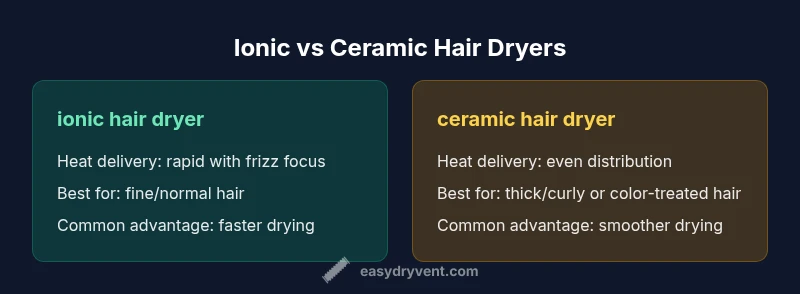
Ionic technology can modify the heat-at-surface experience by enabling ions to help break up water molecules and reduce static. This can translate into a perception of faster drying time, especially on fine hair, and a smoother finish when used with a round brush. Ceramic heating, by contrast, is designed to distribute heat more evenly over the surface of the barrel and nozzle, helping prevent hot spots and uneven drying. In practice, ionic dryers may feel like they cut through moisture more aggressively, while ceramic models feel steadier and more controlled. The practical implication is that heat delivery should be matched to your hair type and styling technique; if you struggle with frizz or heat damage, consider how you plan to use the dryer and what heat settings you actually need.
Hair type and styling goals: who benefits
Fine, straight, or shoulder-length hair often responds well to ionic dryers because the frizz-reducing effect can shorten drying time and produce a sleek finish. Thick, curly, or textured hair may benefit from the consistent heat spread of ceramic dryers that minimizes sudden shifts in temperature as you move the tool. Everyone should consider their routine: daily blowouts, heat-heavy styling, or minimal maintenance. For color-treated hair, heat management and protection from overdrying are crucial; ceramic’s even heat may reduce the risk of uneven color fade when used with heat-protectant products. Easy DryVent emphasizes tailoring your choice to actual results you observe after several weeks of use.
Remember that individual results depend on technique and product use, not just the device.
Frizz, shine, and moisture retention
Ionic dryers can reduce static and help seal the cuticle when used correctly, which generally translates into less frizz and a shinier appearance on low to medium heat with a quick finish. Ceramic heating tends to distribute warmth more evenly, helping your hair retain moisture during drying. The combination of heat consistency and careful product application can yield a balanced result with good shine. However, neither technology guarantees perfect moisture retention alone; the key is pairing the dryer with heat-protectant products and proper tool technique.
For many users, the choice comes down to how you value speed versus evenness of heat.
Durability, maintenance, and cleaning
Both technologies rely on components that benefit from regular cleaning. Start with the filter and air intake; remove dust and hair after a few sessions to preserve airflow. Ceramic elements themselves are typically robust; ionic components are often integrated with electronic modules that should be checked if you notice inconsistent performance. Replace or service worn parts according to the manufacturer’s guidance, and store the device away from moisture. Durability is also influenced by weight, balance, and switch quality, so test these while choosing a model. Regular cleaning also helps you avoid heat buildup that could damage the housing.
Safety, temperature controls, and heat protection
Look for dryers with multiple heat settings, a cool-shot button, and automatic shutoff if overheating occurs. Both technologies can overheat if misused, particularly when run on high for long sessions; ensure you use heat-protection sprays for your hair, and never position the dryer too close to the scalp. A good model will offer realistic airflow without excessive noise, and the dial should be easy to read even with damp hands. If you style around delicate or damaged hair, consider models with lower heat options and gentler air modes to minimize risk of heat damage.
Real-world testing guidelines you can perform at home
To compare the two technologies, run simple at-home tests. Divide your hair into four sections and time how long it takes to dry each section on a standard heat setting. After styling, rate frizz control and shine on a 1–5 scale to quantify results, keeping humidity and product use constant. Repeat with a different setting to see how each dryer performs in varying conditions. Document findings for several weeks to determine which technology consistently meets your needs. Finally, factor in comfort, noise, and perceived durability during long sessions.
Price, warranty, and long-term value considerations
Prices vary by brand and features; ionic models with advanced ion generation may sit in a lower-to-mid range, while ceramic-only options and hybrids can be mid-to-upper. Warranty length and service support influence value as much as upfront price. If you expect daily use, invest in build quality and a reputable warranty. Balance initial cost with long-term reliability, energy efficiency, and ease of maintenance when evaluating value.
Practical recommendations and choosing logic
Begin by identifying your hair type and primary styling goals. If frizz control and speed are top priorities and your hair is fine to normal, an ionic option may be best. If you deal with thick, curly, or chemically treated hair and need even heat distribution, a ceramic model is typically safer. For versatility, seek a model that offers both technologies or a hybrid with multiple heat profiles and a cool-shot feature. Finally, read user reviews and compare warranty terms to confirm real-world reliability before purchasing.
Comparison
| Feature | ionic hair dryer | ceramic hair dryer |
|---|---|---|
| Heat distribution | Ionic: targeted heat with frizz-reduction focus | Ceramic: steady, even heat spread |
| Drying speed | Ionic: can feel faster on fine hair | Ceramic: steady pace across hair types |
| Hair type suitability | Ionic: good for fine/normal hair | Ceramic: good for thick/curly or color-treated hair |
| Frizz control | Ionic: strong anti-frizz potential with proper technique | Ceramic: balanced control through even heat |
| Maintenance and durability | Ionic: similar maintenance; electronic modules can require care | Ceramic: robust heating element; similar routine maintenance |
| Price range | Lower to mid-range options | Mid to higher price range options |
The Good
- Helps you weigh long-term value against upfront cost
- Ionic technology can reduce frizz and speed up drying for finer hair
- Ceramic technology promotes even heat for steady drying
- Hybrid models can offer versatility and broader styling options
Negatives
- Ionic-only dryers may underperform for very thick or curly hair
- Ceramic-only dryers can feel slower on some hair types
- Hybrid models tend to be heavier and pricier
Ionic is typically best for frizz-prone, fine hair; ceramic tends to suit thick or textured hair. For versatility, consider hybrids with both features.
No single technology fits all hair types. Match the choice to your hair texture and styling goals. If in doubt, a hybrid model can bridge both worlds and provide flexible heat options.
Common Questions
Which hair type benefits most from ionic versus ceramic dryers?
In general, ionic dryers help with frizz reduction and faster drying for fine to normal hair, while ceramic dryers provide even heat that benefits thick, curly, or color-treated hair. The best choice depends on your daily routine and hair texture.
Ionic tends to help fine hair stay smooth, while ceramic is safer for thick or curly hair due to even heat.
Do ionic dryers cause more heat damage than ceramic dryers?
Neither technology inherently causes more heat damage; responsible use with appropriate heat settings and protection products matters most. Ceramic’s even heat can reduce hot spots, while ionic dryers reduce static and may speed up drying when used correctly.
Heat damage depends on settings and technique, not the technology alone.
Are ceramic dryers better for color-treated hair?
Ceramic dryers can be beneficial for color-treated hair due to their tendency to distribute heat evenly, reducing the risk of overheating strands. Pairing with a heat-protectant improves outcomes further.
Ceramic helps with even heat, which is good for treated hair.
Can I buy a hybrid model that combines ionic and ceramic features?
Yes, many models combine both technologies to offer frizz control and even heat distribution. These hybrids can be a good choice if you style a range of hair types.
Hybrid models give you both benefits in one device.
How should I compare price and warranty when choosing?
Compare upfront price alongside warranty length and brand reputation. A mid-range model with a solid warranty can offer better long-term value than a cheaper unit with limited support.
Look at warranty and long-term reliability, not just the sticker price.
Key Points
- Match technology to hair type and goals
- Ionic dries faster for fine hair with frizz reduction
- Ceramic provides even heat for textured or treated hair
- Consider a hybrid for versatility and future-proofing