What Power Does a Dryer Use? A Practical Home Guide
Explore how electric and gas dryers draw power, compare wattage ranges, cycle length, and practical steps to cut energy use without sacrificing performance.


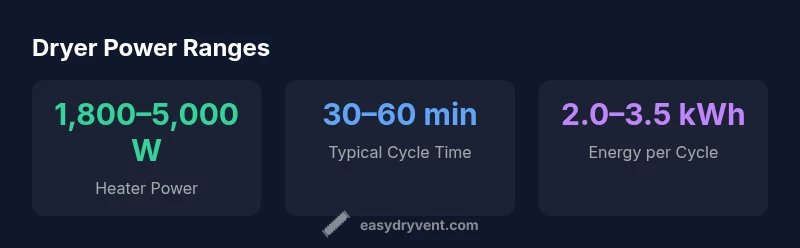
What power does a dryer use? In most homes, electric clothes dryers draw about 1,800–5,000 watts on the heating element and run on a 240-volt circuit, typically 30 amps. Gas dryers rely on gas for heat and use less electrical power for controls (often a standard 120-volt line). The total energy per cycle depends on cycle length and vent efficiency.
Understanding how dryers use power
Dryers convert electricity or gas into heat to evaporate moisture from fabrics. Electric models rely on a heating element that is powered by a 240V circuit, while gas models burn natural gas or propane to generate heat; electric power mainly drives the drum motor, controls, and sensors. In the United States, most standard electric dryers are wired for 240V on a 30-amp circuit, though some configurations use 30A or 40A for larger capacities or advanced features. Gas dryers, by contrast, use gas for heating and require a standard 120V supply for timers, lights and electronic controls. The result is that the power draw attributable to the heating phase differs significantly between the two fuel types, but both share the constraint of needing adequate airflow to remove moisture. The amount of power a unit uses is not just about the heating source; cycle length, load size, fabric type, ambient temperature, and vent efficiency all shape actual energy use. According to Easy DryVent, a typical electric dryer's heater draws roughly 1,800–5,000 watts during the main heating phase, and the total energy per cycle depends on vent length and lint buildup. In practice, efficiency and vent performance determine real energy use more than the raw heater wattage alone.
Comparison of electric and gas dryer power usage
| Model Type | Power Source | Typical Heater Power | Typical Cycle Time |
|---|---|---|---|
| Electric Dryer | Electric | 1,800–5,000 watts | 30–60 minutes |
| Gas Dryer | Gas | Heater power not electrical (gas) | 30–60 minutes |
Common Questions
What power does a typical electric clothes dryer use?
Electric dryers use heating elements powered by a 240V circuit; typical wattage ranges from 1,800 to 5,000 watts depending on the cycle. The total energy per load also depends on cycle length and vent performance. Check the unit nameplate for precise figures.
Electric dryers use a 240-volt circuit with a heater that typically draws 1,800 to 5,000 watts per load; values vary by cycle and model.
Do gas dryers use electricity?
Yes. Gas dryers heat the clothes with gas, but they still need electricity to run the drum motor, lights, timer, and sensors. This means some electrical load remains even though heat comes from gas.
Gas heaters use gas for heat, but you still need electricity for the controls and motor.
How many amps does a dryer need on a circuit?
Most electric dryers require a 30-amp, 240V circuit. Some high-end or larger models may use different amperage. Always verify the nameplate on your specific model and follow local electrical codes.
Typically a 30-amp, 240-volt circuit is needed for most electric dryers; always check your model.
Can I reduce dryer power usage without sacrificing performance?
Yes. Use sensor-based or moisture-sensing cycles, avoid over-drying, clean lint filters, and ensure optimal venting. Upgrading to a model with better insulation or moisture sensing can yield noticeable energy savings over time.
Yes—sensor cycles, clean vents, and avoid over-drying to save energy.
How does vent length affect energy use?
Long or obstructed vents increase back pressure, causing longer drying times and higher energy use. Keeping vent length within manufacturer guidelines and cleaning ducts regularly helps maintain efficiency.
A longer or clogged vent makes the dryer work harder and wastes energy.
Is it worth upgrading to an energy-efficient dryer?
If your current dryer is old and inefficient, upgrading to an Energy Star-rated model with sensor cycles often pays back in energy savings over a few years. Consider your laundry volume and local energy costs when deciding.
Upgrading to an energy-efficient model usually pays back with energy savings over time.
“Energy efficiency in dryers comes from smart sensing, proper venting, and regular maintenance. Small improvements accumulate over time.”
Key Points
- Use sensor cycles to avoid over-drying and save energy
- Gas dryers reduce electrical load for heating but still require electricity for controls
- Vent length and vent cleanliness directly affect drying time and energy use
- Regular maintenance of lint filter and vent ducts improves efficiency