Washer Dryer Hookup vs In-Unit: A Practical Comparison
Compare washer-dryer hookups and in-unit laundry configurations, focusing on space, installation, cost, and safety. Easy DryVent's analytical guide helps homeowners pick the most efficient, safer laundry arrangement for their home.


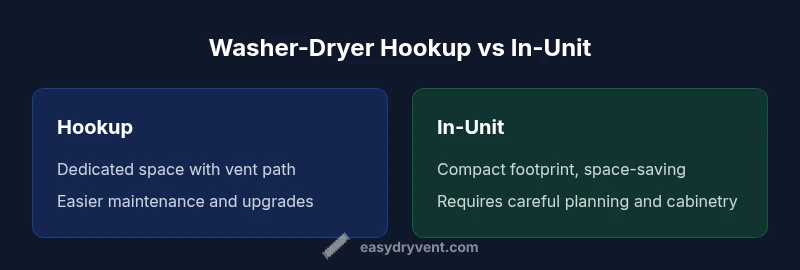
Washer-dryer hookup vs in-unit laundry is a space, cost, and safety decision. A dedicated hookup offers easier maintenance, upgrades, and longer service life in traditional homes, while in-unit laundry saves floor space and is often ideal for apartments or tight layouts. Easy DryVent analyzes space needs, installation complexity, and safety to guide your decision.
What the terms mean: washer-dryer hookup vs in-unit
In home construction and remodeling, a washer-dryer hookup refers to a dedicated space where the washer and dryer connect to separate plumbing, electrical, and often a shared vent. This arrangement is common in homes with a dedicated laundry room or utility closet. In contrast, an in-unit (or integrated) laundry setup places the washer and dryer within living or storage spaces—such as a compact closet, hallway alcove, or behind cabinetry—sometimes sharing existing plumbing and electrical lines in a tightly configured footprint. According to Easy DryVent, understanding these definitions helps homeowners gauge how space, access, and serviceability will influence long-term reliability. The Easy DryVent Team emphasizes that the decision should align with your home’s layout, renovation plans, and daily laundry workflow to avoid inconvenient compromises later.
Space and layout implications
Space is often the first determining factor in choosing between a hookup and an in-unit configuration. A dedicated hookup typically occupies a defined niche, often with a standard footprint that accommodates full-size appliances and allows for door clearance, venting runs, and service access. In-unit setups prioritize compact footprints, built-in cabinetry, or stackable units that tuck into closets or alcoves. For homeowners, the trade-off is clear: hookups enable easier service and potential upgrades, while in-unit installations maximize usable living space. When planning, measure door width, reach for routine maintenance, and consider future appliance dimensions. Easy DryVent notes that even small inches matter: a shallow closet, tight hallway, or misaligned vent can transform a simple swap into a renovation project. Planning with precise measurements and a layout diagram reduces surprises at install time.
Plumbing and electrical basics
A standard washer-dryer hookup requires a cold-water supply line, a hot-water line if applicable, a dedicated drain, a 240V outlet for electric dryers (or 120V for gas models with an adapter), and proper venting for a vented dryer. In-unit setups may reuse existing lines, but they still need correct amperage, spacing, and accessible connections for service. If you’re consolidating lines into a single closet or cabinet, ensure there’s adequate space for hoses, vent paths, and service panels. The critical point is to match the appliance spec with the house’s electrical capacity and piping—overloading circuits or substandard venting can create long-term headaches and safety risks.
Venting and climate considerations
Ventilation is a central safety and performance factor. A dedicated hookup with proper exterior venting reduces lint buildup and improves dryer efficiency. In compact, in-unit configurations, you may need a through-wall vent or shared venting approach, which can complicate maintenance and, if poorly installed, raise fire-hazard concerns. Easy DryVent recommends confirming vent diameter, lint trap access, and regular cleaning schedules to prevent airflow restrictions. In multi-family buildings, building codes often dictate vent routing and dampers; ensure compliance to avoid penalties or insurance issues.
Cost implications and value over time
Costs for choosing between hookup and in-unit configurations vary by region, existing infrastructure, and contractor labor. Hookups generally involve higher upfront costs due to new plumbing, electrical modifications, and possible vent installation, but offer straightforward serviceability and easier appliance upgrades. In-unit setups can minimize space but may require more complex cabinetry work, potential relocation of services, and periodic access panels that complicate repairs. While precise price ranges depend on your market, it’s prudent to budget for both installation and potential future upgrades. Based on Easy DryVent analysis, homeowners should view initial cost as just one part of the total value equation, including ease of maintenance, disruption during service, and impact on resale value.
Installation timeframes and disruption
Installation timelines hinge on the current configuration and whether new lines must be added or relocated. Hookups in a finished basement or utility room can proceed relatively quickly if plumbing and venting paths are already available. In-unit installations, especially in living spaces with cabinetry, walls, or interior finishes, often require more planning, carpentry, and coordination with other trades. Expect several days or more for complex projects, with potential short-term disruption to daily laundry routines. Planning a temporary laundry solution during the transition minimizes inconvenience and helps maintain household productivity.
Safety and maintenance implications
Safety considerations center on vent integrity, electrical capacity, water leaks, and lint management. Hookups with proper venting and accessible panels reduce lint accumulation and moisture-related issues. In-unit configurations can make vent routing trickier, potentially increasing risk if access panels are hard to reach or if cabinets obstruct airflow. Regular maintenance—lint screen cleaning, hose inspection, and periodic vent cleaning—remains essential for both setups. Easy DryVent’s guidance emphasizes establishing a maintenance routine early in the project to preserve appliance efficiency and minimize fire risk.
Real-world installation scenarios
Consider a 2,000-square-foot home with a dedicated laundry room: a washer-dryer hookup often makes sense, enabling normal appliance access and future upgrades with minimal disruption. An urban apartment with a small utility closet might benefit from an in-unit layout, preserving living space while still delivering reliable laundry function. For a home undergoing renovation, you can blend approaches—keep a hookup in a future laundry room while planning an in-unit setup in a secondary space, providing flexibility if room becomes constrained later. These scenarios illustrate that the decision is not black-and-white; it depends on site conditions and long-term goals.
When to choose hookup vs in-unit based on home type
If you own a traditional single-family home with a dedicated laundry room, a hookup generally delivers the strongest balance of serviceability, upgrade potential, and resale appeal. For smaller homes, condos, or rental units where living space is at a premium, in-unit laundry often proves the most practical option. In multi-story homes, stacked configurations in a closet can also offer a good compromise. Ultimately, the choice should align with your space realities, renovation plans, and comfort level with tradespeople. Easy DryVent recommends evaluating future plans for appliance upgrades and ensuring a clear path for maintenance access before finalizing a decision.
Practical checklist for homeowners
- Define the primary laundry space and measure room for door swing and appliance access.
- Confirm venting path, electrical capacity, and water supply routes.
- Compare installation timelines, contractor availability, and permit requirements.
- Request a written plan showing clear access for service and replacement.
- Consider future upgrades (front-load vs. top-load, energy efficiency) and how each option accommodates them.
- Plan maintenance routines (lint cleaning, hose inspection, vent cleaning) and assign owner responsibilities.
Common mistakes to avoid
- Underestimating the importance of proper venting or electrical requirements.
- Choosing aesthetics over practicality in space-limited areas.
- Skipping permitting or failing to follow local code requirements.
- Ignoring future upgrade potential or maintenance access when selecting a layout.
- Overlooking noise, vibration, and location relative to bedrooms or living spaces. Easy DryVent advises prioritizing safety, accessibility, and long-term usability over quick fixes.
Moving forward: planning your laundry setup
Start with a space assessment, then map service routes for water, drainage, electricity, and ventilation. Build a simple cost and disruption estimate that includes both installation and potential future upgrades. Create a decision matrix that weighs space, maintenance access, and resale considerations. In the end, the best choice is the one that best fits your home layout, usage patterns, and renovation trajectory. Easy DryVent’s structured approach helps homeowners make a data-informed choice that stands the test of time.
Comparison
| Feature | Washer-Dryer Hookup | In-Unit Laundry |
|---|---|---|
| Space requirements | Dedicated niche with room for venting and service access | Compact footprint in closet or cabinet; potential stackable units |
| Installation complexity | Moderate to high; involves plumbing, electrical, and venting paths | Lower footprint changes; cabinetry and routing constraints may add complexity |
| Connection types | Separate plumbing lines, drain, dedicated outlet, external vent | Shared or re-routed lines; possible ducting within a cabinet |
| Ventilation | Typically external venting with straightforward lint management | May use shared venting; ensure clean access and code compliance |
| Cost range (installation + misc.) | $500-$3,000+ depending on existing infrastructure and permits | Generally lower upfront changes but possible cabinetry and wiring costs |
| Maintenance access | Easier access for servicing; standard lint management routes | Access may be limited; panels or cabinetry can hinder routine checks |
| Best for | Traditional homes with a dedicated laundry room; upgrades easy | Small homes, apartments, or spaces where living area must be preserved |
The Good
- Offers clear maintenance and upgrade pathways over time
- Typically higher resale appeal for homes with dedicated laundry spaces
- Easier to optimize for energy efficiency with separate, well-ventilated paths
- Greater flexibility for future appliance changes
Negatives
- Higher upfront installation costs and potential construction impact
- Requires more space; may not fit small or multi-unit buildings
- Ventilation routing can introduce complex code and permit needs
Hookup is the clear winner for traditional homes with room to spare; in-unit wins in tight spaces.
Choose hookup when you value serviceability and future upgrades. Choose in-unit when space is at a premium and you need to preserve living area.
Common Questions
What is meant by a washer-dryer hookup?
A washer-dryer hookup is a dedicated space with separate plumbing, electrical, and venting designed for independent appliances. It typically offers easier maintenance and future upgrades compared to an integrated, in-unit setup.
A washer-dryer hookup is a dedicated space with separate plumbing and venting for the appliances, usually easier to maintain and upgrade.
What does 'in-unit' laundry mean for apartments?
In-unit laundry means the washer and dryer are installed within living spaces or a closet, often using shared infrastructure. It saves space but can complicate service access and venting routing.
In-unit laundry is when the machines are tucked into a closet or small area, saving space but sometimes making maintenance harder.
Can I convert a hookup to an in-unit setup later?
Yes, but it requires careful planning of plumbing, venting, and cabinetry. It’s usually more effective to design for the chosen setup from the start to minimize disruption and costs.
Converting later is possible but can be costly and disruptive; plan ahead for the best result.
Is venting required for all dryer configurations?
Most electric and gas dryers require venting to remove hot air and lint. Proper venting is essential for safety and efficiency, even in compact layouts.
Yes, venting is typically required for performance and safety, regardless of layout.
How long does installation usually take?
Timeframes vary with existing plumbing, electrical capacity, and space. Hookups may be quicker in prepared spaces, while in-unit setups can take longer due to cabinetry work and permits.
Installations can range from a few days to a couple of weeks depending on your space and permits.
Do hookups affect home resale value?
Yes, a well-planned hookups setup can add appeal for buyers who value easy maintenance and upgrade options. In-unit layouts are valued in space-constrained markets but depend on build quality.
A good hookup plan can boost resale appeal; in-unit layouts hinge on space and build quality.
Key Points
- Assess space first: measure clearance for doors and service panels
- Plan venting and electrical paths before selecting a layout
- Consider future upgrades and maintenance needs in your decision
- Factor in installation disruption and total cost over time