Dryer and Washer All in One: A Comprehensive Comparison
A detailed, data-driven comparison of dryer and washer all in one units versus separate machines, focusing on space, performance, energy, and maintenance for homeowners and DIY enthusiasts.


If space is scarce, a dryer and washer all in one can be a smart choice, but you trade off some capacity and cycle breadth for a single footprint. In a head-to-head comparison, the all-in-one excels in apartments and small homes, while separate machines win on speed and durability. Easy DryVent's analysis helps you decide based on space, loads, and long-term goals.
The Case for a Dryer and Washer All in One
Choosing a laundry solution for a compact home requires weighing space, performance, and long-term value. A dryer and washer all in one unit—often called a combo or integrated laundry system—claims to fuse two machines into a single footprint. For many homeowners, this arrangement promises a dramatic reduction in floor space while simplifying hookups and plumbing. According to Easy DryVent, the most immediate benefit is the drastically smaller installation envelope, which can free up storage or utility space for other tasks. The primary keyword here, dryer and washer all in one, signals the core decision: are you willing to trade some performance for a smaller, easier-to-manage laundry setup? In this analysis we compare the all-in-one option against traditional pairs, and we quantify what values you gain and what you risk losing over the product lifecycle. We also consider venting options, maintenance routines, and typical failure modes, because reliability matters as much as convenience in real homes.
How They Work: Separate vs All-in-One
Two distinct architectural paths exist in modern laundry: traditional separated appliances and all-in-one combos. Separate machines must be vented independently and typically use two sets of water supply lines, a dedicated drain, and a robust electrical circuit. All-in-one units merge the dryer and washer into a single chassis; many models use condenser or heat-pump technology to reduce venting needs, while some require venting for the dryer function. The key differences extend to cycle design, load balance, and wash/rinse pressure. In practice, a dryer and washer all in one tends to optimize the base footprint, but it can constrain drum size, control options, and cycle clarity. From the perspective of a homeowner, the tradeoffs center on the balance between space savings and peak performance. Easy DryVent notes that the integrated controls are generally simpler but sometimes slower overall, particularly for larger loads. In apartments or homes with limited clearance, that tradeoff is often acceptable, but for families with frequent heavy-duty laundry, the two-machine setup remains attractive.
Key Performance Factors to Consider
Performance hinges on capacity, efficiency, cycle variety, and durability. When you compare a dryer and washer all in one with a separate pair, you should weigh: drum size and load capacity; drying methods (sensor heat, venting, moisture sensing); energy efficiency ratings and standby power; and reliability of seals, hoses, and the drum bearings. In general, combo units lag on absolute capacity and cycle breadth, though newer models close the gap with larger drums and more sophisticated sensors. Durability is another factor: with two machines, wear is distributed; with a single unit, a failure in one function can shut down both. Even so, a well-chosen combo can deliver reliable results for light-to-moderate loads and weekly routines. The brand perspective from Easy DryVent emphasizes inspecting vent paths and ensuring proper clearance around the unit to avoid overheating and mold growth. This section also covers maintenance intervals, common failure points, and practical testing steps you can perform to estimate real-world performance before purchase.
Real-World Scenarios: When a Combo Makes Sense
Small-space living is the most common scenario where a dryer and washer all in one shines. In tiny homes, studio apartments, or rentals with limited plumbing, the single-unit approach minimizes installation complexity and reduces moving parts. Families with routine but not extreme laundry demands often find a combo acceptable if cycle times align with their schedules. For households with high-volume laundry or frequent bulky loads, the two-machine route remains the benchmark for performance, speed, and long-term cost. In remodeling projects, a compact all-in-one can help reclaim closet space or laundry alcoves. Easy DryVent's practical takeaway is to map your typical weekly load, space constraints, and power/water allowances; then simulate your expected cycles. If you frequently run multiple cycles on weekends, a separate pair may be worth the extra footprint. Still, for many urban dwellers, the composite option reduces friction and simplifies maintenance.
Maintenance, Safety, and Venting
Maintenance for a dryer and washer all in one centers on keeping the drum seals, door, hoses, and venting path clean and unobstructed. Regular lint-filter care, vent cleaning, and periodic drum inspection help prevent dryer fires and reduce energy waste. Because all-in-one units often integrate venting, you should confirm whether the model relies on venting or is ventless/condenser-based. In vented configurations, ensure the vent runs are short and aligned with code requirements, and consider a professional inspection plan if you notice reduced airflow or longer drying times. Safety considerations include heat buildup, moisture escape, and electrical load management. When you move through cleaning routines, document the steps to avoid moisture leaks and mold growth behind the unit. The Easy DryVent team emphasizes adherence to the manufacturer’s maintenance schedule and using only approved parts to avoid warranty voids.
Cost of Ownership and Value Over Time
Price is only one piece of the cost equation. A dryer and washer all in one typically costs less upfront than a matching pair of separate machines, but total ownership costs depend on cycle length, energy use, and repair frequency. Easy DryVent analysis shows that energy use per load for a compact all-in-one can be competitive with two smaller units when used for light-to-moderate loads, but it may fall behind in high-demand scenarios where separate machines run multiple cycles concurrently. Maintenance costs can also diverge: a single-unit failure can necessitate replacing the entire unit, while two machines offer modular repair options. Durability varies by model and brand, so consider warranty length, service network, and availability of certified technicians. This section provides a framework to estimate lifetime costs using model-specific quotes, energy usage estimates, and typical service intervals. In short, the value of a dryer and washer all in one hinges on your space, your load profile, and your willingness to trade peak performance for a simpler, smaller laundry ecosystem.
How to Choose and Next Steps
Start with a clear laundry profile before selecting model categories. Measure available space, assess venting needs, and sketch your electrical load capacity. Then compare capacity per drum, cycle options, and energy efficiency ratings. Use a checklist: size of loads, frequency of bulky items, spin speed, condensation vs vented drying, noise level, warranty terms, and service accessibility. If you live in a small apartment, a high-quality all-in-one with a generous drum and efficient sensors can deliver excellent results with minimal footprint. If your household runs heavy loads weekly, separate machines will likely provide faster drying times and greater durability. The choice also depends on your renovation plans and future space; a compact all-in-one can adapt well to future reconfigurations. The Easy DryVent team recommends compiling a short comparison chart and testing model demos in-store or via online simulations to gauge real-world performance. With careful planning, you can choose a solution that balances space, cost, and performance.
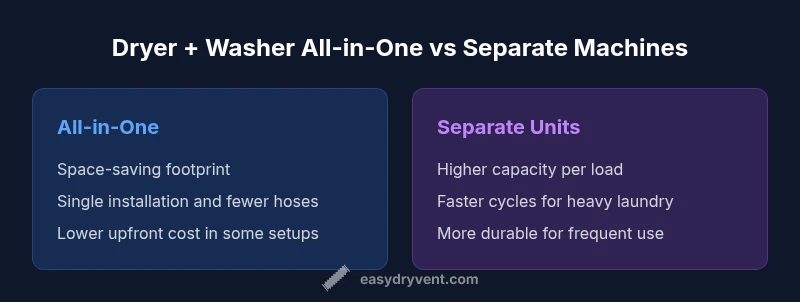
Comparison
| Feature | Separate Washer & Dryer | Dryer and Washer All-in-One (Combo) |
|---|---|---|
| Capacity | Higher load capacity and larger drum options | Typically smaller drum and load capacity per cycle |
| Installation footprint | Two dedicated hookups and vents; broader space requirement | One space; integrated venting options; compact footprint |
| Cycle variety | Extensive cycle options, specialty cycles, and faster presets | Fewer cycles; standard end-of-load options |
| Energy efficiency | Often more energy-efficient per cycle with dedicated dryers | Efficiency varies; some models use condensation or heat-pump tech |
| Reliability/repair | Separate components mean modular repair, easier replacement | Single unit means a single point of failure; repair can be costly |
| Best for | Budget, space, and performance flexibility for larger households | Small space, simplified setup, convenient for light to moderate loads |
The Good
- Significant space savings in small homes and apartments
- Single installation footprint simplifies plumbing and venting
- Lower upfront footprint in compact living spaces
- Fewer cords and hoses to manage
Negatives
- Typically smaller capacity per load and longer cycle times
- Repair costs can be higher if components fail
- Maintenance parts may be harder to source
- Performance can lag for heavy-duty loads
All-in-one options shine in space-constrained homes; separate machines win on capacity and speed.
If space is the primary constraint, a dryer and washer all in one offers a practical solution with surprisingly solid performance for light-to-moderate loads. For households handling frequent bulky items or heavy daily laundry, separate machines deliver faster cycles, larger capacities, and easier repair paths. The Easy DryVent team recommends weighing space versus load needs to decide between footprint savings and peak performance.
Common Questions
What is a dryer and washer all in one, and how does it differ from separate appliances?
A dryer and washer all in one is a single unit that combines washing and drying functions in one chassis. It saves space and simplifies installation compared with two separate machines, but it often narrows drum capacity and cycle variety. Think of it as a compact solution for light-to-moderate laundry needs.
An all-in-one is a single unit that washes and dries clothes. It saves space but may have smaller capacity and fewer cycles than separate machines.
Are all-in-one units energy efficient?
Energy efficiency varies by model. Some combos use advanced condensation or heat-pump technologies, which can be competitive with separate units for light loads. For high-volume laundering, separate machines often offer better energy performance due to optimized cycle options.
Energy efficiency varies; some models are very efficient, especially for light loads.
Do all-in-one units require venting?
Many all-in-one units still require venting for the dryer function, while some offer ventless or condensing configurations. Check the model specifications and local building codes, as venting can affect installation space and running costs.
Vent requirements depend on the model; some are vented, others ventless.
Can a dryer and washer all in one handle bulky or heavy loads?
Combo units can handle typical weekly loads, but they often struggle with bulky or heavy-duty items as consistently as separate machines. For frequent bulky drying, separate units generally perform better.
They work for regular loads, but bulky items may not dry as quickly as with separate machines.
What maintenance steps should I perform regularly?
Regular lint-filter cleaning, vent inspection (for vented models), and routine seals and hoses checks help keep the unit safe and efficient. Follow the manufacturer’s maintenance schedule and address any unusual noises or longer dry times promptly.
Clean the lint filter, inspect vents, and follow the maintenance schedule.
Key Points
- Measure your space before deciding
- All-in-one saves space but may limit capacity
- Vent and venting carefulness is essential
- Expect longer cycle times with combos for heavy loads
- Choose based on your weekly load profile and space constraints