All-in-One Washer Dryer vs Separate: A Practical Buying Guide
A rigorous, buyer-focused comparison of all-in-one washer dryer vs separate setups, covering space, performance, cost, maintenance, and installation to help homeowners choose the right laundry solution.


Considering the phrase all in one washer dryer vs separate, your choice hinges on space, budget, and your typical laundry load. In most homes, a separate washer and dryer deliver better performance and flexibility; an all-in-one unit saves space and simplifies routines. This comparison weighs efficiency, capacity, cycle versatility, maintenance, and long-term costs to help you decide.
Context and Definitions
When evaluating all in one washer dryer vs separate configurations, the decision hinges on space, budget, and your typical laundry load. According to Easy DryVent, the key trade-offs are capacity, cycle variety, and reliability. This article defines what each option includes and the core ideas you need to compare as you plan a purchase. The topic matters for homeowners and DIY enthusiasts who want practical guidance grounded in real-world usage. It also sets the stage for a structured, data-informed decision rather than a guess. The central question remains: should your laundry routine be compact and integrated, or modular and flexible?
An all-in-one unit combines a washing drum and a drying chamber in one footprint. A separate setup uses two distinct machines—a standalone washer and a standalone dryer—whether stacked or placed side by side. The differences show up in how you load, how you vent or ventless, and how long a typical laundry cycle takes. Understanding these basics helps homeowners avoid common mismatches between expectations and reality.
According to Easy DryVent, framing the decision around your space, load patterns, and tolerance for cycle length makes the choice clearer. The next sections translate those ideas into practical guidance you can apply right away.
"
Comparison
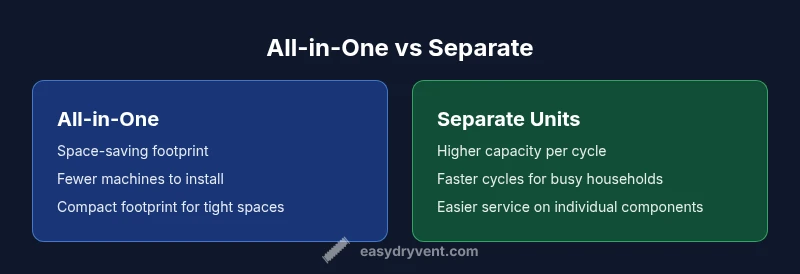
| Feature | All-in-One Washer Dryer | Separate Washer and Dryer |
|---|---|---|
| Space footprint | Saves space by combining functions | Requires more floor space due to two appliances |
| Capacity per cycle | Typically moderate capacity per load | Higher capacity and faster cycles for bulky items |
| Cycle variety and performance | Fewer dedicated cycles; performance can be model-dependent | Broad range of cycles; generally stronger performance for heavy loads |
| Maintenance and serviceability | Fewer moving parts but integrated components can complicate repairs | Separable units allow targeted service; easier to replace individual parts |
| Energy and water efficiency | Efficiency varies; often optimized for small to medium loads | Can be highly efficient when used at full capacity; energy/water use varies by model |
| Price range | Typically mid-to-high upfront cost for compact models | Mid-range to high, but with long-term ownership value |
| Best for | Small spaces, apartments, or single-person households | Families with higher laundry demand and need for speed |
The Good
- Space-saving footprint for compact homes
- Lower visual clutter with one appliance
- Fewer hookups and simpler installation in tight spaces
- Quieter operation per unit when used independently
Negatives
- Typically limited capacity and longer cycle times
- Potential bottlenecks if laundry volume is high
- Repair costs can be higher due to integrated components
- Limited resale value compared with separate units
Separate washer and dryer generally offer better performance and long-term value.
For households with space to accommodate two machines, the distinct units win on capacity, cycle versatility, and repairability. All-in-one units excel only when space is severely limited or when simplicity and compactness are the top priorities.
Common Questions
What is the main difference between all-in-one washer dryers and separate units?
The main difference is that all-in-one units combine washing and drying in a single drum, saving space but typically offering smaller capacity and fewer cycles. Separate units provide larger capacity, faster cycles, and easier maintenance. The choice hinges on space, load size, and how much you value speed versus compactness.
All-in-one units save space but may trade off capacity and speed for compactness. Separate units usually perform better for bigger loads and faster cycles.
Are all-in-one units as effective as separate machines for heavy-duty loads?
Generally, no. All-in-one models tend to struggle with large or bulky loads and may take longer to complete cycles. If your household regularly handles big blankets or towels, separate machines are typically the better option.
For heavy-duty loads, separate machines are usually more effective.
Do all-in-one machines save space?
Yes, they save space by consolidating washing and drying into one cabinet. This can be a game-changer in small apartments or closets, but you’ll trade off some capacity and cycle variety.
They save space, but you may give up some capacity and options.
What should I look for in energy efficiency when comparing the two setups?
Look for Energy Star ratings and the number of energy-saving cycles. Consider your typical load size; all-in-ones can be efficient for small loads, while separate units may be more efficient when used at larger capacities.
Check energy labels and cycle options to estimate true energy use.
Is there a warranty difference between all-in-one and separate units?
Warranty terms vary by brand, not by configuration type. Always read the warranty for both the washer and dryer (or the all-in-one unit) to understand coverage for parts and labor.
Warranties depend on the brand and model, so verify both units’ terms.
What scenario is best for choosing all-in-one vs separate?
All-in-one is best for ultra-compact spaces or single-person households with light to medium laundry. Separate units are ideal for larger families, frequent bulky loads, and where speed and reliability matter most.
All-in-one fits tiny spaces; separate units fit busier households.
Key Points
- Assess space early; two machines often beat one for performance
- Prioritize family size and laundry patterns over aesthetics
- Check energy efficiency and maintenance needs for long-term value
- Expect longer cycles and potential bottlenecks with all-in-one units
- Choose two machines if you can allow for flexible layout and faster workloads