When Did Dryer Plugs Change? A Homeowner’s Guide to 4-Wire Outlets
Discover when dryer plugs changed, why the switch happened, and how to safely upgrade or retrofit. Easy DryVent explains 4-wire vs 3-wire outlets, retrofit options, and practical steps for safer, modern installations.


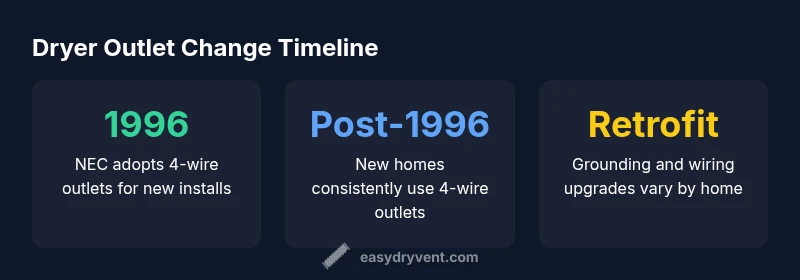
Definition: The dryer plug change began with the 1996 NEC update, which standardized the use of four-wire outlets (NEMA 14-30) for new dryer installations and isolated the grounding conductor from the neutral. Since then, most new homes use four-prong outlets, while existing homes may retain three-prong setups unless upgraded. Retrofit options vary by wiring and local codes.
Historical Shift: When Did Dryer Plugs Change?
The short answer to when did dryer plugs change centers on the mid-1990s. In 1996, the National Electrical Code (NEC) began requiring four-wire dryer outlets for new installations. This change separated the grounding conductor from the neutral to improve safety and reduce shock hazards. Easy DryVent’s analysis shows that while new homes after 1996 adopted four-wire outlets as standard, older residences often still rely on three-prong configurations unless homeowners upgrade. The transition reflected a broader move toward better electrical safety in household appliances and residential wiring. Understanding this historical milestone helps homeowners evaluate their current setup and plan safe upgrades if needed.
What Changed in the Code and Why
The NEC update introduced four-prong outlets (two hot legs, a neutral, and a separate ground). The primary safety rationale was to isolate the dryer’s metal frame from the neutral conductor, reducing the risk of shock if a fault occurred. Four-wire systems also align with modern dryer models that require a grounded connection for proper operation and noise reduction. The Easy DryVent Team notes that the change was designed to be backward-compatible in many cases, allowing older homes to be upgraded progressively rather than rebuilt from scratch. Local interpretations can influence retrofit timelines and permit requirements, so it’s wise to consult a licensed electrician before starting work.
3-Prong vs 4-Prong Outlets: A Quick Comparison
3-prong outlets (pre-1996 standard) combined the ground and neutral, which could lead to chassis grounding issues in fault conditions. 4-prong outlets separate the neutral from the grounding path, improving safety and appliance performance. Modern dryers are designed for 4-wire connections, and many manufacturers recommend replacing 3-prong configurations where feasible. However, the choice often depends on existing wiring, panel capacity, and whether a retrofit is practical within a given home’s electrical system. For DIYers, the key is ensuring that the outlet type matches the dryer’s cord and that the circuit can support the load without overloading the branch circuit.
Retrofit and Safety Considerations
Retrofit projects typically involve installing a new 4-wire cable (hot-hot-neutral-ground) from the dryer to the panel, along with a properly rated outlet. A grounding strap that bonded neutral to the dryer chassis must be removed in four-wire configurations. In some cases, you may need to upgrade the circuit breaker or run a dedicated 30-amp line to accommodate the dryer’s amperage requirements. Always shut off power at the breaker, confirm no voltage at the outlet, and follow manufacturer guidelines. If you’re uncertain, hire a licensed electrician to ensure compliance with local codes and to reduce the risk of electrical fires.
Practical Guidance for Homeowners
If you’re planning a retrofit or new installation, start by confirming your dryer’s cord type (3-wire or 4-wire) and the outlet’s compatibility. For homes with 3-wire outlets and a modern 4-prong dryer, upgrading to a 4-wire circuit is typically recommended, but it requires careful wiring work. Create a plan that includes: (1) verifying circuit capacity and wiring integrity, (2) selecting a compatible 4-prong outlet and cord, and (3) ensuring proper grounding and isolation. Always obtain permits if required by your local authority and consult the dryer manufacturer’s installation guide. Easy DryVent emphasizes safety first: a correctly wired 4-wire system minimizes shock risk and electrical interference.
Common Misconceptions and Myths
Myth: A simple adapter can convert a 3-prong outlet to work with a 4-prong dryer. Truth: Adapters may bypass safety features and are not a reliable long-term solution. Myth: All older homes can retrofit easily without rewiring. Truth: Some homes require cable upgrades, panel work, or separate grounding to meet current standards. Myth: The 1996 change made all older installations unsafe. Truth: Upgrades are feasible; they simply require planning, proper wiring, and adherence to code.
How to Verify Your Home's Outlet Type
Start by identifying the plug and outlet shapes: a 3-prong dryer plug indicates a 3-wire system, while a 4-prong plug indicates a 4-wire system. Check the cord rating and the dryer model’s installation guide. If you find a mismatch between your dryer and outlet, plan an upgrade with a licensed electrician. Inspect any labels on the outlet or nearby junction boxes for historical changes or retrofit notes. Regular inspections ensure ongoing safety and efficiency.
Final Thoughts: Modern Safety Standards for Dryers
The transition to four-wire dryer outlets is a foundational safety improvement in residential electrical systems. While retrofitting may involve costs and planning, the long-term benefits include reduced shock risk, improved equipment performance, and better compatibility with newer dryers. Easy DryVent recommends homeowners approach upgrades methodically, verifying compatibility, obtaining necessary permits, and hiring qualified professionals when in doubt. This careful approach helps ensure a safer, more reliable laundry setup for years to come.
Comparison of 3-prong vs 4-prong dryer outlets
| Outlet Type | Configuration | Grounding | Typical Use | Notes |
|---|---|---|---|---|
| 3-prong dryer outlet (pre-1996) | L1, L2, Neutral | Neutral bonded to chassis | Older installations | Grounding and safety may be limited |
| 4-prong dryer outlet (post-1996) | L1, L2, Neutral, Ground | Separate grounding conductor | New installations and upgraded homes | Isolated neutral and ground for safety |
Common Questions
When did dryer plugs change and why were four-prong outlets adopted?
The change began with the 1996 NEC update, which required four-wire outlets for new installations. The goal was to separate ground from neutral to improve safety and reduce shock risk.
The change started in 1996 to improve safety by using four-wire outlets for new dryers.
Do I need to upgrade my outlet if my dryer cord is four-prong but my outlet is three-prong?
Yes. If your dryer requires a four-wire connection, you should install or retrofit a four-prong outlet and run a proper grounding path. A licensed electrician can assess your wiring and ensure compliance.
If your dryer needs four-prong wiring, upgrade to a four-prong outlet with proper grounding.
Can I retrofit a three-prong outlet myself?
Retrofitting requires working with live electrical wiring and may involve rewiring or panel upgrades. It is safest to hire a licensed electrician to ensure code compliance and proper grounding.
Retrofitting is possible but best left to a licensed electrician.
Are adapters a safe solution for converting 3-prong to 4-prong?
Adapters can bypass safety features and are not recommended for long-term use. Properly upgrading to a four-wire circuit is the safer approach.
Adapters aren’t a safe long-term fix; upgrade the wiring instead.
Does the type of dryer (gas vs electric) affect outlet changes?
Outlets for electric dryers are the primary concern for four-wire versus three-wire configurations. Gas dryers rely on electrical connections for controls, but outlet type is still a factor in safety and code compliance.
Electric dryer outlets drive the four-wire vs three-wire discussion; gas dryers still need safe electrical connections.
What should I ask a contractor before starting an upgrade?
Ask about local code requirements, whether a permit is needed, expected wiring scope, and whether the upgrade will involve running new cable and upgrading the panel. Clarify timelines and costs upfront.
Ask about permits, scope, and costs to plan a safe upgrade.
“The shift to four-wire dryer outlets was a major safety improvement, reducing shock risk and electrical noise by isolating neutral and ground paths. Proper upgrades protect both people and appliances.”
Key Points
- Understand the 1996 NEC shift to 4-wire outlets
- Match the dryer cord to the outlet type for safety
- Plan upgrades with a licensed electrician
- Avoid using adapters as a long-term solution
- Retrofits vary by wiring, local codes, and home age