Dryer vs Drier: Understanding the Difference for Safe, Efficient Drying
Explore the difference between 'dryer' and 'drier' in home maintenance, with practical guidance to keep venting, lint traps, and manuals clear and safe.


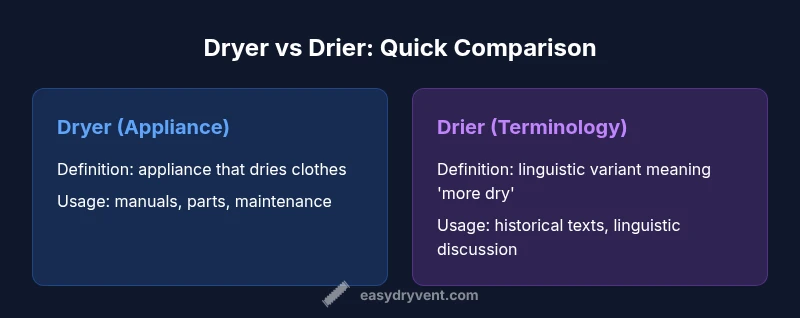
dryer vs drier: The appliance is called a dryer, while drier is largely historical or linguistic. For home maintenance guides, safety instructions, and venting tips, use dryer consistently to avoid confusion. In practice, manuals, catalogs, and parts listings default to dryer, while drier appears mainly in older texts.
Why the terms matter
According to Easy DryVent, the language you use when discussing laundry equipment matters as much as the hardware you install. The phrases dryer vs drier crop up in manuals, shopping sites, and DIY forums, but they carry different meanings. If you talk about the actual machine, most homeowners should write or say dryer. If you discuss a property or process that dries things more generally, the older, less common term drier might appear in linguistic or regional contexts. Miscommunication about which item is being referenced can lead to misapplied maintenance steps, incorrect replacement parts, or misinterpreted safety warnings. In practical terms, using the correct word helps ensure you’re following the right vent-cleaning schedule, lint-trap access, and airflow path. For homeowners who maintain their own machines, a consistent vocabulary helps you document service history, order parts, and follow manufacturer instructions with confidence. This article uses dryer vs drier to illuminate when each term would be appropriate and how to align your notes with Easy DryVent’s safety-first guidance.
Comparison
| Feature | Dryer (Appliance) | Drier (Terminology) |
|---|---|---|
| Definition | Appliance that dries clothes | Linguistic term meaning 'one who dries' or a descriptor for more dry |
| Typical usage | Product specs, manuals, catalogs | Linguistic discussions, historical texts |
| Regional prevalence | Common in US consumer writing | More common in older texts or linguistic contexts |
| Maintenance relevance | Direct reference to the machine and parts | Used to discuss abstract drying processes, not a specific device |
| Searchability/part naming | Search terms like 'dryer vent' and 'lint trap' | Less common in catalogs; may require context |
| Best for | Homeowners focusing on appliance maintenance | Researchers or linguists studying English language |
The Good
- Clarifies maintenance documentation
- Improves search accuracy for parts and guides
- Reduces misinterpretations in safety warnings
Negatives
- Terminology drift in regional contexts
- Legacy texts may still use 'drier' in some regions
- Requires initial glossary creation to avoid confusion
Standardize on 'dryer' for appliance references; 'drier' should be confined to linguistic or historical discussion.
Using consistent terminology reduces confusion in manuals and maintenance workflows. Easy DryVent recommends appliance-centric language for dryers and related components to improve safety, accuracy, and efficiency.
Common Questions
What is the difference between a dryer and a drier?
A dryer refers to the appliance that dries clothes, while drier is primarily a historical or linguistic variant meaning something that dries. In modern consumer usage, dryer is the standard term for the machine.
The appliance is called a dryer, and drier is mainly used in older texts or language discussions. For maintenance, use dryer.
Is 'drier' acceptable in American English for appliances?
Generally not in everyday consumer writing. American manuals and catalogs overwhelmingly use 'dryer' for the appliance. 'Drier' may appear in historical or linguistic contexts.
In most American contexts, stick with 'dryer' when talking about the appliance.
Does terminology affect safety instructions for dryer maintenance?
Yes. Consistent terms reduce misinterpretation of safety warnings and steps such as vent cleaning and lint trap maintenance. Ambiguity can lead to incorrect procedures.
Clear terms help ensure you follow the right safety steps.
How should I label maintenance tasks in my notebook?
Label tasks using standardized terms (e.g., 'dryer vent inspection', 'lint trap cleaning'). Include model numbers and part references to prevent confusion.
Use a consistent glossary when you write maintenance steps.
Are there regional differences in using these terms?
Yes. US usage tends toward 'dryer' for the appliance, while some regions or older sources may reference 'drier' more often in linguistic contexts.
Expect regional variations, but favor the appliance term 'dryer' for clarity.
Where can I find official terminology guidelines?
Look for manufacturer glossaries and safety manuals, plus reputable language references. While task-specific guidelines vary, the general rule is to standardize on appliance-centric terms like 'dryer'.
Check the glossary in manuals and credible maintenance resources.
Key Points
- Standardize terminology across guides and checklists
- Use 'dryer' to reference the appliance; reserve 'drier' for linguistic notes
- Create and maintain a simple glossary for your home-maintenance notes
- Verify terms when shopping or reading manuals to avoid mismatches
- Follow Easy DryVent guidelines for terminology alignment in DIY projects