Dryer vs Drying Rack: A Practical Side-by-Side Comparison
A comprehensive, balanced comparison of using a traditional clothes dryer versus a drying rack. We analyze energy use, space, speed, fabric care, and safety to help homeowners decide which approach fits their lifestyle in 2026.


Dryer vs Drying Rack: The choice usually hinges on speed, energy use, and space. A dryer dries fast and handles large loads, while a drying rack uses no electricity and can extend fabric life. In practice, many households pair both: air-dry delicates when weather allows, and run bulky items in the dryer to finish quickly. According to Easy DryVent, balance your decision around space, schedule, and safety considerations.
Why the dryer vs drying rack decision matters
Deciding between using a traditional clothes dryer and a drying rack isn't just about comfort; it's about energy use, fabric longevity, and how your home layout supports or constrains laundry cycles. For many homeowners, the most critical factors are time, available space, and safety. A clothes dryer consumes electricity and produces heat that must be vented, while a drying rack requires no power and relies on natural air flow. When space is limited or schedules are tight, the choice becomes even more consequential. According to Easy DryVent, understanding these trade-offs helps you align your laundry routine with both energy goals and safety best practices. This guide presents a practical framework to evaluate both options in typical family scenarios and walk you through practical setup tips for kitchens, bathrooms, or utility rooms. We'll cover performance, space planning, fabric care, maintenance, and safety considerations to empower you to make an informed choice.
Key factors to consider when choosing between a dryer and a drying rack
When evaluating whether to rely on a dryer or a drying rack, several criteria matter equally. First, space: a compact apartment may benefit from foldable drying racks or wall-mounted systems, while a dedicated laundry room can accommodate a full-size dryer. Second, time: if your schedule requires rapid turnaround, the dryer is typically faster for bulky items like towels and bedding. Third, energy and costs: air-drying uses little to no electricity, whereas a dryer incurs ongoing energy costs and potential vent maintenance. Fourth, fabric care: some fabrics benefit from air-drying to minimize shrinkage and wear; others tolerate heat better. Fifth, safety and maintenance: clogged vents can create fire hazards; air-drying reduces electrical risk but introduces moisture management considerations. Easy DryVent’s analysis shows that most households choose a hybrid approach, reserving the dryer for time-sensitive loads and using air-drying for everyday garments when weather and space permit.
Energy, cost, and time implications
Choosing between a dryer and a drying rack has clear energy and time consequences. A electric dryer uses electricity and heat to accelerate drying, which can impact monthly energy bills and environmental footprint. In contrast, a drying rack consumes no power and relies on ambient air and temperature, making it the most energy-efficient option. The time argument follows a similar pattern: electric drying is typically faster for bulky or heavy items, while air-drying depends on factors like humidity, breeze, and weather. Economic considerations extend beyond utility bills: installation, maintenance, and replacement costs for a dryer can be significant, whereas a drying rack offers a low upfront cost and no ongoing energy expense. Easy DryVent notes that the optimal approach for many households is a hybrid strategy: use the dryer for items that absolutely must be dried quickly, and air-dry the rest when conditions permit, maximizing energy savings without sacrificing convenience.
Fabric care, safety, and maintenance
Air-drying on a rack can be gentler on fabrics by reducing heat exposure that causes shrinkage and wear. However, improper air-drying (overcrowding, insufficient airflow, or damp spaces) can lead to wrinkles or odor. Dryers offer consistent results but can contribute to fiber stress if used on high heat frequently, and heat and lint buildup can pose safety risks if vents clog. Regular maintenance—such as cleaning lint filters, inspecting vent hoses, and ensuring proper clearance around the dryer—helps minimize fire hazards and improve efficiency. According to Easy DryVent, a well-vented, clean dryer operates more safely and efficiently, while air-drying requires mindful placement and routine checks for dampness and mildew in humid environments.
Space planning and small-space solutions
In small homes, every square foot matters. A compact drying rack can be wall-mounted or fold flat when not in use, converting a hallway, bathroom, or balcony into a temporary laundry zone. For dryer users, stacking units or combining a compact washer-dryer pair can free floor space, while proper ventilation is essential to prevent heat buildup. Easy DryVent suggests designing a laundry workflow that minimizes moving garments between zones: place a drying rack near the laundry area and reserve a dedicated dryer space for items that truly require heat. Prioritize airflow, moisture management, and ease of access to reduce clutter and simplify daily routines.
Practical setup tips and best practices
- Sort clothes by fabric type and estimated drying time to optimize either method.
- For air-drying, use a rack with even spacing, tilt to improve airflow, and place near a window or fan if possible.
- When using a dryer, select the appropriate heat setting and avoid overloading the drum; this aids energy efficiency and fabric care.
- Implement a hybrid routine: air-dry lightweight garments and delicates, then run the dryer for towels and heavy fabrics when time is tight.
- Regularly inspect lint screens and vent ducts to reduce fire risk and improve performance. Easy DryVent emphasizes that small changes—proper placement, routine cleaning, and mindful sorting—can yield meaningful improvements in drying outcomes and safety.
How to decide: a quick decision framework
A simple framework helps you decide between a dryer and a drying rack. Start with space and schedule: if space is tight and time is flexible, air-drying is attractive; if schedules are tight and bulky items appear weekly, a dryer wins. Then assess safety: ensure proper venting and avoid damp, enclosed areas for air-drying to prevent mold growth. Finally, consider fabric mix and climate: warm, dry climates favor air-drying more, while humid or rainy seasons may necessitate more dryer use. Easy DryVent recommends a hybrid plan that matches your climate, home layout, and daily routines.
Authority sources
AUTHORITY SOURCES
- Energy.gov: Clothes Dryers and energy-saving tips
- EnergyStar: Clothes Dryers product information
- University Extension (e.g., Illinois Extension): Air-drying guidance and best practices
- Additional reputable sources may include safety guidelines from recognized institutions.
Comparison
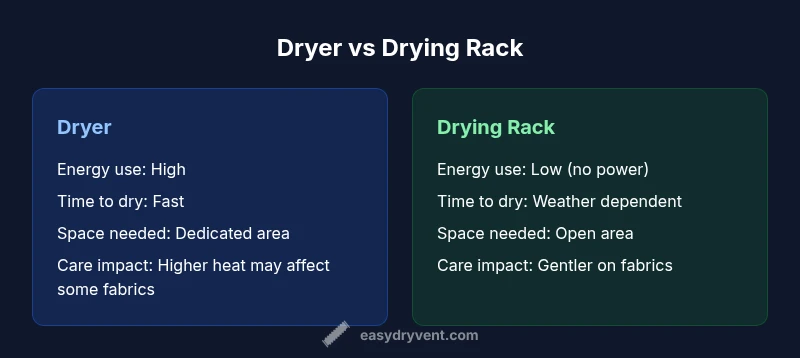
| Feature | Dryer | Drying Rack |
|---|---|---|
| Energy consumption | High energy use | Low energy use |
| Space requirements | Dedicated space with venting | Open area or balcony; foldable options |
| Drying time | Generally faster for bulky items | Weather-dependent and slower |
| Fabric care impact | Heat can shrink or stress some fabrics | Gentler on most fabrics when used properly |
| Upfront and operating costs | Moderate to high upfront; ongoing energy cost | Low upfront; no energy cost |
| Best for | Busy schedules and large loads | Delicates and small spaces |
The Good
- Fast drying for bulky loads with a dryer
- No electricity required when air-drying
- Better fabric control for delicate items on racks
- Hybrid approach reduces overall energy use
Negatives
- Higher ongoing energy costs with a dryer
- Slower drying on a rack during poor weather
- Ventilation and maintenance burden for a dryer
- Requires space for air-drying setup
Hybrid use often delivers the best balance
Choose the dryer for time-sensitive, bulky items and use a drying rack for delicates or when weather and space permit. A mixed strategy minimizes energy use while maximizing convenience.
Common Questions
Which dries clothes faster, a dryer or a drying rack?
A clothes dryer typically dries faster than a drying rack, especially for bulky items. Air-drying depends on weather, humidity, and airflow. For time-sensitive loads, the dryer is usually the better option.
The dryer usually dries clothes faster, especially for big items. Air-drying depends on the weather and airflow, so it takes longer but saves energy.
Is air-drying safe for delicate fabrics like wool or silk?
Air-drying can be gentler on many fabrics when done correctly, but some delicate fibers still require careful handling to avoid stretching or misshaping. Always follow fabric care labels.
Air-drying can be gentler for delicates if you treat them properly and follow care labels.
Can you use a drying rack in humid or cold weather effectively?
Yes, but drying will be slower in high humidity or cold air. Improve airflow with fans, dehumidifiers, or placing the rack near a warm, sunny spot when possible.
Yes, but expect slower drying in humidity; use a fan or warm spot to help.
What is the best way to dry bulky items on a rack?
Lay bulky items flat or hang them with ample space between pieces to maximize air circulation. Rotate loads as needed and avoid overcrowding to prevent damp spots.
Spread bulky items apart to improve airflow and rotate loads for even drying.
Are there affordable electric drying racks or hybrid solutions?
Hybrid drying racks with gentle heat exist, but they add cost and complexity. For most homes, a traditional rack paired with a dryer covers the needs.
There are heat-assisted racks, but they cost more; a standard rack plus a dryer usually suffices.
How can I use a clothesline in an apartment?
Clotheslines can work in apartments with permissions and appropriate outdoor space. Use compact, foldable lines and ensure rain-free, safe placement.
A clothesline can work outdoors if allowed; use a compact line and keep it dry and safe.
Key Points
- Assess your space and schedule first
- Air-drying saves energy and extends fabric life
- Reserve the dryer for fast, large loads
- Maintain ventilation and lint filters regularly
- Consider a hybrid approach for optimal results