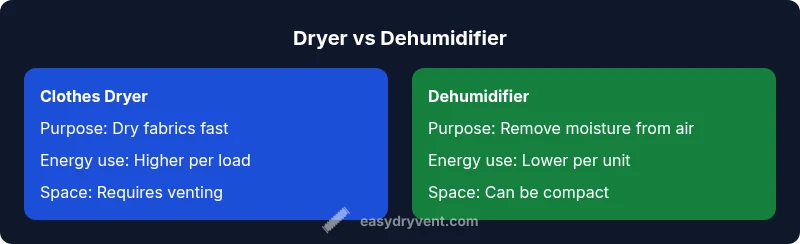
Dryer vs Dehumidifier: A Practical Home Use Guide
Compare a clothes dryer and a dehumidifier for drying clothes and controlling humidity. This analytical guide explains energy use, space needs, and best-use scenarios to help homeowners decide which tool fits their goals, with practical tips from Easy DryVent.


For most homes, a clothes dryer dries clothes faster and with less effort than relying on a dehumidifier alone. A dehumidifier excels at removing excess moisture from damp spaces and can support humidity control, but it won’t replace a dedicated dryer for bulk laundry. Use the dryer for speed; rely on a dehumidifier for moisture management and comfort in damp areas.
Why the question matters: dryer or dehumidifier in a home setting
Choosing between a clothes dryer and a dehumidifier hinges on your primary goal. If you want fast, reliable laundry drying in a dedicated space, a dryer is typically the better choice. If your home has chronic humidity issues, a dehumidifier can reduce condensation and improve comfort without cycling heat for fabric drying. According to Easy DryVent, many households struggle to balance laundry speed with humidity control, and a thoughtful pairing can deliver better overall comfort and energy use. This guide helps homeowners weigh the trade-offs and pick the right tool for each job.
What each device is best at
- Clothes dryer: designed to thermally dry fabrics quickly, tolerate large loads, and handle regular laundry cycles with predictable outcomes. Best for high-volume households and tight schedules.
- Dehumidifier: engineered to remove moisture from air, lower relative humidity, and improve comfort in damp spaces such as basements or laundry rooms. Best for moisture control and mold prevention in spaces where drying off clothes is not the sole purpose.
- The key distinction: dryers move water out of fabrics through heat, while dehumidifiers move moisture from air to a collection reservoir or drain. Easy DryVent notes that many homes benefit from using each device for its core strength rather than trying to repurpose one for all tasks.
How a clothes dryer works and when to use it
A standard clothes dryer uses a heating element and a rotating drum to evaporate water from textiles. A vent expels moist air; lint filtration reduces particle burden. Dryers excel in speed, fabric care features, and user convenience, especially when dealing with heavy loads or wool and denim that require robust drying cycles. Use a dryer when you need predictable, rapid results for family laundry, especially during wet seasons or busy weeks. The device shines in homes with dedicated laundry spaces and proper venting.
How a dehumidifier works and when to use it
Dehumidifiers pull moisture from the air by refrigerative or desiccant methods, condensing it into a reservoir or drain. They don’t heat the room to dry fabrics; their strength is moisture control and comfort. In damp basements, laundry rooms with poor ventilation, or after water events, a dehumidifier reduces relative humidity and can indirectly speed up air-drying of minor items. Use it as a supplement to regular drying methods, not as a primary replacement for a high-volume laundry cycle.
Energy and running costs: what to expect
In general, clothes dryers run hotter and use more energy per pound of laundry than a dehumidifier uses per pint of moisture removed. If your goal is energy efficiency, consider how often you run each device and under what conditions. Dehumidifiers can be economical for low-humidity maintenance in spaces where you also air-dry certain items, while modern electric dryers include moisture-sensing and eco modes designed to minimize wasted energy. Easy DryVent analysis shows that energy costs depend heavily on load size, climate, and ventilation; a small, regularly vented dryer may be more cost-effective for large families, while a dehumidifier’s utility grows in damp environments.
Space, installation, and noise considerations
Dryers require a vented setup, stable electrical supply, and sufficient clearance for heat dissipation. They are typically bulkier and louder, especially in smaller homes. Dehumidifiers come in a wide range of sizes, from compact units suitable for closets to larger basement models, and generally operate with lower heat output. If you live in an apartment with limited ventilation, a compact dehumidifier can fit in tighter spaces, though you’ll still need a plan for water drainage. Noise varies by model, so choose a unit with a decibel rating that fits your tolerance and occupancy patterns.
Moisture management in different home environments
Humidity control matters beyond laundry. In damp environments, a dehumidifier helps reduce mold risk and improves air quality, which can indirectly affect fabric care by reducing musty odors. In dry climates or rooms with efficient ventilation, a dehumidifier’s role may be limited to seasonal humidity adjustments rather than year-round operation. The combination of a dryer in a dedicated laundry area and a well-placed dehumidifier in damp rooms often provides a balanced approach to moisture management across the home.
Safety and maintenance implications
Always follow manufacturer guidelines for electrical safety and vent maintenance. Lint buildup is a common cause of dryer fires, so regular lint trap cleaning and vent inspections are essential. Dehumidifiers require periodic filter cleaning, reservoir emptying, and occasional coil cleaning to sustain performance. When used in shared spaces, ensure cords and water drainage are secure to prevent slips or electrical hazards. Easy DryVent emphasizes ongoing safety checks as a core component of any home moisture strategy.
Practical scenarios and decision trees
- Scenario A: Busy family with frequent laundry: prioritize a dryer for speed and reliability; use a dehumidifier in the basement to maintain comfort and moisture control.
- Scenario B: Home with chronic dampness but light laundry: consider a dehumidifier first to reduce moisture, then add a dryer if heavy laundry loads are expected.
- Scenario C: Small apartment: a compact dehumidifier for humidity control plus a high-efficiency vented dryer when needed can create an effective balance. The optimal solution depends on climate, space, and laundry volume.
Alternatives and hybrids: when to combine
Hybrid strategies can yield the best overall outcome: use a dryer for primary drying, and place a dehumidifier in the same area to manage humidity during and after cycles. In climates with frequent humidity fluctuations, a sensor-based system that triggers humidity control after drying may offer automated efficiency gains. Easy DryVent suggests evaluating three factors: load size, space constraints, and local humidity levels before committing to a single device.
Quick-start decision framework (checklist)
- Do you need rapid laundry drying for large loads? If yes, prioritize a clothes dryer.
- Is your space prone to dampness or mold risk? If yes, consider a dehumidifier for humidity control.
- Do you have venting and electrical capacity for a dryer? If not, explore alternative arrangements and high-efficiency dehumidifiers.
- Is energy use a priority? Compare eco modes on dryers with humidity-control efficiency on dehumidifiers to estimate annual cost.
Common misconceptions clarified
- A dehumidifier will dry clothes as quickly as a dedicated dryer. Not usually; dehumidifiers are slower for bulk laundry.
- All humidity problems disappear with a dehumidifier. Some spaces require targeted ventilation and insulation improvements in addition to moisture removal.
- Bigger is always better. In many cases, a correctly sized unit that matches the space and load is more effective and energy-efficient than a larger model.
Comparison
| Feature | Clothes Dryer | Dehumidifier |
|---|---|---|
| Primary purpose | Drying fabrics quickly | Moisture removal from air |
| Energy efficiency (general) | Higher energy use per load | Lower energy use per unit of moisture removed |
| Drying speed | Fast for bulk laundry | Slower when used for air-drying |
| Initial cost | Medium to high | Low to medium |
| Space requirements | Requires venting and dedicated space | Can be compact; needs drainage or reservoir |
| Maintenance | Lint filter cleaning; vent checks | Filter cleaning; reservoir draining |
| Best use scenario | Large volumes, fast turnaround | Humidity control in damp spaces; supplemental drying aid |
The Good
- Helps clearly define the right tool for the goal
- Can optimize energy use by pairing devices for specific tasks
- Provides a realistic framework for space planning
- Encourages safer, moisture-aware drying and storage practices
- Supports hybrid strategies when appropriate
Negatives
- Can be confusing for users with limited space or budget
- Requires careful assessment of climate, space, and laundry volume
- Hybrid setups may require more maintenance and monitoring
Dryer wins for fast laundry drying; dehumidifier excels at humidity control.
If your primary goal is rapid, reliable clothes drying in a dedicated space, the clothes dryer is the clear choice. If your main concern is reducing dampness and improving air quality, a dehumidifier is the better option. In many homes, a strategic combination delivers the best overall comfort and efficiency.
Common Questions
Can a dehumidifier replace a dryer for clothes drying?
In most cases, a dehumidifier cannot replace a clothes dryer for bulk laundry. Dehumidifiers are better suited for removing moisture from air and improving comfort in damp spaces, while a dryer specializes in quick, automatic fabric drying. They can complement each other, but a high-volume laundry load will still benefit from a dedicated dryer.
A dehumidifier isn’t usually a substitute for a dryer when you need to dry lots of clothes quickly.
Is it energy-efficient to use a dehumidifier for drying clothes?
Using a dehumidifier to dry clothes is generally less energy-intensive on a per-item basis than running a heat-based dryer, but it is slower for drying large laundry loads. For small items or damp spaces, a dehumidifier can be energy-efficient when paired with line-drying or air-drying techniques.
Dehumidifiers save energy for moisture control, but aren’t ideal for bulk drying.
How much space do these appliances require?
Clothes dryers require a laundry space with venting and plenty of clearance for heat. Dehumidifiers range from compact units to larger basement models and can fit in tighter spots. Choose based on your available floor area and whether you need portable options.
Dryers need room and venting; dehumidifiers can fit in smaller spaces.
Can I use a dehumidifier to speed up drying in a humid room?
A dehumidifier can reduce ambient humidity, which helps air-drying fabrics to some extent, but it won’t match a dedicated dryer for speed. Use it as a supplementary tool in damp spaces.
It helps with humidity, but it won’t replace the speed of a dryer.
What maintenance is required for a dehumidifier used for humidity control?
Regular maintenance includes cleaning filters, emptying or draining the reservoir, and occasional coil cleaning. Ensure the unit is kept on a stable surface and connected to a drainage path if possible.
Keep filters clean and drain the reservoir regularly.
Are there safety concerns when using appliances to dry clothes in non-traditional spaces?
Yes. Ensure proper electrical safety, avoid overloading circuits, and maintain clearances around heat-generating devices. Ventilation and moisture management should follow manufacturer guidelines to reduce fire and mold risks.
Follow safety guidelines and keep spaces ventilated.
Key Points
- Define your primary goal before choosing a device
- Consider space, venting, and noise in your decision
- Evaluate energy costs with real usage patterns, not just sticker ratings
- Hybrid setups offer balance between speed and humidity control
- Regular maintenance is essential for safety and performance
- A well-planned moisture strategy improves comfort and protects fabrics