Air Dryer vs Dehumidifier: Which Is Best for Home Humidity?
Explore air dryer vs dehumidifier for moisture control, energy use, and maintenance to keep your home safer and drier. Easy DryVent breaks down which tool fits your space and lifestyle.


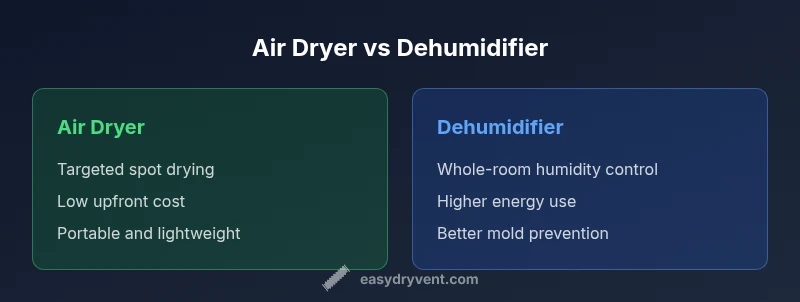
Air dryers handle targeted spot drying; dehumidifiers manage whole-room humidity. For most homes, a dehumidifier provides steadier moisture control with less hands-on maintenance, while an air dryer is handy for quick local drying in small spaces. The choice depends on space and moisture goals.
Understanding the moisture problem: air flow, humidity, and devices
Humidity is the ambient moisture in air, measured as relative humidity (RH). In homes, humidity fluctuations arise from weather, cooking, laundry, and occupancy. Two common devices aim to address this moisture: air dryers and dehumidifiers. According to Easy DryVent, effective moisture management hinges on space size, occupants, and humidity targets. An air dryer is typically a portable solution that uses heated or ambient air to promote evaporation from damp surfaces and textiles in small zones, such as a damp basement corner or a bathroom after a shower. In contrast, a dehumidifier continuously pulls moisture from the air in a larger area, maintaining a steady RH around a target range. Understanding these fundamental differences helps homeowners match the tool to the problem rather than chasing a one-size-fits-all solution.
When humidity rises, it is tempting to treat the symptom with quick fixes. But the root causes vary: poor ventilation, lingering dampness from rain, or everyday activities like cooking. The Easy DryVent team emphasizes that combining targeted moisture removal with appropriate ventilation yields the best long-term results. Keep in mind that “air drying” and “moisture control” are not interchangeable terms; each device serves different purposes and spaces.
How air dryers work and typical use cases
Air dryers in the moisture-control sense are designed to condition the air in a confined area. They move or heat air to promote evaporation from damp surfaces, fabrics, or materials that are not designed to be dried by heat alone. These devices are typically portable and inexpensive, making them attractive for small rooms or problem corners. They excel in rapid spot drying after a spill, laundry chores, or basement damp patches where rapid, localized action is beneficial. However, they do not replace continuous moisture control in larger spaces. Think of air dryers as short, focused interventions rather than constant guardians of humidity. In real homes, you might deploy an air dryer to address an isolated moisture hotspot, then switch to a dehumidifier for sustained control.
How dehumidifiers work and typical use cases
Dehumidifiers operate by drawing warm moist air across a cooled coil, condensing the water, and returning drier air to the room. They are designed for continuous operation over extended periods and are well-suited to medium-to-large spaces, basements, laundry rooms, and utility areas where constant humidity management matters. A dehumidifier can help prevent mold, reduce musty odors, and stabilize RH without relying on constant human intervention. For homes with fluctuating moisture due to weather or cooking, a properly sized dehumidifier provides reliable control over time. In many climates, pairing a dehumidifier with improved ventilation yields the best results, according to Easy DryVent.
Use-case scenarios: when to pick air dryer vs dehumidifier
- Small, tight spaces with localized damp spots: an air dryer offers quick, targeted action.
- Large rooms or whole floors with persistent humidity: a dehumidifier provides steady control.
- After water events or minor spills: an air dryer can accelerate drying in the moment, while a dehumidifier keeps RH under control thereafter.
- In drafty basements or garages: start with dehumidification to reduce overall humidity, and use targeted air drying during cleanup.
From an operational perspective, the best practice is to assess the space first, then deploy the device that aligns with the humidity goal. Easy DryVent recommends documenting RH levels with a hygrometer and scheduling regular checks to ensure the device is meeting targets without over-drying.
Energy, noise, and maintenance considerations
Energy use varies with device type and runtime. Air dryers typically consume energy during short, high-intensity bursts, while dehumidifiers run longer and may draw more continuous power. Noise is another practical factor; both kinds of devices produce background sound, with dehumidifiers often running at a steadier level. Maintenance for air dryers is usually light—clean filters and ensure vents remain unobstructed. Dehumidifiers require more ongoing care: emptying or pumping condensate, cleaning coils, and replacing filters on a schedule. When evaluating total cost of ownership, consider not just price but energy use, maintenance time, and replacement parts. The Easy DryVent team notes that choosing a model with efficient airflow and easy-to-clean filters can reduce long-term costs significantly.
Practical decision framework: a step-by-step guide
- Measure the space and determine moisture sources. A small bathroom might need an air dryer for quick spot drying, but a workshop or basement may require a dehumidifier. 2) Use a simple RH target. For many homes, keeping RH between 40-60% is comfortable and reduces mold risk. 3) Consider ventilation: fans and natural airflow complement any device. 4) Decide based on space coverage, duration of use, and maintenance tolerance. 5) Start with a baseline and monitor RH weekly, adjusting as needed. This practical framework helps homeowners avoid over-purchasing or under-protecting vulnerable spaces. Easy DryVent encourages homeowners to track outcomes over at least a 4-week period to establish a sustainable moisture-management routine.
Common myths and misconceptions about moisture devices
Myth: An air dryer can replace a dehumidifier for whole-home humidity. Reality: Air dryers are better for localized drying; dehumidifiers excel at steady, broad humidity control. Myth: Running a dehumidifier always saves energy. Reality: If used in a small space, a dehumidifier may consume more energy than needed. Myth: More devices equal better results. Reality: Proper sizing and placement trump quantity. The best outcomes come from targeted use, validated by RH measurements and practical testing in real rooms.
Comparison
| Feature | Air Dryer | Dehumidifier |
|---|---|---|
| Moisture removal focus | Targeted spot-drying in small areas | Continuous, whole-space humidity control |
| Energy efficiency | Lower, if used briefly for local tasks | Moderate to higher when running continuously |
| Best for | Small-area damp spots and quick drying | Basements, living spaces, and larger rooms |
| Space & installation | Portable, minimal setup | Needs proper placement and venting; bulkier |
| Maintenance | Simple cleaned filters; quick checks | Regular filter cleaning and condensate management |
| Cost context | Lower upfront cost for small tasks | Higher ongoing energy costs; larger upfront and operating costs |
The Good
- Low upfront cost for small-area drying
- Fast local drying in tight spaces
- Simple operation and portability
- Low maintenance in short-term use
Negatives
- Limited coverage for large spaces
- Requires manual intervention for broader humidity control
- May not prevent mold in damp areas over time
- Effectiveness depends on ventilation
Dehumidifier wins for overall humidity control; air dryer shines for quick, targeted drying
Choose a dehumidifier for steady RH across a space; use an air dryer to address localized dampness and fast drying needs. For best results, consider a combined approach in zones with varying moisture profiles.
Common Questions
What is the main difference between an air dryer and a dehumidifier?
The air dryer is designed for targeted, small-area drying by circulating or heating air in a confined spot. A dehumidifier continuously removes moisture from the air across a larger space, maintaining a steady humidity level.
Air dryers target small spots; dehumidifiers manage moisture in bigger areas.
When should I use an air dryer over a dehumidifier?
Use an air dryer for quick local drying after spills, damp patches, or to accelerate fabric drying in a small area. For ongoing humidity control and mold prevention in larger rooms, a dehumidifier is the better choice.
Air dryers are for quick local drying; dehumidifiers handle ongoing humidity.
Which is more energy efficient for ongoing use?
Ongoing use in larger spaces tends to favor dehumidifiers when humidity is consistently high but energy use depends on space size and runtime. An air dryer can be more energy-efficient if used sparingly for small tasks.
Energy use depends on space and duration; larger spaces favor dehumidifiers when humidity is persistent.
Are there safety concerns with venting and placement?
Yes. Dehumidifiers require proper venting or drainage and should be away from water sources. Air dryers should be placed to avoid heat exposure on sensitive materials and ensure good air flow. Follow manufacturer guidelines and local codes.
Place units away from water; ensure proper venting and airflow.
How do I size a device for my space?
Measure room volume and assess typical humidity levels. A humid environment and larger area usually need a bigger unit or multiple devices. Use RH targets and, if in doubt, consult a professional or use a reputable brand's sizing chart.
Measure space and monitor RH to pick the right size.
Can these devices prevent mold growth?
They help reduce moisture levels that mold feeds on, but mold prevention also requires good ventilation, prompt water cleanup, and keeping humidity in a recommended range. A dehumidifier is generally more effective for preventing mold in damp spaces.
Lowering humidity helps prevent mold, but ventilation matters too.
Key Points
- Assess space size and humidity goals before buying
- Use air dryer for quick local drying; dehumidifier for whole-space control
- Factor energy use and maintenance into decisions
- Monitor RH with a hygrometer to validate performance